Canterbury, a municipal and parliamentary borough, a county by itself, a cathedral city, and the seat of the metropolitan see of all England, in East Kent, on the Stour, 56 miles ESE. of London by road (62 by rail), and 16 NW. of Dover. Standing in a plain on the banks of the Stour, amid gently swelling hills, it occupies the site of the Roman Durovernum and Saxon Cantuarabyrig ('borough of the men of Kent'), and from its position on the great London high-road must always have been a place of importance. There are some where Chaucer's pilgrims lodged, lost its 'dormitory of the hundred beds' by fire in 1865.
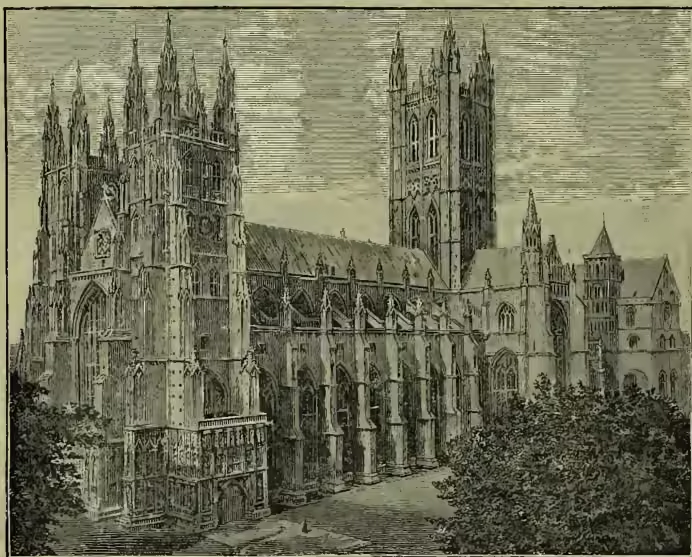
But the great glory of Canterbury is its magnificent cathedral, whose precincts are entered through a splendid Perpendicular gateway (1517). When in 597 St Augustine became Archbishop of Canterbury, he consecrated, under the name of Christ's Church, a church said to have been formerly used by Roman Christians. Enlarged by Archbishop Odo (942-959), this church was totally destroyed by fire in 1067. Archbishop Lanfranc and Priors Ernulf and Conrad rebuilt it (1070-1130), and it was this cathedral that witnessed the murder of Becket, 29th December 1170. The choir was wholly burned down in 1174, and to rebuild it a number of French and English artificers were summoned. Among the former was one William of Sens, and to him, a man of real genius, the work was intrusted. The church was rich in relics: Plegmund in 890 had brought hither the body of the martyr Blasius from Rome; here too were the bodies of SS. Wilfrid, Dunstan, and Alfege, and now of the great martyr, St Thomas of Canterbury. The offerings at these shrines, especially the last, contributed greatly to defray the expenses of the sumptuous work. William of Sens did not, however, see its completion. He was succeeded in 1178 by another William, an Englishman, and to him we owe the completion of the existing unique and beautiful choir, with the choir transept, the retro-choir or Trinity Chapel, and the corona or circular apse called Becket's Crown. Gervasius, a monk, who witnessed the fire of 1174, and has left an account of it, tells us that the parts of Lanfranc's church which remained in his time were the nave, the central and western towers, the western transepts, and their eastern chapels. In 1378-1411 the nave and nave-transepts were transformed by Prior Chillenden into the Perpendicular style of that period. The central or 'Bell Harry' tower, successor to the Angel steeple, was carried up (1495) to about double its original height; also in the Perpendicular style, it is 235 feet high, and 35 feet in diameter. The north-west or Arundel steeple was taken down and rebuilt in 1834-40; like the south-west or Dunstan steeple (1413-44), it is 130 feet high. The Norman plinth still remains on each side of the nave in the side aisles, and portions of Norman ashlar-work may still be seen about the transepts outside the west wall, and on the east piers of the great tower. The indiscriminate use of the Round or Norman and the Pointed or Early English arch is also a very striking feature in the eastern part of the building. The Lady Chapel, now called the Dean's Chapel, stands on the north side of the church, and was built between 1449 and 1468; the roof is a rich fan-vault. The adjoining north transept is called the Martyrdom transept, for here took place the murder of Becket. In 1220, fifty years later, his remains were translated from the crypt to a shrine in the newly-erected Trinity Chapel, eastward of the choir. About the year 1500 the yearly offerings at this shrine amounted to £4000 of our present money, though then they had declined much in value. A curious mosaic pavement still remains in front of the place where the shrine stood, and the stone steps which lead up to it are worn by the knees of countless pilgrims; but the shrine itself was demolished in 1538, when remains of the ancient walls (1½ mile in circuit and 20 feet high), and the West Gate (circa 1380) is the survivor of six. Near the city wall is a large artificial mound, known as the Dane John (probably Donjon), and connected with this mound is a public garden, laid out in 1790, from the top of which is a fine view of the country around. The much mutilated castle, whose Norman keep resembled Rochester's, has been degraded to a gas-work; the guildhall (1439; rebuilt 1697) has been refaced with modern brick; and the Chequers' Inn, its treasures filled twenty-six carts. (In 1888 a stone coffin, with remains of a skeleton, supposed to be Becket's, was discovered in the crypt, and reinterred there after careful examination.) In 1643 the building was further 'purified,' as it was called, by order of parliament. Still very many most interesting monuments remain—such as the tombs of Stephen Langton; that which is commonly, but wrongly, supposed to be the tomb of Archbishop Theobald; with those of the Black Prince, of Henry IV., of Archbishops Peckham, Meopham, Stratford, Sudbury, Courtenay, Chicheley, Stafford, Kemp, Bouchier, Morton, Warham, and Cardinal Pole. The fifty-one statues that since 1863 have adorned the south porch and the western entrance include 19 of Canterbury's 94 archbishops, 21 English sovereigns, 3 deans, Erasmus, &c. Of stained glass there are some fine old specimens; some new ones of very varied merit, two, lately put up, being very fine. The total length of the cathedral is 522 feet, by 154 in breadth at the eastern transept. Its predominant styles are Transition-Norman and Perpendicular. The crypt is of greater extent and loftier—owing to the choir being raised by numerous steps—than any other in England. In 1561 it was given up by Elizabeth to a congregation of French and Flemish Protestant refugees, and a French service still is held here. On 3d September 1872 the church narrowly escaped destruction for the fourth time by fire, the outer roof being burned, over all the east portion of the choir.
To the north of the cathedral are the eight-bayed Cloisters, 144 feet square; the Chapter-house (1411), 90 by 35 feet; the New Library, with 10,000 volumes; the Howley Library, containing the libraries of Archbishop Howley and Archdeacon Harrison; the beautiful Green Court; the Deanery (1517); and the King's School, founded by Henry VIII. In 1541, where Marlowe, Dr Harvey, Lord Tenterden, and 'David Copperfield' went to school. These occupy the site, and in part the buildings, of the Benedictine Priory of Christ's Church. The remains of the Abbey of St Augustine, to the east, were in 1844-48 transformed by Mr Beresford Hope into an Anglican missionary college. There are fourteen old churches in Canterbury, mostly of rough flint, and containing fragments of still older structures. St Martin's Church stands on the site of one of the 6th century, and is partly built of ancient Roman brick and tile; its font is said to be the very one in which Ethelbert was baptised by St Augustine. St Dunstan's contains the monuments of the Ropers, and, in a vault, the head of Sir Thomas More. The archbishop's palace, the scene of the death of Edward the Black Prince, was built by Lanfranc. It has long been superseded by Lambeth, and is now represented only by a gateway. The Clergy Orphan School occupies a conspicuous position on St Thomas's Hill, about a mile out of the city; the Simon Langton Schools were opened in 1882. There are, besides, several hospitals, large infantry and cavalry barracks, a corn exchange, and an art gallery presented to the city in 1882 by one of her sons, Mr Sidney Cooper, R.A. Canterbury has a large trade in grain and hops. Races are run on Barham Downs, but they are quite eclipsed in importance by the Canterbury 'cricket week.' Since 1885 the city has returned only one member. Pop. (1891) 23,026.
See articles ARCHBISHOP, ENGLAND (CHURCH OF), and on the various archbishops and others mentioned above; also Professor Willis's Architectural History of Canterbury Cathedral (2 vols. 1845-69); Dean Stanley's Historical Memorials of Canterbury (1854; 10th ed. 1883); Dean Hook's Lives of the Archbishops of Canterbury (12 vols. 1860-76); and R. Jenkins' Diocesan History of Canterbury (1880).