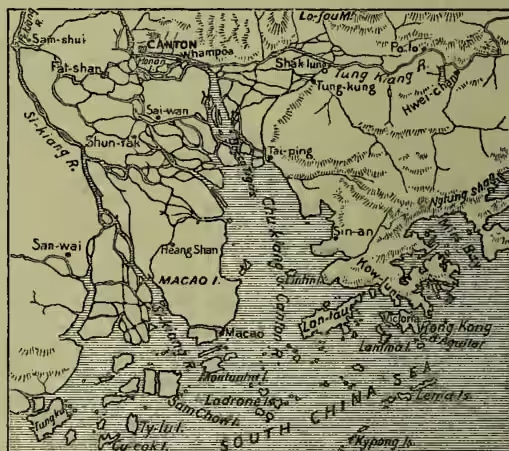
Canton, called also Yang-Ching (i.e. 'city of rams'), a large commercial city and port in the south of China, and capital of the province of Kwang-tung (of which the name Canton is merely a corruption), is situated in 23° 7' 10" N. lat., and 113° 14' 30" E. long., on the north or left side of the Shu-kiang, or Pearl River, in a rich alluvial plain, 70 miles N. of Macao and 90 NW. of Hongkong. The Pearl River is the estuary of the same stream that higher up is called Boca Tigre (q.v.), or Bocca Tigris. Farther up still, the stream is known as the Canton River; and this is but the chief channel by which the united waters of the Si-kiang and the Pe-kiang rivers reach the sea through the delta. The city is surrounded by walls partly brick, partly sandstone, 25 to 40 feet high, 20 feet thick, with an esplanade inside, six miles in circumference; and it is divided by a partition wall running east and west into two unequal parts, the north or old city, much the larger, and the south or new city. There are twelve outer gates, four gates in partition wall, and two water gates; shut and guarded by night. The entire circuit, including suburbs, is nearly 10 miles. Among the names of the gates are Great Peace Gate, Eternal Rest Gate, &c. At the southwest corner of the suburbs, south of the river, are the Hongs or European quarter, divided from the river by a quay, 100 yards wide, called Respondentia Walk. The streets, more than 600, are in general less than 8 feet wide, and very crooked. The houses along the water-side are built on piles, and subject to inundations. Ancient barricades inclose each street, and in the principal streets night-watchmen in watch-towers proclaim the hours and sound fire alarms. There are two pagodas, the 'Plain Pagoda,' erected ten centuries ago, 160 feet high, and an octagonal nine-storied pagoda, 175 feet high, erected more than 1300 years ago; and 124 temples or Joss-houses. The Honam temple, one of the largest in Canton, covers, with its grounds, 7 acres, and has 175 priests attached. The 'Temple of Filial Duty' has 200 priests, supported by 3500 acres of glebe-lands. The priests and nuns in Canton number more than 2000, nine-tenths of them Buddhists. The 'Temple of Five Hundred Genii' has 500 statues of various sizes in honour of Buddha and his disciples. Examination Hall, in the old city, is 1330 feet by 583 feet, covers 16 acres, and has 8653 cells. There are also in Canton four prisons, fourteen granaries, a handsome English church, fourteen public schools, and thirty colleges, a foundling hospital, an English and an American missionary hospital. Nearly half the craft on the river are fixed residences, and the population on land and water can hardly be less than a million and a half. The climate of Canton may be pronounced healthy. The average temperature ranges from 42° to 96° F.; though a fall of snow occurred in 1835, and again in 1861. There are fogs in February and March. From October to January the temperature is agreeable, the sky clear, the air invigorating. The average rainfall is 70 inches annually.
The admirable situation of Canton, connected by three rivers with the whole province east, north, and west, and to the west with the distant interior of China, and commanding a safe and commodious anchorage for the largest vessels, explains how, from an early period, it was a favourite port with foreign merchants. The earliest notices date back to two centuries B.C. In 700 A.D. a regular market was opened and a collector of customs appointed. The Arabs made regular voyages hither as early as the 9th century. The Portuguese found their way to it in 1517, and were followed by the Dutch a hundred years later. These in turn were overtaken and supplanted by the English before the close of the 17th century, and an immense trade was carried on by the agents of the East India Company. Their monopoly ceased on the 22d April 1834. Since that date the proceedings of the Canton government officers have originated two wars with the British. The city was captured by the allied French and English forces, December 1857, and continued to be garrisoned by them till October 1861 (see CHINA). After the treaty of Nankin (signed August 29, 1842), Canton was known as one of the five treaty ports, with Amoy, Foochow, Ningpo, and Shanghai. Foreign commerce, however, is still hampered in many ways in Canton. The lekin duties press most heavily on foreign merchants; ocean steamers have been compelled to discharge their cargo at Whampoa; and the general insecurity of property renders it necessary that every shop which contains anything of value should be barricaded at dusk, so that it could stand a siege: at sunset business must stop.
The chief exports from Canton are tea, silk, sugar, and cassia; the chief imports, cotton, woollen, and metal goods, food-stuffs, opium, kerosene, &c. The value of the exports is about £4,000,000 a year; that of imports varies from £3,000,000 to £3,500,000. These figures represent only the movements through the foreign customs, and do not include the comparatively enormous trade with Hong-kong by junk. Of upwards of 3000 vessels, with a tonnage of 2,500,000, that annually visit the port, four-fifths are British. The population of the city, which was ravaged by the plague in 1894 (as was also Hong-kong), is stated at 1,800,000.
See Mrs Gray's Fourteen Months in Canton (1880); Dr Gray's China (1878); The 'Fan Kwae' at Canton, by H. W. C. (Lond. 1882).