Cardinal. The word was first used of any cleric regularly settled (incardinatus, 'inhinged') in any church, then from the 8th century of the clergy in the cathedral, the bishop being regarded as the cardo or 'hinge' of the diocese. Next, the forged decretals (see CANON LAW) speak of the pope as the cardo or 'hinge' of the whole church, and Leo IX. claims a high and singular position for the clergy of the Roman Church; but not till the time of Pius V. was the title formally restricted to its modern use, according to which it signifies the counsellors of the pope who, next to him, hold the highest dignity in the church over which he rules.
The present college of cardinals has arisen (1) from the deacons who from early times assisted the Bishop of Rome, and who were originally seven in number; (2) from the presbyters who remained in the chief church, or administered tituli—i.e. subordinate churches erected as need arose in the city; (3) from bishops who resided in the Roman diocese and helped the bishop proper. The Liber Pontificalis makes mention of such assistant-bishops in Stephen IV.'s pontificate (768-72). After many fluctuations, the number of cardinal bishops was fixed by Sixtus V. at six, of cardinal priests at fifty, of cardinal deacons at fourteen, making seventy cardinals in all.
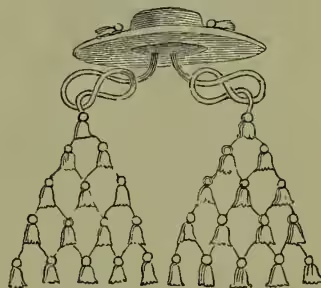
According to the present law the appointment (creatio) of cardinals rests with the pope, who generally consults the existing cardinals, and often receives proposals from secular governments. Their seniority dates from the pope's nomination, even if that nomination be made in pecto—i.e. even if the pope merely states that he has determined to create a new cardinal without mentioning who he is, provided always that the pope lives to proclaim the cardinal by name. The same qualifications of age, learning, character, &c., are required in the case of a cardinal and of a bishop. The cardinals in Conclave (q.v.) elect the new pope, have constant access to him, and form his chief council. They have a vote at general councils, and since the 13th century, precedence over all other members. They have quasi-episcopal jurisdiction within the churches from which they take their titles. They have had since Urban VIII. the title of 'Eminence.' The body of cardinals is called the Sacred College. Their insignia are the red cardinal's hat which is given them by the pope, and not worn, but suspended in the church of their title, and finally buried with them; the red birretta, the sapphire ring, the mitre of white silk, the purple cassock, &c. Cardinals, however, who belong to a religious order, retain the colour proper to it in their cassocks. If a cardinal holds an episcopal see, he must reside there; otherwise he must not leave Rome without permission. At the head of the college of cardinals stands the dean, who is usually Bishop of Ostia and senior of the cardinal bishops. It is he who consecrates the newly-elected pope, if not already a bishop. We must add that the chief affairs of the Roman Catholic Church are in the hands of the cardinals not as such, but as the chief members of the Roman (administrative) congregation. But the cardinals possess no constitutional rights under the absolute government of the papacy. They cannot even meet together without the pope's leave. From Pole's death (1558) there was no resident English cardinal till Wiseman's time (1850); in the United States the first cardinal was McCloskey (1875).