Carrier Pigeon, a fancy variety of domestic pigeon; large in size, long in body and neck, bred in several different colours, and very remarkable in appearance from the great length of head and beak and enormous excrescences of white carunculated skin, called wattle, at the base of the beak and round the eyes. According to Darwin, the carrier is undoubtedly of Eastern origin, and is probably a descendant of the Persian messenger pigeon. It is stated in Moore's Columbarium (1735) that the carrier was first imported from Persia into Europe by Dutch sailors, 'being sometimes brought by shipping and sometimes in the caravans.' The striking appearance of the English carrier of to-day is due to the careful breeding of English pigeon-fanciers, and existed only to a very modified extent in the original imported bird. The Eastern carrier was probably very similar in appearance to the present 'dragon' pigeon, or to the formerly well-known 'horseman.' A good English show carrier should have a length of face of fully two inches, measured from the centre of the eye to the extremity of the beak. A stout box-beak is much esteemed, and the fineness of texture of the wattle is also an important property. From £50 to £100 has been paid for an exceptional bird—i.e. one good enough to take prizes in some of the many pigeon shows of this country. Having been bred for more than two centuries as a purely fancy variety, for show points alone, and its flying properties having been neglected, the English carrier has long since lost the attributes that gave it its name.
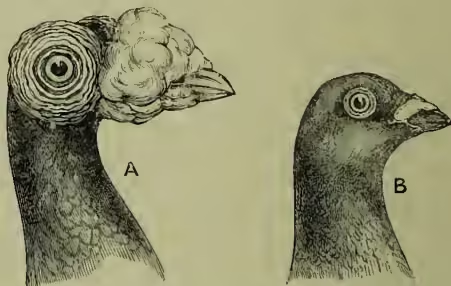
Moore states in his Columbarium that 'those who are possessed of true carriers, which are at present very scarce here, pay too dear, and have too great a value for them to risk their being lost' as letter-carriers. Like all highly developed fancy breeds, they are often delicate, and most of them are deficient in the strength, the intelligence, and the vigorous constitution necessary in a messenger bird. It is a common error to speak of the birds employed as messengers as 'carrier pigeons.' The pigeons now made use of for long-distance flying and as message-bearers are called homers, or homing Antwerps, and are very different in appearance from 'carriers.' They are of medium size, somewhat similar to the common pigeon in appearance, but heavier, stronger, and have larger heads.
The modern homer is a direct descendant of the pigeon voyageur of Belgium. The voyageur is a composite breed, resulting from a cross between the common thin-beaked blue rock (Columba Livia), the short-faced intelligent owl-pigeon, or smerle, the strong, determined, long-faced dragon, and the high-flying Antwerp cumulet, or other tumbler pigeon. The breed is now well established, and may be said to be of a general uniform type. From £40 to £50 has been paid for a good homer, a winner in a 500 miles race, but such a price is very exceptional. To insure the return of a homing pigeon that has been liberated far away from its home, a previous course of training is necessary. This is usually commenced in July, when the young birds are three or four months old. Those selected for training are placed in a basket, transported a short distance from home, and then liberated. These distances are successively increased in the same direction until the required stage has been reached. The following are the usual training stages, in miles from home: 1, 3, 6, 12, 21, 35, 50, 75, 100. There should be an interval of a few days between the tosses. Old birds may be 'jumped' farther than young ones. At three years of age 500 miles may be flown. Stages after 100 miles would be about as follows: 100, 150, 225, 325, 450 miles. These long distances are accomplished only by the very best birds. A large percentage of birds are always lost in training. Pigeon-racing is conducted through the medium of pigeon-flying societies or clubs. In England there are some 50 such clubs. In Belgium, France, Germany, and Italy they are very numerous. Every bird competing in a race is stamped with a mark unknown to the owner until the bird is caught on his return home. About 800 yards per minute is an average velocity. The highest authenticated velocity is 2200 yards per minute, in a race of 150 miles. The greatest distance flown is 1100 miles, in America.
The nature of the faculty by the exercise of which homing pigeons are able to find their way back to their far-distant homes has been much discussed by ornithologists. It is probable that sight and memory are supplemented by the effect of training always in the same direction, and that the bird may be assisted by the position of the sun, and the directions of warm or cold winds. Pigeons are frequently jumped 250 miles—i.e. after they have flown home from a place 200 miles away, their next toss may be 450 miles. At a height of 430 feet, a moderate height for a pigeon, the range of view on level ground is 25 miles. There are many instances of the heavy employment of pigeons for transmitting intelligence. The use of the dove by Noah suggests a knowledge of the bird's habits. It is recorded that pigeons were used as message-bearers by the early navigators of Egypt, of Cyprus, and of Candia, and by the Romans in connection with the Olympic games. Their first employment in war appears to have been at the siege of Modena, 43 B.C. About the middle of the 12th century a regular system of pigeon communication was organised between Bagdad and all the important towns of Syria, and was afterwards extended to Egypt. Pigeon-flying is still in vogue in Asiatic countries where telegraphs do not exist. Further instances of the use of pigeons as war-messengers are the siege of Haarlem (1572), siege of Leyden (1574), and by the Chinese at the beginning of the 14th century.
Much prominence was given to the pigeon-post during the siege of Paris (1870-71). No birds had been sent out of the French capital previous to the arrival of the besiegers. Every pigeon that flew into Paris with messages had been previously sent out by balloon. Of 363 birds which were thus sent out over the heads of the Germans, 302 were liberated, but only 73 reached the capital. As some performed the journey several times, only 57 different birds succeeded in accomplishing the task. The pigeons were collected at Tours and afterwards at Poitiers, but were liberated with their messages at the farthest point north that could be safely reached.
By the use of microscopic photography an enormous number of messages could be sent. By first printing the messages, then photographing them on a thin film or pellicle of collodion about inches by 2 inches, each film could contain 2500 despatches of twenty words each. One bird could carry at least a dozen of these, making 30,000 despatches. A pigeon that arrived in Paris on the 3d February carried 18 pellicles containing 40,000 messages. The pellicles were rolled up and inserted in a goose-quill about inches long, which was attached by a silk thread or thin wire along the upper surface of one of the tail-feathers. The weight of the messages was always less than 1 gramme ( grains). Pigeons will, however, carry 100 grains with ease, and for short distances have carried of an ounce (360 grains). The organisation of regular 'military pigeon systems' in almost every continental nation of Europe soon followed the Franco-German war. There are now about 60 European military pigeon stations. In France, Germany, Italy, and Denmark great encouragement is given by the state to private societies that fly their birds in directions fixed by the war ministers. England had, up to 1888, taken no steps in this direction.
During the first half of the present century pigeons were extensively employed for the conveyance of intelligence, but up to 1830 their use was almost confined, in England, to publicans and prize-fighters. A little later, however, they became generally used by newspaper reporters, and secretly for stockbroking purposes. The first English loft established by a stockbroker was at Dover in 1834, and two years later, there were three lofts at Dover, containing a total of 600 birds, employed by London stockbrokers and by the custom-house authorities. Birds were also kept at Folkestone for similar purposes. There were lofts at Boulogne, and others between Dover and London. Four pigeons were often used to carry a message from a few miles south of Boulogne to London, a distance of 135 miles. In summer time the message carried by the pigeon would arrive in London by mid-day, whereas the Paris mail could not be expected before midnight. Large fortunes were made on the stock exchange by this means. Before the introduction of railways, the difficulties of training the birds were very great, and 80 miles was the farthest distance flown by a pigeon in England. The Belgians were the pioneers of modern long-distance flying. According to Dr Chapin, their first pigeon-race was in 1818, when 100 miles was accomplished. In 1820 a pigeon flew from Paris to Liège, about 200 miles, and in 1823 the first race from London to Belgium took place. In 1830, 110 pigeons flew a race from London to Antwerp, the winning bird accomplishing the journey of 180 miles in 5 hours and 5 minutes. The Belgian birds, up to this date, were shorter in face and smaller than those used for flying in England. They were faster on the wing, but not so reliable in bad weather. The present pigeon voyageur dates from about 1835, when the Belgian birds were first crossed with the larger and stronger English flyers. By the strict application of the principle of the survival of the fittest, and by breeding only from birds that have proved themselves good workers, the breed of homing pigeons has continued to improve up to the present day. Belgium is still the chief pigeon-flying country of the world. Every village has a 'Société Colombophile.' Races take place chiefly from the south-west of France, and are generally flown on Sundays. During the summer months, special trains, loaded entirely with pigeons, leave Brussels every Saturday. The king and the Comte de Flandres give prizes for the annual 'Concours National' of 500 miles, in which over 3000 pigeons often compete. In favourable weather this distance is accomplished in one day.