Caryatides (pl. of Caryatis, lit. 'a woman of Caryæ'), a name given to female figures, in Greek architecture, when used instead of columns to support an entablature. The traditional account of the origin of the name is that the inhabitants of Caryæ, a city in Arcadia, having joined the Persians after the battle of Thermopylæ, the Greeks, after their victory over the Persians, destroyed the town, slew the men, and carried the women into captivity. As male figures representing Persians were already used for this purpose, it occurred to Praxiteles, and other Athenian artists, that female
Caryatides, in their national costume, might be thus employed to commemorate the disgrace of their country. Male figures used for the same purpose are called Atlantes (q.v.). The caryatides which form the portico of St Pancras Church (1822) in London are a reproduction from the Erechtheum on the Acropolis at Athens.
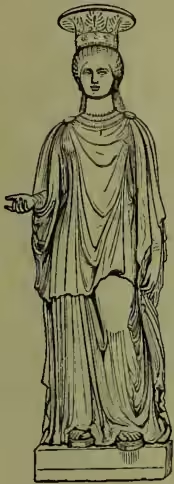
From Villa Strozzi, on
Appian Road—height,
7 feet 10 inches.