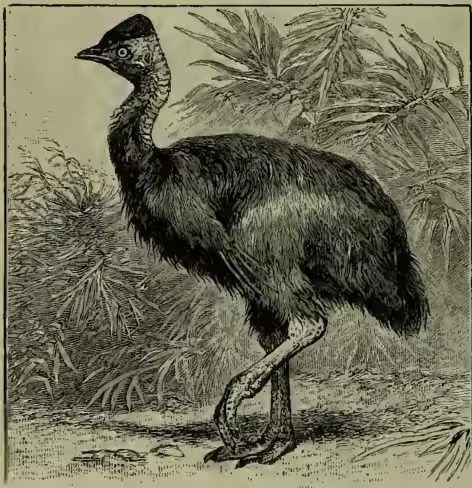
Cassowary (Casuarinus), a genus of running birds (Ratitæ), nearly related to the true ostrich, and nearer to the American rhea. From the former it differs conspicuously in having three, not two toes; from the latter less markedly in its laterally compressed skull, and in the 'after shafts' of its feathers. The latter are nearly as long as the main shafts, so that the feathers look double. The wings and tail are extremely degenerate, the nail of the inmost toe is very long, the naked forehead bears a horny brightly coloured helmet, the neck is in four species adorned with two pendent red and blue wattles. In one species there is one wattle, in the other four two. The breast exhibits a bare callous patch, on which the bird rests when sitting. The alimentary canal differs from that of the ostrich as the food does, being suited not for coarse diet, but for the soft parts of plants and fruits. Generally ostrich-like, the cassowary has a shorter neck, yet stands about 5 feet high. The general colour of the loose hair-like feathers is brownish black. When attacked, it kicks forwards with its feet, or strikes with the few (five) rigid barbs of its degenerate wings. Cassowaries have great powers of running and leaping. They live in pairs in wooded districts. The few eggs are incubated by both sexes, are of a greenish colour, and thinner in shell than those of the ostrich. Eight species of cassowary are known in Ceram, New Guinea, and the South Sea Islands, and a ninth in North Australia. The best-known species are the Mooruk of New Britain (C. bennetti) and C. galcatus; the Emu or Dromæus is a nearly allied genus. The flesh of the cassowary is black, tough, and juiceless. They are sometimes kept in confinement, are common in menageries, but are rapidly becoming rarer in their native haunts. See RATITE, OSTRICH, EMU.