Castor-oil, a fixed oil obtained from the seeds of the castor-oil plant. In extracting the oil, the seeds are first bruised between heavy rollers, and then pressed in hempen bags under a hydraulic or screw press. The best variety of oil is thus obtained by pressure in the cold, and is known as cold-drawn castor-oil; but if the bruised and pressed seeds be afterwards steamed or heated, and again pressed, a second quality of oil is obtained, which is apt to become partially solid or frozen in cold weather. In either case, the crude oil is heated with water to 212° (100° C.), which coagulates, and separates the albumen and other impurities. Exposure to the sun's light bleaches the oil, and this process is still resorted to, but since the introduction of the nearly tasteless Italian castor-oil, which in itself is almost colourless, there is not the same demand for the bleached article. When pure and cold drawn, castor-oil is of a light-yellow colour; but when of inferior quality, it has a greenish, and occasionally a brownish tinge. It is somewhat thick and viscous. Its specific gravity is high for an oil, being about .960. It is miscible with alcohol or spirits of wine and ether. Reduced to a temperature of 0° (-18° C.), it does not become solid; but exposed to the air, it very slowly becomes rancid, then dry and hard, and serves as a connecting link between the drying and non-drying oils. The commoner qualities have a nauseous smell, and an acrid, disagreeable, and sickening taste, but the fine medicinal article is frequently almost free from those objectionable properties. Repeated attempts have been made to obtain from it an active principle, to which it might owe its purgative properties, but without success. It, however, contains a peculiar oily acid, called Ricinoleic Acid, .
Castor-oil is one of the most convenient and mildest of purgative medicines. Given in doses of one or two tea-spoonfuls, it forms a gentle laxative for those who are easily acted on by medicine; while a dose of a table-spoonful, or a little more, will almost always succeed if it remains on the stomach. The only serious objections to the use of castor-oil are its flavour and the sickness often produced by it. It may be administered floating on peppermint or cinnamon water, or on coffee, or shaken up with glycerine. But the most effectual plan for disguising the disagreeable flavour is to inclose it in thin gelatin capsules, holding as much as a tea-spoonful or more.
The adulterations of castor-oil may be various. Several of the fixed oils, including lard, may be employed. The best test of its purity is its complete solubility in its own volume of absolute alcohol. It is used also as a lubricant, and in India for burning in lamps. Croton-oil is occasionally added.
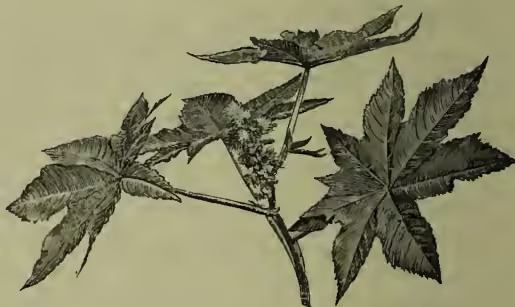
CASTOR-OIL PLANT (Ricinus communis; natural order Euphorbiaceæ) is a native of India, but now naturalised in most tropical, subtropical, and even warm temperate countries. It is known in the Mediterranean countries as Palma Christi. It is also found in cultivation even in northern Europe, where, however, it is only annual. Under these circumstances it attains a height of 4 to 6 or more feet, while in warmer climates it becomes a small tree. The flowers are comparatively inconspicuous, in monocious racemes, but the foliage is peculiarly handsome. There are a large number of varieties, many described as distinct species.