Cat, a name applied to various species of the genus Felis, in the family Felidæ, and in the æluroid section of carnivora. This æluroid section includes the most specialised carnivores; and the members of the genus Felis, including lion and tiger, panther and cat, exhibit carnivorous characteristics in their highest perfection.
General Characters of Cats.—The canine teeth of Felidæ are large and strong, the true molar teeth reduced to one on each jaw, the molar of the lower jaw and the last premolar of the upper jaw function as special cutting (sectorial) teeth, the face portion of the skull is short and broad, the auditory bone bulbs (bullæ) are large, rounded, smooth, and divided by an internal septum. The feline carnivores walk on the tips of their toes, in digitigrade fashion; the claws are large, strong, sharp, and completely retractile. The iris is very movable, and the aperture contracts to a vertical slit. The tongue is covered with sharp rough papillæ. The cæcum on the intestine is small and simple. There are many other more technical structural characters. The Felidæ are conspicuously carnivorous in their diet. Domestic cats eat fish when they can get it; and the Indian Fishing-cat (F. viverrina) feeds on fish and even molluscs. They hunt alone and stealthily, surprising their victim by a sudden spring, loving darkness, hating water, and in most cases are more or less arboreal.
Species.—The genus Felis includes some fifty species, the distinctions of which are somewhat difficult. Among the Old-World species, the most familiar are the lion, tiger, leopard or panther, ounce, wild cat (F. catus), and domestic cat.
Among the New-World species, the puma, cougar or American panther (F. concolor), the jaguar, the pardal (F. pardalis), the pampas cat, are common forms. The term lynx is applied to several different species, and the name cat is used with equal width. The Cheetah (q.v.) is often regarded as a distinct genus.
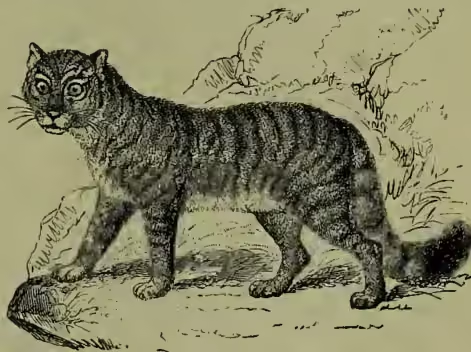
Wild Cat.—The Wild Cat (F. catus) found in the woods of Europe was common in England in the middle ages, when abbesses were forbidden to use fur more costly than that of lambs or cats. It lingered on till the beginning of this century, was still known in Wales about 1850, and is not yet extinct in the north of Scotland. It is the opinion of specialists that the true wild cat never existed in Ireland. It is now very rare in France, apparently absent in Scandinavia, but still common in Southern Russia and in the wilder parts of Germany, Switzerland, Spain, Hungary, Dalmatia, Turkey, &c. It is stronger and larger than the house cat, with stouter head, shorter and thicker tail, more abundant whiskers, and in the male with deep black soles. The predominant colour is yellowish gray, a dark stripe runs along the back, darkish stripes down the sides, cross bands on the legs, and rings on the tail. It is very savage in disposition. The female has its litter in a hollow tree or rock cleft. Though a large number of the 50 species of Felis have received special popular titles, like lion, tiger, ounce, &c., there remain a large number to which the title 'wild cat' is quite as applicable as it is to the more familiar F. catus of Europe.
Domestic Cat—History.—Our common cat, familiar in many varieties of colour, is not a tamed descendant of this Wild Cat (F. catus), but seems, like other domestic animals, to have come from the East. It is usually, though not indeed with absolute certainty, regarded as the descendant of the Egyptian Cat (F. caligata or maniculata), which was certainly domesticated in Egypt thirteen centuries B.C. That the taming should have taken place in the 'granary of the ancient world' is very natural. From Egypt the domestic cat spread through Europe, certainly before the Christian era, but at first sparsely, and confined to those who could afford a high price for the pet. It is quite possible that other species may have been domesticated elsewhere, and have mingled with the Egyptian breed. Rolleston and others have believed that the domestic mouse-killer of the ancient Greeks and Romans was not the cat at all, but the white-breasted Marten (Mustela foina), for which felis is good Latin.
In the middle ages cats were often kept in numeraries, and this may have something to do with their traditional association with old maids. Of its rarity in Britain in former times, when the wild cat was common in all the woods which covered so much of the island, a curious evidence is afforded by a Welsh law quoted by Pennant—a law of the reign of Howel the Good, who died in 938 A.D.—fixing the prices of cats according to their age and qualities, beginning with a price for a kitten before it could see, and enacting that if any one stole or killed the cat that guarded the prince's granary, he was to forfeit a milch ewe, its fleece and lamb; or as much wheat as when poured on the body, suspended by its tail, the head touching the floor, would form a heap high enough to cover the tip of the tail.
Varieties.—The varieties of domestic cat, though numerous, are trivial, and concern colour and quality of fur, not differences of form as in the case of dogs. Thus we have (1) black cats with clear yellow eyes, usually with a few white hairs, and with hints of markings in the kittens; (2) white cats, sometimes with blue eyes, and then generally deaf; (3) tabby cats, like the wild species, and perhaps the result of crossing with the same; (4) gray cats, which are rare, and differ from the tabby forms in having no black stripes, except the common ones over the fore-legs; (5) tortoise-shell, fawn-coloured, and mottled with black, usually females; (6) sandy-coloured, usually males. A true tortoise-shell tom-cat fetches a big price. The royal Siamese cat is fawn-coloured, with blue eyes and small head; the Carthusian or blue cat has long dark grayish-blue fur, with black lips and soles; the Angora or Persian cat is large, finely furred, generally white, tending to yellow or gray, and possibly derived from an Asiatic species. The Malay cat, in Pegu, Siam, and Burma, has a tail only half the normal length; the Manx cat of the Isle of Man is tailless and has longer hind-legs. Long-tailed forms, probably due to intercrossing, also occur in Manxland, and curtailed forms occur in the Crimea. No cats with pendant ears exist, in spite of frequent statements to the contrary. In South America, not to mention other varieties, there is said to be a race of cats which do not 'caterwaul' at nights, and Professor Mivart justly remarks that 'it is to be wished that this breed could be introduced into this country.' Abnormalities, such as absent fore-limbs and the like, have been repeatedly recorded.
Characteristics.—The domestic cat is too well known to require description. It has been known to attain a weight of 23 lb., and an age of eighteen years. Though thoroughly domesticated, it retains many characteristics of wildness, especially in its private hunting expeditions, nocturnal amatory wanderings, unsocial habits, and generally self-centred, not entirely confident disposition. When turned out in the woods, it usually adapts itself readily. Domestication has had a different influence on cat and on dog, and the former may be fairly said to have surrendered itself less. In normal surroundings it is an expert hunter or stalker of birds and small mammals, and is often known to bring home rabbits; at the same time it has a marked predilection for food which it could not obtain if wild—e.g. milk, cheese, fish, and the like. Its sense of smell has probably degenerated, but is still very sensitive to certain favourite odours. The great dilatability of the pupil enables it to make the most of feeble light. The cat is very prolific, mature by the end of her first year, fecund till the ninth, bringing forth often three or four times in a year. It is not necessary to say anything about its familiar purring, mewing, and spitting; about its aversion to water and love of warmth; its scrupulous and painstaking cleanliness; about its dexterous movements and patient watching for prey; or about the delight in cruelty (comparatively rare in other animals) which characterises its treatment of captured mice. The dry fur, free from any oily matter and readily injured by water, becomes highly electric by friction, especially in dry or frosty weather.
Intelligence.—In cats the senses of sight, hearing, and touch are very highly developed, and the intelligence is proportionately great. That they exhibit great adroitness in catching their prey is well known, but the climax is reached in certain recorded cases where a young bird was used as a decoy for its parents, and where crumbs were scattered or scraped from beneath the snow to attract sparrows. That they bring zoological curiosities to their mistresses, that they may learn without teaching to 'beg' like dogs for food, that they show for a while considerable interest in the looking-glass problem are not unfamiliar facts, while more rarely they have been known to combine reasoning and manual dexterity in opening thumb-latches, working knockers, ringing bells, or even turning an easy lock. Mr Romanes has collected illustrations of the above, and closes his account with the remarkable case of a cat which, being accidentally ignited by paraffin, ran 100 yards and plunged into a trough of water. See his Animal Intelligence (1882).
Emotions.—The sexual emotions of cats are well known to be very strong, and their maternal kindness and solicitude are equally pronounced. From the time of Buffon, the cat has been usually reproached for liking places more than persons, but while there is much truth in the familiar observation, many cases of genuine fondness for owners are well known. They sometimes show great power of finding their way home under the impulse of home-sickness, and often show much careful love in concealing and transplanting their young. The case of a cat which ran for help for an endangered parrot friend, and of another which exhibited great solicitude about kittens—not its own—which had been accidentally buried under flooring, are at once suggestive and beautiful.
Diseases.—Besides being subject to common diseases like catarrh, diarrhoea, distemper, &c., cats are not unfrequently infested by parasites, either externally, as by the itch mite (Sarcoptes cati), causing swelling and baldness, and by fleas, or internally, by threadworms and tapeworms, and by the aberrant Pentastomum. Fits of vomiting are often due to small threadworms (Ascaris mystax) in the stomach, and Ollulanus trieuspis, another nematode, is even more important. The bladderworms of mice and rats become the tapeworms of the cat.
Superstitions regarding Cats.—Cats have been objects of superstition from the earliest ages. In Egypt they were held in the highest reverence; temples were erected in their honour; sacrifices and devotions were offered to them; and it was customary for the family in whose house a cat died to shave their eyebrows. In the middle ages, they were regarded as the familiars of witches. The favourite shape of Satan was said to be that of a black cat, and the animal was an object of dread instead of veneration. There is or was a belief among sailors, that the frolics of a cat at sea portended a storm. Many people still prophesy rainy weather from a cat washing over its ears or simply its face; and a cat-call on the housetop was formerly held to signify death. Their assumed connection with witches, and the belief that a cat has nine lives, have led to the perpetration of great cruelties upon this harmless and very useful domestic animal (see Brand's Popular Antiquities, Ellis's revised edition).
Importance.—As a destroyer of vermin the cat is of no little economic importance, and the connection (through field-mice and humble-bees) between cats and clover crops is one of the stock instances of far-reaching influence. The more cats the fewer field-mice is evident enough; but as the latter ravage humble-bee nests and combs, we may say, the more cats the more humble-bees; but as the bees carry the fertilising dust from one purple clover flower to another, and as this fertilisation is essential to the perfecting of the crop of seeds, we may read the complex relation again, as Darwin has pointed out, connect the two extremes in saying the more cats the larger purple clover crop. It need hardly be said that the fur and skin are also utilised. Most people will be inclined to allow, however, that even apart from their utility, cats justify their existence as domestic pets.
See Prof. St George Mivart's valuable monograph, The Cat (1880), on which the present article is largely based; Champfleury's Cats Past and Present, translated by Mrs Cashel Hoey (1885); and Mrs W. Chance's delightful Book of Cats (1898).