Catacombs. An English traveller recording his impressions of a visit to Rome about the year 1450 writes thus: 'This same Cathaemmbas is a marvelous name, for it is not expounded in our Latyne bookes, ne non of the gramariones touch this word thus compounded' (Bodleian MS.). Though this can no longer be said, the etymology of the word still remains doubtful. It occurs first in a Christian calendar of the end of the 3d century, or beginning of the 4th. In this calendar the feast of St Fabian on the 20th of January is set down as being celebrated in Callisti, the feast of St Sebastian on the same day in Catacumbas, thereby denoting two adjacent subterranean cemeteries on the Via Appia, about two miles out of Rome, where those two martyrs lay buried. The same designation is repeated in this and similar documents, and always to mark the same place, the cemetery in the neighbourhood of the church of St Sebastian. This cemetery remained always known and accessible even when all others of the same kind on other sides of Rome had been totally lost sight of and forgotten. Hence, on their rediscovery in the 16th century, a visit to the cemeteries having long become synonymous with a visit ad Catacumbas, the local name came to be regarded as the specific name of all subterranean excavations used for purposes of burial, not only in the neighbourhood of Rome, but also in Naples, Malta, Paris, Sicily, and wherever else similar excavations have been found.
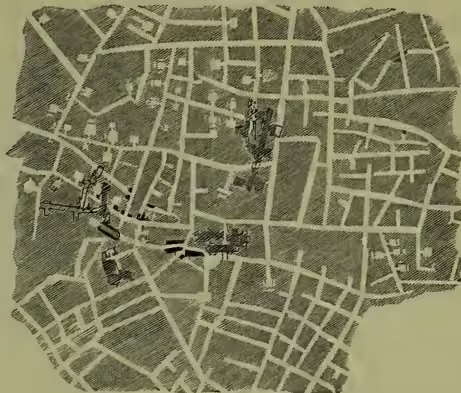
We shall confine ourselves to an account of the Roman catacombs as being incomparably the most important. They are to be found on almost all the roads leading out of the city at a distance of 2 or 3 miles outside the walls, wherever the nature of the soil allowed of their being made. This soil is of volcanic origin, too soft to be used for building purposes, yet of sufficient consistency to admit of a considerable amount of excavations without the necessity for supports or substruction of any kind. More than forty of these cemeteries are known to have existed, and two-thirds of these were of considerable extent. They may have begun, indeed, in a very limited area (280 by 100 feet), but subsequent additions extended them tenfold. There is no truth, however, in the idle reports of a perfect connection between all the cemeteries, making them to reach for many miles together; though it is perfectly certain that if the galleries (which continually cross and recross, and are repeated in some places four or five times beneath one another) could be extended in a straight line, they would reach, at least, 300 or 400 miles.
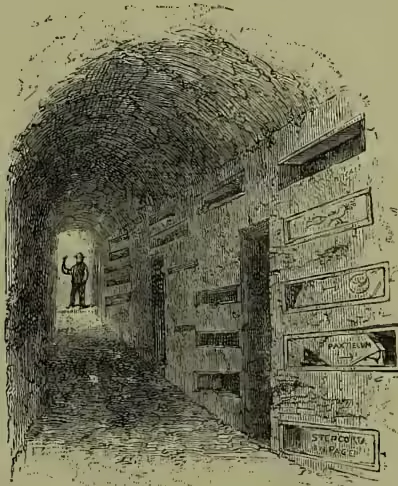
It was once a subject of constant discussion among Christian archaeologists how a work of this kind could have been carried on by the faithful during times of persecution, but modern scientific researches have solved the difficulty. We know, on the one hand, that from the earliest times the burial of the dead was looked upon by the Christians as an important act of religion, accompanied by the prayers of the church, and intrusted to her ministers, and it was one of the objects to which the alms of the faithful were devoted, and for which it was considered lawful even to sell the sacred vessels. On the other hand, the Roman law fenced round with peculiar privileges all places of burial, even though they contained only the bodies of slaves or criminals. Such places became ipso facto religious. They could not be sold, or in any way alienated from their original purpose, and the severest penalties were inflicted upon those who in any way violated them. Moreover, it was the custom of the wealthier Romans to provide chambers at their places of burial for the entertainment of guests who resorted there on certain fixed days in the year; and the poorer members of society secured the same results by means of burial clubs, which were specially protected by the law even when all other voluntary associations were strictly forbidden. It is possible that the Christians availed themselves of this most convenient screen for their own meetings from the very earliest times.
It is certain that they did so from the end of the 2d century. Some of the chambers found in the catacombs were manifestly nothing more than family vaults, as the inscriptions themselves testify, whilst others again, it is equally manifest from their very form and arrangements, were designed for public worship. Some of these may occasionally have been used as hiding-places by the bishops, or others, special objects of persecution, but it is quite impossible that they could ever have been used as general places of concealment.
There is abundant evidence, both literary and monumantal, that at first the Christians made no attempt to conceal their cemeteries. They did but exercise their undoubted right to bury instead of burning the bodies of their dead, and they used a mode of burial already familiar to the Jews, and not altogether unknown even among the pagans. Neither did the Roman government interfere in any way with the catacombs at their first beginnings, nor so long as they were confined to their original use as places of burial. The first decree recorded against them is by Valerian, 253 A.D., who forbade the Christians 'to assemble in those places which they call cemeteries.' In the following year his edict was revoked, and during the next fifty years the catacombs come before us in successive periods of church history as enjoying good or evil fortune, according to the varying fortunes of the church herself; they were tolerated or forbidden according to the changing will of the government, until at last, before the end of the 3d century, they were altogether confiscated. We learn from St Cyprian that Pope Sixtus II., with some of his deacons, were surprised and martyred whilst in the act of celebrating the holy mysteries in the catacombs of Pretextatus, and the charge on which he was condemned was distinctly this, that he had set at nought the commands of Valerian. When the persecution of Diocletian ended, the catacombs were restored together with the rest of ecclesiastical property to the Bishop of Rome, and in the year 311 Pope Melchiades sent an important rescript commanding this restitution, by the hands of some of his deacons, to the prefect of the city. From this time, if not somewhat earlier, other Christian cemeteries were made above ground instead of below, and during the next hundred years both modes of burial were in use. During the last forty years of the 4th century, the practice of burial in the catacombs was considerably diminished, and at the end of the first decade of the next century it ceased altogether.
When the ages of persecution ceased, a new era opened in the history of the catacombs. The basilicas which Constantine began to build over the tombs of some of the principal martyrs necessarily involved considerable interference with the adjacent graves. Moreover, there was a great desire among the faithful to secure places of burial as near as possible to the tombs of the martyrs; and this again could not be gratified without injury to the decorations, if not to the walls themselves, of the existing chambers and galleries. Pope Damasus in the latter half of the 4th century yielded to no man in his enthusiastic love of the martyrs, but his zeal was tempered by an intelligent prudence. He tells us himself of his desire to be buried with his predecessors, but that he denied himself the indulgence of this wish because it would involve the disturbance of other men's graves. (Hic fateor Damasus volui mea condere membra, sed cineres timui sanctos vexare piorum). Yet even he was forced to make some changes in the internal arrangements of the catacombs. Christian pilgrims from all lands flocked to them in such numbers, that to prevent both scandals and accidents it was essential that wider and more convenient entrances should be made, some passages of the subterranean labyrinth shut up, and others made more easy of access. Besides this, he ornamented with marble, and even with the precious metals, some of the more important tombs. Perhaps this helped in the end the destruction of these venerable sanctuaries. It was probably a hope of finding treasure that led the Goths to enter and ransack these places when they invaded Rome in 557. The Lombards made still greater havoc in 756, so that immediately afterwards Pope Paul I., pathetically lamenting the work of desecration, caused the bodies of the martyrs to be removed for safety's sake to churches within the city. This work of translation of relics was continued by some of Paul's successors until the middle of the next century (848).
Practically the living history of the catacombs may be said to have now come to an end. Efforts were made by some of the popes to keep alive an interest in them, and when basilicas had been built over them some were still occasionally visited, but generally they were neglected and forgotten. Seven centuries later (May 31, 1578) an accidental landslide brought them to light, and they soon attracted universal attention. One man in particular, Antonio Bosio, devoted his whole life to examining them at great personal risk, and to studying all ancient documents which promised to throw light on their history, but he did not live to complete or publish his work. It appeared at last in 1632, and in the space of less than forty years afterwards it was reproduced either in translations or abridgments eight successive times, in Italian, in Latin, and in German. This work, from the consummate learning and scrupulous honesty of its author, has always remained a standard authority. The intervening centuries until our own day have only added supplementary works illustrating some portions of the subject in detail, but not adding much to our knowledge of the whole. At length, after the lapse of 250 years, another author, De Rossi, has arisen who has devoted a yet longer time to the study of the catacombs, and has resumed the work of Bosio with the same honesty of purpose, and with the assistance of the lights accumulated by more than two centuries of historical, critical, and archaeological research, has given to the public the most magnificent results of new discoveries. These have appeared in three folio volumes in 1864, 1867, and 1877. A whole series of abridgments in English, French, and German have also been published, and numerous pages of history hitherto unstudied and altogether unknown have been recovered for general use. It has been a special object with De Rossi's investigations to settle the chronology of the various parts of the catacombs, and in this he has succeeded so wonderfully that, as Mommsen truly says 'the successive execution of individual parts of the whole plan may now be traced in periods of two to ten years; and by this means it has become possible to obtain a chronological precision, not only with regard to epigraphy, but also to painting and many other branches of archaeology, such as it would be impossible to arrive at in any other field of archaeological research.' The history of early Christian art may now be traced with great accuracy, and different stages of its progress and decay be marked, even within the limits of the pre-Constantinian era.
At first the Christians decorated their sepulchral chambers much in the same style as their pagan neighbours did. The roof was divided into geometrical figures by means of lines or garlands of flowers, and the spaces were filled with birds, flowers, winged genii, and other graceful figures, so that the spectator might almost doubt whether he was looking on a pagan or a Christian work until he recognised in the centre the figure of the Good Shepherd, or of Daniel among the lions, or some other Christian subject. By degrees a more decidedly Christian character was given to the decorations, and a few subjects both from the Old and New Testament were repeated over and over again, instead of the innocent but unmeaning ornaments which had preceded them. Among these subjects the Good Shepherd was by far the most frequent; Noah in the ark, Moses striking the rock, Daniel in the lions' den, the history of Jonah, multiplication of the loaves and fishes, and the resurrection of Lazarus, follow next in order of frequency; and in later times Adam and Eve, the Three Children in the fiery furnace, and the adoration of the Magi make their appearance. To these must be added certain subjects symbolical rather than historical, such as the vine, a man fishing, the fish and the anchor, fish and bread placed in various relations to one another, &c. It is not difficult to see the hidden teaching of these pictorial lessons: they point to the resurrection, to a new and glorious life as the fruit of a new life imparted to the soul in this world through the sacrament of baptism, and fed and nourished by the Holy Eucharist. In some instances these subjects are arranged round the walls in so orderly a succession as almost to assume the form of a dogmatic pictorial catechism. More commonly, however, there is no such precise arrangement, but each subject stands by itself, unintelligible to a pagan intruder, but suggesting holy and instructive thoughts to all the faithful. Everything which belonged to the cycle of polytheistic worship was from the first rigorously excluded, but towards the end of the 2d century, or beginning of the 3d, they did not scruple to use, but very rarely, such figures as Orpheus and Psyche, which were capable of a Christian interpretation, and in the middle and latter half of the 3d century they used the head of Oceanus, Iris, Hippocampi, and even Tritons, to represent parts of the earth or of the sea, the rainbow, the seasons, &c.
The Christian art of the pre-Constantinian era has been divided into three periods. The first, lasting till the middle of the 2d century, may be styled the hieroglyphic or ideographic period, characterised by the utmost simplicity, each figure standing alone—e.g. the fisherman fishing, the Shepherd bearing a sheep on his shoulders, an anchor, a lamb, a fish, &c. In the second period, reaching to the middle of the 3d century, different emblems or histories are blended together, making a more artistic whole—e.g. a fisherman fishing is combined with a man baptising, and the paralytic whose sins are forgiven carrying his bed; the Good Shepherd stands in the midst of many sheep arranged in different attitudes, denoting a difference of internal disposition, and each receiving a proportionate measure of grace under the form of water flowing from the rock struck by Moses, &c. In the third period the symbolical element is sensibly diminished, the hieroglyphic element is almost or quite abandoned, and even the historical types are represented in a more literal form, and words are sometimes added, as Pastor, to identify the subject represented.
After the days of Constantine, the crypts in which famous martyrs had been buried continued to receive new decorations, but these are of a wholly different character, and need not be described here, nor need we say anything of the sculpture on the sarcophagi, which reproduced the same biblical subjects as were painted on the walls. It will be more interesting to say a few words of the epitaphs, which are to be numbered by thousands. When arranged chronologically, they tell the same tale that we have already learned from the paintings—that is to say, the earliest series are quite simple, consisting of the name only (generally the cognomen), or with the addition of a Pax tecum, Pax tibi, Vivas in Deo, Vivas cum Sanctis, &c., and perhaps the relationship of the deceased to the survivor. Towards the end of the 2d century these short aspirations are developed at greater length, but always in the same spirit. There is a total absence of the blank despair or impious defiance which characterise so many pagan epitaphs: all is simple, hopeful, and joyous. But in the 4th and 5th centuries a more worldly tone makes itself manifest. Complimentary phrases as to the goodness, wisdom, innocence, and holiness of the deceased are repeated with wearisome sameness, and other expressions borrowed from pagan sources may be detected. The beauty and religiousness of Christian epigraphy had reached its highest perfection before the end of the 3d century; in the 4th it was more formal and void of sentiment. See De' Rossi, La Roma Sotteranea (1864-77), and his Inscriptiones Christianæ (1857-61); also the Roma Sotteranea of Northcote and Brownlow (London, 1878-80).