Caterpillar, the larval stage of butterflies and moths (Lepidoptera), and the representative in this special order of the grub, maggot, or larva phase in the life-history of many insects.
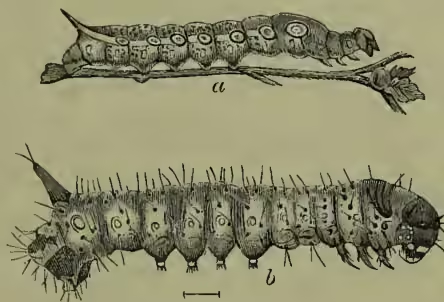
General Structure.—The caterpillar, so familiar in its external appearance, has usually 12 body-rings, not including the head, is provided with strong biting jaws, strikingly contrasted with the mouth organs of the adult, has three pairs of five-jointed clawed legs on the region corresponding to the thorax, and usually five rudimentary stumps or pro-legs on the abdomen. These unjointed appendages are borne on the sixth to the ninth, and on the twelfth segments of the body; some of them may be absent; in the majority of cases they are adapted for clambering. The body may be naked or covered with hairs, bristles, and spines, which, in caterpillars living an exposed life, are usually brightly coloured. The large head is divided by a median line, and bears six eye-spots on each side, a pair of short three-jointed feelers, strong upper jaws or mandibles, besides jointed palps on the two successive pairs of mouth appendages. Two well-developed spinning organs open on the second pair of maxillæ forming the lower lip or labium. On each side, on the first ring, and on the fourth to the eleventh, there are nine pairs of stigmata or openings into the respiratory air-tubes. Hatschek has observed the appearance of three pairs of stigmata on the jaw-segments of the head. The colours are familiarly bright in many instances, and may have their seat in the cuticle or in the skin below, or very frequently in deeper regions of the body. A metallic sheen is sometimes superadded. The surface is often beautifully marked longitudinally, or transversely, or with ring-spots and eye-spots. Odoriferous and other glands frequently occur on the skin, and are in some cases (Dicranura, Orgyia) eversible. The internal anatomy of the caterpillar, though essentially resembling that of the adult, differs in some striking features. Thus while the larva has 11 to 12 separate nerve ganglia in the ventral chain, the adult insect has usually only two separate ganglia in the thorax, and five in the abdomen. The digestive system is comparatively short and simple; the circulatory and respiratory systems much like those of the adult; a few aquatic caterpillars have gill-like appendages.
History.—The caterpillar develops like any other larva from the segmented egg and differentiating embryo; its life is usually more or less active and voracious; it undergoes several moult- ings or ecdyses; begins to develop some of the adult structures, and falls into a quiescent pupa, chrysalis, or aurelia stage. The pupa is usually (except in butterflies) insheathed in a silken cocoon, may be fixed or free, suspended by one thread or more to leaf or branch, or hidden away underground. Among butterflies, the uninsheathed pupa may be fastened head downwards by a single silken rope fastened to the tail end (pupæ suspensæ), or head upwards with an extra suspensor round the body (suscinctæ). The intimate structural changes associated with the remarkable alteration in habit of life have not yet been fully followed. One of the most important features is the appearance on the caterpillar of what are known as 'imaginal discs,' which appear to arise from the skin, and give origin to the limbs and wings of the adult insect. In the quiescent pupa stage very important changes go on, amounting to more or less of a remaking of the entire body; but it is not possible within the present limits to describe the changes undergone by the digestive, nervous, and other systems, or the very marked transformation of the mouth appendages. The cocoon in which the pupa becomes the perfect insect may be altogether absent, or very slight, or strikingly compact and protective. Some firm cocoons open very neatly from the inside by valvular lips, and in other cases the moth is known to soften the walls of its prison by means of some secretion. The gilded colour of some pupæ (chrysalids indeed), so mineral-like in appearance, not improbably arose, it has been suggested, in hot dry countries, and had a protective value among dry rocks. It has been shown experimentally to arise as a direct consequence of bright surroundings. The cocoon occasionally consists solely, or almost solely, of the hairs of the larva; in some cases leaves, wood, earth, &c. are used in construction; in most moths it is spun. The work of spinning the usual cocoon is carried on almost ceaselessly, sometimes for four or five days, and Trouvelot calculates that the larva of Polyphemus in distributing its silk must have moved its head to and fro about 254,000 times.
A very primitive insect type is represented by a widely distributed genus Peripatus (q.v.), which remains permanently at a sort of caterpillar level, and serves to connect jointed-footed animals or arthropods with worm-like forms. The caterpillar may be interpreted as in part a recapitulation of this historical stage in the evolution of insects.

Survival of ancestral insects (from Moseley).
The caterpillar thus represents the prolongation of an ancestral and embryonic stage, while many of its characters have arisen as secondary adaptations to its peculiar mode of life. Between each moult there is a period of quiescence, and this becomes greatly prolonged in that all-important moult in which the mouth organs of the larva are modified into those of the adult. Free life at a period so momentous would evidently be disadvantageous even if it were possible. The pupa, furthermore, may come to have a secondary importance other than that of simply being an exhausted quiescence at the final moult; it may come to be of vital moment as a protective phase, by means of which the insect survives the cold of winter or the drought of the dry season. In one case (Cossus) the preparatory stages may be prolonged for three years. From another point of view the life-history may become more intelligible—viz. from the side of its physiology. In the embryonic development the young form is built up at the expense of its endowment of food-capital. The first chapter is one of passivity and living on past gains. When these are exhausted, and the embryonic processes completed, the larva emerges, hungry, voracious, active. In its ravages and moultings it exhibits alternate minor rhythms of activity and passivity. Finally having laid up a store of food-capital in the recesses of its 'fatty body,' it falls asleep into the more emphasised quiescence of the pupa stage. During this phase of fasting and passivity, and of life sustained by past gains, momentous changes, associated with gradual loss of weight, take place, and the final début is made by the appearance of the active, frugal, sexually-mature, comparatively short-lived adult. It is not yet possible to rationalise the details of the life-history, but in the alternations of activity and passivity common to all living organisms, and here more marked than in any other case, the solution must be sought.
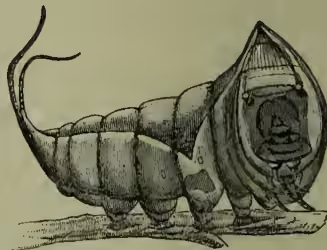
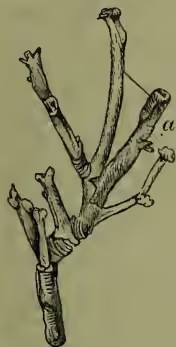
Protection and Colour.—Caterpillars are evidently enough tempting juicy morsels to birds and other insect-eating animals; their slow movements render them liable to ready capture, and, as Wallace has pointed out, their soft-walled tense structure is 'extremely dangerous, for a slight wound entails great loss of blood, while a moderate injury must prove fatal.' It is therefore not surprising to find that caterpillars, in common with the larvæ of other insects, have found out, or have become the subjects of, various devices for evading their enemies. The more conspicuous forms almost always possess some unpleasant attribute in taste or smell, either in the tissues generally or in special glands. Weismann notes how a curious lashing about of the tail may preserve one form, and how the juices of another attract a protective body-guard of ants. Others are so uncanny in the disposition of their hair-tufts and colour, or in the of larvae trust to this mode of defence. Thus others are in their colour and markings so like the plants on which they feed, or the ground on which they crawl, that they avoid detection, and this protective resemblance is often not merely general and superficial, but detailed and exact. Thus some when fixed as pupæ to the stems of plants, are almost indistinguishable from knobs or stunted twigs. In the twig-like attitude the supporting thread is sometimes dispensed with. Others are like little splinters of wood, or the curled margins of withered leaves. The hairs and fleshy tubercles may prevent the casting of a sharp shadow. Nor is the 'mimicry' confined to resembling the parts of plants, but a palatable insect may probably save itself by approximating in colour to one that is distasteful. Mr Bates observed a large caterpillar deceptively like a small venomous snake. Protective resemblance may be further abetted by unpalatable taste or unpleasant smell. Some forms hide during the day; others feign death when caught. In more than one species (Dicranura) the larva spurts out formic acid.
Darwin had been impressed with the colours of caterpillars, which, occurring as they do on larvæ, could not be referred to the action of sexual selection. Though, as an exception, a male caterpillar may be much brighter than the female, the two sexes are all but invariably the same, and no sexuality or sexual choice is yet developed. Wallace attacked the problem, and maintained that the conspicuous forms were distasteful to birds and reptiles, and that the conspicuous colours were advantageous reminders of unpalatableness. To this Poulton has added the necessary caution, that animals forced by hunger will eat the distasteful beauties, and come to like them.
For a most interesting series of studies on the colour and markings of caterpillars, the reader should consult Professor Weismann's Studies in the Theory of Descent, and the valuable editorial notes of the translator, Professor Meldola. The whole burden of Weismann's work is to show that in the marking and colouring (of the Sphingidæ in particular) no action of an impelling vital force can be recognised, but that 'the origination and perfection of these characters depend entirely on the known factors of natural selection and correlation,' though of course natural selection can only operate on the variations possible to the physical constitution and conditions of the organism. In tracing the presumed historical evolution of the Sphingidæ, which is more or less fully recapitulated in the individual development, he starts (1) from concealed or subterranean, white or yellow, forms, with a horn on the tail and with bristles, but without markings; (2) in adaptation to life on linear plants like grasses, longitudinal markings are evolved and confirmed by natural selection;
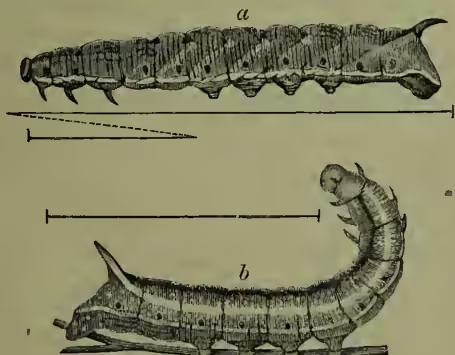
(3) these are succeeded by oblique stripes, spreading from one segment to another, evolved by natural selection and correlation, and followed by the disappearance of the longitudinal lines which spoil the effect; (4) on the second last segment ring-spots then appear, and tend to spread to other rings; these are deceptively like the berries of the food-plant at one time, or have a terrifying eye- like appearance afterwards, and are often signals of distastefulness.
Poulton made a long series of experiments of a most interesting nature on the subtle relations between Lepidopterous larvæ and their surroundings. The colours and markings have a double source: (1) pigments derived from the food-plants; (2) pigments proper to the larvæ. A larva may be coloured from either or both of these sources; all greens seem due to the chlorophyll, and most yellows to the xanthophyll of plants; other colours to the proper pigments of the larvæ. The derived pigments are more frequently the basis of general resemblances to surroundings, the true pigments of special and detailed likeness. Poulton arranges the causes of colour in larvæ, in the presumed historic order of their employment, thus: (1) Ready-made colour in the internal tissues and organs, in the digestive tract, fat, and dorsal blood-vessel; (2) derived pigments which have passed through the walls of the digestive tract into the blood or the tissue under the cuticle; (3) true pigment in the cuticle and in the layer immediately below (the hypodermis). But the point of most general interest is the relation between the colour of the larvæ and that of their food-plants. Within the same species the colours may vary to suit the colour of the feeding-ground. Abundant instances of this are recorded in Meldola's notes to Weismann's Studies. McLachlan noted for instance that the larvæ of Eupithecia absynthiata were yellowish on the yellow ragweed (Senecio jacobaea), reddish on the purplish centaury (Centauria nigra), and white on the mayweed (Matricaria). Poulton has the credit of analysing this interesting relation. He has shown that the influence of the food-plant must act throughout a long period of larval life, that the effects probably accumulate during successive generations, and that the result cannot be referred to the direct influence of the material eaten. The interpretation is rendered particularly difficult 'by the gradual working of the process, often incomplete in a single life, by the excessively complex and diverse result, and by the special character of the stimulus, for it is only part of the environment which produces any effect.' In the case of the larva of Smerinthus ocellatus, Poulton has shown that the colour relation is adjustable within the limits of a single life, and that the predominant colour of the plant is the inciting stimulus. The colour adaptation is not in this case at any rate due to the gradual working of natural selection, but to relatively immediate power enabling the larva to suit itself to its conditions. But the influence, though in one sense direct, is a very subtle one. Poulton's investigations show (1) that larvæ have certain hereditarily transmitted tendencies towards certain colours; (2) that the colour of the leaf, and not the substance eaten, is the agent which influences the larval colours; (3) that the influence is an intricate nervous one, 'making itself felt by affecting the absorption and production of pigments rather than their modification when formed;' and (4) that individual variations are comparatively unimportant, though it is quite possible that variation began somewhat uselessly in the pigments in the blood, &c., and were afterwards 'rendered efficacious by co-ordination with the environment.' Some of Mr Poulton's most beautiful recent experiments (1887) are those which show how the golden surroundings of a gilt-lined box favour the production of golden pupæ. The above naturalist, to whose observations this article is so much indebted, has done more than any one else to penetrate into the physiological conditions of caterpillar colour, but much still remains to be done in elucidating the rôle of colour in the constitution of these and other animals.
General Life.—As already noted, most caterpillars lead an active life, some roving only at night, others also in the daytime. Young larvæ have been observed to seek the light. Their movements are guided by an appreciation of the force of gravitation; they usually crawl upwards; and they always know their food-plant when they come to it. Their frequent falls from, for them, considerable heights, are broken, it has been suggested, by the springy hairs with which they are so often covered. Many of them seem to have an insatiable hunger, and eat straight on. Their ravages among vegetables and other plants are only too well known. Some forms are carnivorous, and Mr Poulton has suggested that this might arise from cannibalism induced by scarcity of food, as his observations vividly indicate. While older larvæ will apparently rather starve than take to a new food-plant, it has been conclusively shown that the newly hatched larva is not so fastidious, but 'is free to form special relations with occasional or rare food-plants.' Trouvelot's experiments on the larvæ of Polyphemus showed that a caterpillar, fifty-six days old, had consumed not less than one hundred and twenty oak leaves, weighing in all three-fourths of a pound, and had drunk not less than half an ounce of water. The food would weigh 86,000 times the original weight of the larva. 'Of this, about one-fourth of a pound becomes excrementitious matter; 207 grains are assimilated, and over five ounces evaporated.' A few larvæ (Nymphula, &c.) are aquatic, many bore in wood, leaves, and soft vegetable substances, others are largely subterranean.
The caterpillars of some of the silkworm sub-order (Bombycina) live together within a common pouch-like cradle, and others move in file-like processions (see ARMY-WORM). Migrating caterpillars (Noctua) have been described, which move in search of food in vast armies, marching straight on over everything, until a fit pasturage is found. In one case (quoted by Kirby and Spence from the Charleston Courier, May 1842) the passage of such a host is said to have made the ground black for days; in another instance reported from America, they stopped a heavy train going at the rate of 10 or 12 miles an hour.
Comparatively few caterpillars reach maturity (happily for the sake of the plants in the next season); many are destroyed by the weather, many by hungry birds, reptiles, and other animals, and many by insect pests of the families Ichneumonidæ (see ICHNEUMON-FLY) and Tachinariæ. The ichneumon-flies pierce the caterpillars, and make them the receptacles of their eggs and the edible cradles of their larvæ.
As typical injurious caterpillars may be noticed, (1) on vegetables, those of the cabbage-moths (e.g. Mamstra brassicae, and several species of Pieris or Pontia), the turnip-moths (Noctua segetum, Cerostoma xylostella), the silver Y-moth (Plusia gamma), the carrot-moths (Depressaria), the hop-moths (Dasychira, Hepialus, Pyralis), the peacock-moth (Grapholitha pisana), the death's-head (Sphinxatropos); (2) on trees, those of the goat-moth (Cossus ligniperda), the wood leopard-moth (Zeuxera æsculi), the buff-tip moth (Pygura bucephala), the lackey-moth (Bombyx clisio-campa) neustria), &c. See Miss Ormerod's Injurious Insects.
The devastations of caterpillars are to some extent compensated for by the fertilising work of the adults, and by the silk of the silkworms. But apart from their destructiveness and utility, they are full of interest and of scientific puzzles. Old Swammerdam saw in their metamorphosis 'the resurrection painted before our eyes,' while moralists and poets have often delighted in pointing out the analogies suggested by the crawling immature caterpillar, with faint promise of its future, by the seeming death and coffin-like cocoon of the chrysalids, by the new birth, glory, and heavenward flight of the perfected forms.
LITERATURE.—Balfour, Embryology, vol. i.; Kirby and Spence, Introduction to Entomology; Lubbock, Metamorphoses of Insects ('Nature' series); Packard, Guide to the Study of Insects; Poulton, Transactions of Entomological Society (1885-6-7), British Association Report (1887), Proceedings of Zoological Society (1887); Wallace, Proceedings of Entomological Society (1867); Weismann (translated by Meldola), Studies in the Theory of Descent (1880-82); Wilson, Larvæ of British Lepidoptera and their Food Plants (London, 1880).