Cattle. In the United Kingdom there are twelve native breeds of cattle. England claims exactly one-half of these—namely, the Shorthorn, Hereford, Devon, Norfolk and Suffolk Red Polled, Sussex, and Longhorn breeds. There are two or three varieties of cattle in Wales, but for practical purposes they may be reckoned as one breed. Four distinct breeds have arisen in Scotland, these being the Polled Aberdeen-Angus, Galloway, Ayrshire, and West Highland breeds. The remaining one is the native breed of Ireland, the hardy little Kerry, regarded as one of the purest and truest existing representatives of the ancient Bos longifrons. In addition to these twelve native races, other two very useful breeds, the Jersey and Guernsey, have become domiciled in the British Isles, and there are also a few of the famous Dutch milking cows scattered over the country. These various races, with an almost endless variety of crosses between two or more of them, make up the entire cattle stock of the United Kingdom, which, according to the official agricultural returns, numbered 10,598,677 head in 1887.
The Shorthorn is by far the most numerous and most widely diffused. It has not inaptly been titled the 'Cosmopolitan Shorthorn.' It has found a home in almost every county in the United Kingdom. The county of Durham is generally regarded as the 'cradle' of shorthorns; indeed, they have often been spoken of both at home and abroad as the 'Durham breed.' But the valuable race of native cattle from which the improved shorthorn
The brothers Charles and Robert Colling were the first to begin the systematic improvement of the breed. In those days the 'rank and file' of shorthorn cattle were large, high-standing cattle, good milkers, but rough in form and slow in fattening. The Collings would seem to have at once directed themselves to the improvement of the native cattle where they were most defective, and they were successful in establishing a stock of cattle of a decidedly more profitable character—wider in the rib, more symmetrical in the frame, shorter in the leg, slightly smaller in size, heavier in flesh, and more speedy in maturing and fattening. It has been said, but not established beyond contention, that in effecting this improvement the Collings made use of an infusion of blood from some of the other smaller breeds. It is more likely that they relied upon 'selection' in breeding—the mating of animals of the shorthorn breed which most nearly approached to their ideal character, and fixing the type by pursuing what is designated as 'in-and-in' breeding—i.e. mating animals which are closely related to each other, a system that is known to assist greatly in stamping or fixing peculiar features and characteristics upon races of stock. The success of the Collings was speedy and complete, for the fame of their cattle spread so rapidly that even earlier than 1810, the year of the 'first great public sale of shorthorns,' they had sold cows and bulls at £100 each, and had hired bulls for use to other breeders at premiums of from £50 to £100 a year. At Charles Colling's historical sale at Ketton in 1810, 29 cows and heifers realised an average of £140, 4s. 7d.; and 18 bulls £169, 8s. each. Eight years later, at Robert Colling's sale at Barmpton, in a time of great depression, an average of £128, 9s. 10d. was obtained for 61 animals. The sensational event of the memorable sale at Ketton was the purchase of the celebrated bull 'Comet' at the fabulous price of 1000 guineas.
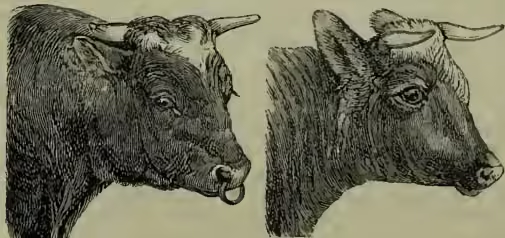
The importance and interest attaching to the operations of these two great pioneer breeders will at once be understood when it is mentioned that there is not at the present day a well-bred living shorthorn in whose pedigree Colling blood does not figure prominently. Colling's successors were, on the one hand, Thomas Bates; on the other, the Booth family, whose representatives then were Thomas and John Booth. At the Ketton sale (1810) Thomas Bates purchased the two-year-old heifer 'Young Duchess' for 183 guineas. Thomas Booth bought the bull-calf 'Albion' for 60 guineas; and at the Barmpton sale (1818) his brother, John Booth, secured the yearling bull 'Pilot' for 270 guineas. With these purchases the shorthorn breed drifted into two great channels, which by degrees absorbed the main current of the race, so that for many years the terms 'Booth' and 'Bates' shorthorns have been as applicable in relation to the bovine world as Whig and Tory to the political. These two strains of Bates and Booth, as has been seen, had one common origin in Colling's blood, but in course of time they developed distinctive shapes and characteristics which in the purer representatives are still well maintained. Mr Robert Bruce, than whom there is no higher authority, thus describes the characteristics of 'Booth' and 'Bates,' speaking in the first place of 'Bates' cattle: 'They are higher standing, better milking, and perhaps gayer looking cattle than the Booths. They have as a rule more upright shoulders, flatter foreribs, opener sides, with long hindquarters less fully packed with flesh than the rival strain. As a rule their heads are clean cut and pretty wide, while the bulls have long arched muscular necks and keen tempers. The prevailing colours in this strain of blood are, generally was raised abounded freely in adjoining counties as far back as reliable history enables us to trace their career. Early in the 19th century they were also known as 'Teeswater' cattle, the first famous shorthorns having come from the valley of the Tees. speaking, deeper than in the other, being reds and rich roans. The Booth cattle are wider, deeper, and perhaps less pretty. Their shoulders are more laid back, their foreribs and flanks deeper and better filled. They are more a beef than a milk breed, with well-packed quarters and thick loins. The sires remind one more of a fat Smithfield ox, and they move without that courage and dash so peculiar to the "Duke's" and other highly valued strains of the Bates tribes.' But while these are the two great divisions of the breed, there are a great many excellent shorthorns of mixed breeding which do not show any decided leaning either to the one or the other. The prevailing colour of shorthorns is roan of varying shades, but many are red, and some white. There is a dislike to red and white in distinct spots as a colour, and quite an unreasonable objection to white.
In precocity, production of meat, and general utility, the shorthorn is unsurpassed. Other varieties may excel it in special points for peculiar purposes or in certain limited districts, but for a combination of all the more useful properties of domestic cattle and adaptability to varying conditions of soil and climate, there is no equal to the shorthorn. The facility with which the shorthorn adapts itself to changes of soil, climate, and treatment is quite remarkable, and this combined with the valuable property which it also possesses in an unequalled degree—suitability for crossing with and improving other and inferior classes of cattle—has spread the improved shorthorn far and wide, not only in its own native land, but in countries beyond the seas. In North and South America, the continent of Europe, Australia, New Zealand, and other parts, the shorthorn has been extensively introduced. In all these countries, as at home, it has been one of the most active and effective agents in improving the native races of cattle and in increasing the production of high-class beef. Many breeders of shorthorn cattle have cultivated the fattening to the detriment of the milking properties. Still, while it is quite common to meet with a very light milker amongst shorthorn cows, there is a large section of the breed which possesses dairying properties of the highest order. Good shorthorn cows give from 700 to 1000 gallons of milk in twelve months. At the London Christmas Fat Stock Show in December 1887 the class of shorthorn steers under two years old (averaging 672 days) gave an average live-weight of 1396 lb.; steers over two and under three years of age (averaging 988 days), 1870 lb.; and steers over three years old (averaging 1321 days), 2116 lb. each.
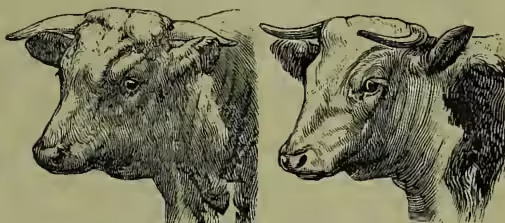
Hereford cattle display strongly fixed and peculiarly distinctive characteristics both in outward features and general attributes. The improved breed traces directly from the stock of cattle which were found by the earliest writers on agricultural topics existing in the county of Hereford and adjoining districts—the same aboriginal variety from which have descended the Devon and Sussex breeds. The improvement of the Hereford would seem to have been begun by the Tomkins family far back in the 18th century, and was taken up in a systematic manner by Benjamin Tomkins about 1766, and carried on by him with much energy and success until his death in 1815. His herd was continued by his daughters till 1819 (one year later than the Barmpton sale of shorthorns), when it was dispersed by public auction. Twenty-eight breeding animals realised an average of £149 per head; four adult bulls having brought as much as £267, 15s. each; and two bull-calves £181, 2s. 6d. each. From that time the fortunes of the breed fell into other hands, and never for a moment have the Hereford stock-owners wavered in their loyalty to their fine old breed of cattle. There is little doubt that infusions of foreign blood contributed to some extent to the building up of the modern Hereford. In the 17th century cattle had been imported into Hereford from Flanders by Lord Scudamore, and in later times there had been introductions of stock from various parts of England and Wales. The dominant ingredient, however, is the aboriginal race of the county, and selection in breeding and careful management have been the principal agencies by which the breed has been brought to the high standard it has now attained. The modern typical Hereford is red in colour, with white face and white marks in the top line of the neck, back over the crops, as well as in the chest and bottom line all the way backwards. The 'white face' is indeed the 'tribal badge' of the Hereford, and with their wide and graceful horns they are singularly handsome in outward appearance. Formerly there were gray-faced or spotted Herefords; and even yet there is in existence a strain of Herefords known as 'smoky-faced Montgomerys.' The Herefords are similar in size to the shorthorn; usually broad along the back and heavily fleshed, but occasionally light in the thighs and deficient in internal fat. Their highest property lies in their value as grazing cattle; and this has led to the extensive employment of Hereford bulls in breeding cattle for the rolling prairie-ranches of the western states of America. They are hardy cattle, with a rank coat of hair and thick mellow hide, and they are excellent 'foragers'—all points of special importance in ranche cattle. It is pre-eminently a beef-producing breed; matures early and yields meat of the finest quality. As a rule the cows are deficient as milkers, for this property has never been cultivated as it ought to have been. The average live-weight of two-year-old Hereford steers (averaging 634 days) at the London Christmas Fat Stock Show in December 1887 was 1390 lb.; of steers over and under three years (averaging 938 days), 1742 lb.; and of steers over three years (averaging 1310 days), 2041 lb. There are a few excellent herds of Herefords in Ireland, and they have been exported in large numbers to foreign countries, notably North and South America, Australia, and New Zealand.
Devon cattle are deep red in colour, and have frequently a white spot on the belly just in front of the udder, with wide round loins, smaller in size than the two breeds just mentioned. It is noted for the almost perfect formation of the shoulder, which is laid into the body with remarkable neatness. The breed has still its headquarters in Devon and Somerset, where it has held undisputed sway for hundreds of years. It won the admiration of Arthur Young, who gives interesting information regarding the breed in his report dated 1776. Here also there was one 'master mind' at work on the improvement of the breed. Mr Quartly of Molland is described by Young as the most celebrated of breeders in North Devon; and the greatest of our early writers on agriculture gives a most minute account of the scheme of breeding which was pursued by Mr Quartly and his brother, 'the clergyman who interests himself much in live-stock.' The ideal animal which the Quartlys kept before them and bred up to exactly corresponds to the typical Devon of to-day; and there is no doubt that their sound and systematic method of breeding imprinted an indelible stamp upon the race through which the blood of their stock has freely permeated. In former times, when cattle were beasts of burden, the Devons were greatly esteemed for their agility and hardiness. Now that the yoke has fallen upon other shoulders, the 'Rubies of the West,' as the plump little Devons have been called by their admirers, are holding a high position as beef-producers. The quality of their meat is excelled by none; and while they are small in size, they give a good return for the food they consume. Garrard, writing in 1800, attributed the excellence of Devon cattle mainly to the mildness of the climate and high dry ground, calcareous soil, and sweet pasture where they were bred; but he considered it might be also to some extent due to an admixture of finer blood from the still warmer continent of Europe. There may have been some slight foundation for this latter suggestion; but it is undeniable that the main forces and features now existing in Devon cattle are distinctively native to the south-west of England. This idea is strengthened by the recollection of the estimate of Devon cattle formed by Bakewell, who declared that they could not be improved by any cross. From the first and greatest of all our early improvers of farm live-stock this testimony is weighty. The dairy properties of the breed are not of a high order. The yield of milk is comparatively small, but its quality is exceptionally rich. Some rare specimens of the breed have reached 19 cwt. live-weight at four years old, but the average is much below that. At the London Christmas Fat Stock Show in December 1887 the class of two-year-old Devon steers (averaging 681 days) gave an average live-weight of 1235 lb.; steers over two and under three years old (averaging 996 days), 1489 lb.; and steers over three years (averaging 1320 days), 1734 lb. each.
The Red Polled cattle of Norfolk and Suffolk are supposed to bear a close affinity to the polled breeds of Scotland through the circumstance that formerly Scotch cattle were freely transported to be fattened on the Norfolk pastures. Be this as it may, the red polled breed has been sufficiently long associated with Norfolk and Suffolk to enable these counties to claim them as natives. Marshall in his Political Economy of Norfolk, published in 1782, tells us that the native cattle of Norfolk were 'a small, hardy thriving race, fattening as freely at three years old as cattle in general do at four or five. They are small boned, short legged, round barrelled, well loined; the favourite colour a blood-red with a white or mottled face.' Arthur Young, writing in 1794, says the Suffolk breed of cattle 'is universally polled, that is, without horns; the size small; few rise when fattened to above 50 stone (14 lb.); the milk veins remarkably large; cows upon good land give a great quantity of rich milk.' These are the progenitors of the modern red polls, and all the good features of the old breed have been retained and developed. The cattle are now relatively larger, still blood-red in colour, but with no white face, good meat-producers, and, taken as a whole, perhaps the best of all the native English breeds from a dairying point of view. Individual shorthorn cows will be found to exceed them in yield of milk, but red-polled cows are distinguished for high average milking properties. The breed has found much favour in the United States of America and elsewhere abroad. Its uniformity of colour, absence of horns, and usefulness both as beef and milk producers have won for it many hearty admirers in America.
Sussex cattle are also uniformly red in colour, with strong spreading horns, larger in size than the Devons, heavy meat-producers, but deficient in dairying properties. Marshall is probably right in stating (1796-98) that the Sussex, Devon, Hereford, North Wales, and Gloucestershire cattle had all sprung from the same aboriginal stock; and that in fact they were 'varieties arising from soils and management of the native breeds of this island.' Formerly Sussex cows were highly esteemed for their milking properties, but in the rage for beef-production these have unfortunately been destroyed. Sussex cattle mature early, grow to great weights, and in late years they have been improving in quality. They have also found supporters in foreign countries, chiefly in the United States of America. Young Sussex steers (averaging 659 days) at the London Christmas Fat Stock Show in 1887 reached an average live-weight of 1436 lb., and three-year-old steers (averaging 1349 days), 2030 lb. each.
Longhorn cattle are now in few hands; so few indeed that the breed may be said to be approaching extinction. They are big, rough, ungainly cattle, with long drooping horns which are often so shaped as to make it difficult for the animals to graze short pasture. The cows give a fair quantity of very rich milk, and the bullocks grow and fatten to great weights. But for general utility they are being ousted by smaller, finer, and more rapidly maturing varieties. Peculiar interest attaches to this breed from the fact that it was upon it that the past great improver of farm live-stock, Robert Bakewell (q.v.) of Dishley, tried his earliest experiments. The improvement of live-stock upon scientific principles dates from 1755, when Bakewell began his great work with longhorns. These cattle were at one time widely diffused through England, and also obtained a footing in Ireland, but were many years ago supplanted by shorthorns, Herefords, Devons, or other varieties.
Welsh cattle present considerable variety of type and character, yet there is all through a noticeable family likeness, arising of course in their common origin in the aboriginal cattle of the principality. They are black in colour, with long horns, hardy in constitution, good milkers, slow in maturing, but able to subsist and thrive upon scanty fare. In late years they have been considerably improved, especially in their fattening properties. They vary greatly in size, but many of them attain great weights at from three to four years old. The average live-weight of Welsh steers at the London Christmas Fat Stock Show in 1887 was 2111 lb. each, their average having been 1286 days.
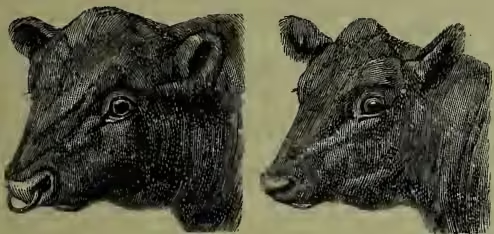
Amongst the four Scotch breeds of cattle the Polled Aberdeen-Angus is well entitled to precedence. Descended directly from the ancient polled cattle of Angus (Forfarshire) and Buchan (in Aberdeenshire)—two varieties of the same type, known in the former as 'Doddies,' and in the latter as 'Humlies'—this valuable beef-producing breed has made great strides in public favour since 1878, when, with five plump black polls the late Mr William M'Combie (1805-80) of Tillyfour carried off the champion prize for the best group of 'meat-making' cattle at the Paris Exhibition, where no fewer than sixty different varieties of cattle were represented, including the best of the English breeds. That remarkable triumph has been followed by great achievements at home, the breed having in 1881, 1885, and 1887 won the £100 Champion Plate at the London Christmas Fat Stock Show. The improvement of the breed was begun before the advent of the 19th century, and all through its breeders have been careful to preserve and cultivate its exceptionally high properties in the production of meat of the choicest quality. In this lies the chief excellence of the breed, and in these times the characteristic is one of great value. This property in the northern polls, combined with the sound system of feeding pursued in Scotland, has secured 'prime Scotch' beef the highest favour and longest price in the London market. At one time the cows of this breed gave a bountiful yield of rich milk, but owing to the breeders' attention having so long been mainly directed to the cultivation of the fattening properties, they are now only moderate milkers. In recent years the breed has improved considerably in early maturity, and at the London Fat Stock Show in December 1887 it surpassed all other breeds in this important property. At that show the class of polled Aberdeen-Angus steers under two years (averaging 667 days in age) gave an average live-weight of 1475 lb.; and steers over two and under three years (averaging 984 days), 1874 lb. Black is the prevailing colour, but occasionally a red calf is dropped.
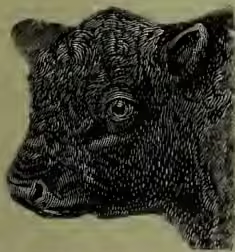
The Galloway breed, which takes its name from the south-west of Scotland, where it has existed it is believed for centuries, has an undeniable claim to an ancient lineage. Its origin is lost in the mists of bygone ages, but enough of its history is known to insure for this breed a high position amongst the native races of British cattle. Black and hornless like the polled Aberdeen-Angus breed, Galloway cattle differ substantially from the former, not only in outward features, but also in their inherent properties. They are similar in size, more shaggy and muscular in appearance, having a thicker hide and ranker coat of hair, but they do not mature so quickly, and are not so well suited for rapid house-feeding as the northern polls. But the Galloways are excellent grazing cattle, and for this property they have been highly esteemed for many generations, both in England and Scotland. In recent years they have been exported in large numbers to America, where they have been found admirably adapted for ranching purposes. They are exceedingly robust and hardy, and have surpassed several of the other finer varieties on the ranches of the western states of America, where the cattle have to accomplish a great deal of walking in finding food and water.
From a dairy-farmer's point of view, the Ayrshire is the most valuable of all the British breeds of cattle. Its origin is uncertain, but it is considered more than probable that its progenitors were of Dutch extraction. Be this as it may, it was well established as a famous dairy breed in the south-west of Scotland before the close of the 18th century. The prevailing colours are brown and white, but some are almost entirely white, others are almost a whole brown. They are wide, low-set cattle, with fine horns curving upwards. They are second-rate cattle as beef-producers, but as profitable general dairy cattle they are unsurpassed. A fairly good Ayrshire cow will give 600 gallons of milk in a year, a very large quantity for her moderate size.
There is no more handsome animal of the bovine species than a genuine representative of the West Highland breed. Almost as large in size as the shorthorn, and quite as well proportioned in the frame, the West Highlander gains in appearance by his rank shaggy coat of hair, long, spreading, gracefully turned horns, and hardy, muscular, and defiant gait. With the Wild
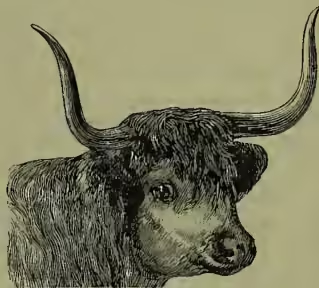
White cattle of Chillingham and the tiny little Kerry of Ireland, the West Highland is regarded as the finest existing representative of the ancient cattle of Britain. The breed presents considerable variety in size and colour. Dun or yellow, of various shades is the prevailing colour, but many are black or brindled. They mature slowly, but their beef is much esteemed for its quality and flavour. They are unequalled for hardness, and can be kept with advantage where no other breed would subsist. The cattle of Orkney and Shetland differ considerably from the varieties on the mainland, but they are as a rule of an inferior character and small in size.
The Kerry is the smallest of all the recognised varieties of British cattle. The breed has its headquarters in the bleak hills and upland pastures of the county from which it takes its name, and having been much neglected by Irish farmers, it forms only a very small proportion of the cattle stock of Ireland, which now mainly consists of crosses between the improved shorthorn and 'old Irish cows,' which were of mixed-bred nondescript character. Kerry cattle are very hardy, and the attributes of the Kerry cow have thus been truthfully described by Youatt: 'Truly the poor man's cow, living everywhere, hardy, yielding for her size abundance of milk of good quality, and fattening rapidly when required.' Black is the prevailing colour, and their horns are upturned and often peculiarly 'cocked.' There is a sub-variety called the 'Dexter Kerry,' shorter in the leg, thicker in body, and heavier in the flesh than the Kerry proper.
The extension of dairy-farming in the United Kingdom, and the somewhat meagre milking properties of the greater proportion of British cattle, have led to the importation of large numbers of Channel Island cattle. These—often indiscriminately called Alderney cattle—comprise the Jersey and Guernsey breeds, supposed to be from one common origin, but known to have been bred in purity in the respective islands of these names for upwards of a hundred years. They are both essentially dairy breeds, giving an abundant yield of rich highly-coloured milk. The Jersey is the smaller of the two, and is docile, delicate, and of graceful deer-like form. In the production of beef it is of little value. The Guernsey is not only larger, but also hardier and more generally useful. When in full milk, whole herds of Jersey cows give an average of lb. of butter each cow per week, an exceptional cow occasionally giving as much as 16 lb. of butter in one week.
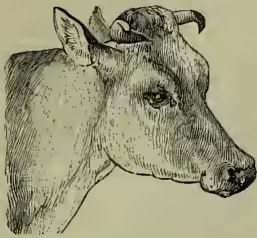
Good Jersey cows yield from 500 to 700 gallons of milk, and from 300 to 350 lb. of butter in twelve months. Guernsey cows have exceeded 800 gallons of milk in a year, and the noted cow 'Select,' when six years old, gave lb. of butter in seven days, this quantity being obtained from 19 quarts of milk per day. In America still higher records have been obtained.
It has been stated that the improvement of cattle-breeding on scientific principles was begun by Bakewell in 1755. Almost continuously since then the good work has been prosecuted with energy and success, and for many years the British Isles have been regarded as the origin and headquarters of almost all the most valuable varieties of farm live-stock. For generations foreign countries have freely resorted to these islands for improved live-stock, and this export trade goes on as briskly and as extensively as ever. The United States of America have in particular drawn very largely upon British herds, and a great stimulus to this trade with the United States has been given by the extension of the ranching system. Vast areas of grazing land in the western states and territories have been acquired by syndicates for the breeding and rearing of cattle; and with the view of improving the stock of native cattle, large numbers of well-bred bulls of the leading British varieties, either imported from the United Kingdom or descended from imported stock, have been sent to the West for use on ranches.
The cattle of the United States and Canada present almost endless variety of form and character. This is what might be expected when it is remembered that they are descended from importations of cattle from Spain, Holland, Sweden, Denmark, France, and England, Scotland, and Ireland. About the year 1525, some six years after the discovery of Mexico by the Spaniard Cortes, cattle were introduced into that country from Spain, and in the abundant pasturage of the Mexican territory they increased rapidly, spreading with the enterprising Spanish settlers into Texas, California, and other parts of the Far West. Exactly a hundred years later the Dutch settlers in New York brought cattle thither from Holland, and a few years earlier small importations of cattle had been made from the West India Islands into Virginia. The earliest of these arrivals in Virginia are assigned to 1610 and 1611, but that colony was broken up in 1622 by the Indians, who massacred 347 men, women, and children, and, it is presumed, also destroyed their cattle. In 1624—four years after the landing of the English Plymouth colony there—cattle were introduced into Massachusetts from England, and many other importations followed during the next few years. The Swedes brought cattle into Delaware in 1627, and in 1631 and two following years Danish emigrants introduced cattle from their native country into New Hampshire. English emigrants settled in Maryland in 1633, in North and South Carolina in 1660 and 1670, and in Pennsylvania in 1682, and took with them, or had sent after them, large numbers of English cattle. The French colonists brought cattle into
Quebec as early as 1608; and towards the close of the 17th century fresh importations of European cattle poured into the great American continent. It so happens, however, that while importations of cattle were made from all the countries named, and perhaps from others also, the existing cattle stock of America—leaving out the Mexican, now more commonly called Texan, cattle, which are still a race by themselves—are largely of British origin. In the earlier importations, again excluding Mexico, British cattle preponderated; and just as the English language has submerged all others in the gradual development of the American continent, so has British blood become the dominating element in the main bulk of the cattle stock of the country. There is no authentic information as to the character of the cattle first introduced into America, but all the leading breeds of the British Isles, as well as the chief milking breeds of the European continent, are now strongly represented in North America. There, as at home, the English shorthorn predominates, and there are also strong representations of the Hereford, Polled Aberdeen-Angus, Galloway, Devon, Norfolk and Suffolk Red Polls, Jersey and Dutch breeds. The cattle of America are being speedily improved, chiefly by the use of well-bred bulls, either imported from the British Isles or bred from imported cattle. Still, the majority of them are of an inferior character—quite unworthy of the rich country which they occupy. The Texan cattle still retain the rough coarse character which distinguished their Spanish ancestors. Improvement amongst the Texan cattle is proceeding very slowly.
The cattle of Australia, which are small, slow-growing, and of inferior quality as beef-producers, have also been greatly improved by the introduction of British stock, chiefly of the Shorthorn, Hereford, and Polled Aberdeen-Angus breeds.
In the management of cattle there is perhaps even greater variation than in the character of the cattle themselves. A full description of the various methods of management would itself occupy a moderate volume. It must suffice here to mention two or three leading features in cattle economy. In the British Isles the ox is no longer a beast of burden, save in a very few localities. The yoke has fallen upon the horse, except where both have been relieved by the steam-engine. The two main purposes for which cattle are now reared are the production of milk and butcher-meat. Certain breeds, as already indicated, are peculiarly adapted for milk-production, such as the Jersey and Guernsey and Ayrshire cattle; others, notably the shorthorn and red-pollé breeds, are distinguished for the combination of both milking and fattening properties of the highest order; while others again, such as the Polled Aberdeen-Angus, the Hereford and Devon, &c., display remarkable aptitude to fatten, and yield meat of the choicest quality. The farmer of course selects the breed best adapted to the locality in which he lives, and to the purposes he has in view. As a rule cattle of all kinds, whether dairying or fattening, spend the summer on the pasture fields; and it is only in exceptional cases, either where there is a deficiency of grass, or where it is desired to force the growth, fattening, or milking of the animals, that any food beyond what they can pick up for themselves is given to cattle on the fields. Oil-cake, cotton-cake, and bruised grain—partly imported, mostly home grown—are the principal auxiliary foods on pasture. Where a careful system of management prevails, the cattle are put into comfortable houses overnight as soon as the chill autumnal evenings set in; and throughout the winter they are kept almost entirely in the houses, store-cattle getting out now and again about mid-day when the weather is favourable. As winter food, turnips and straw or hay preponderate, but in the improved practice of recent years smaller quantities of roots and more of the concentrated foods, such as cake and grain, are being given to cattle. Silage is fast becoming an important article of food for cattle. Now cattle are fattened off at from eighteen to thirty months old, instead of from three to five years, as prior to 1850. The essence of the feeder's art is to produce the maximum quantity of first-class meat in the shortest possible time and at the lowest possible cost; and in the struggle after this the maturing and fattening properties of cattle have been greatly accelerated. The young or 'baby-beef,' as it has been called, is more tender and perhaps more palatable than the substantial 'rounds' of the slow-growing five-year-old beefs of 'fifty years ago'; but it is questionable if it is either so wholesome or so strength-giving. Be that as it may, the popular taste is entirely in favour of the 'baby-beef'; and what the public desire the feeder must endeavour to supply.
Of late there has been considerable growth in dairy-farming throughout the British Isles. But as in 1898 butter to the value of £15,961,780 (not to speak of £2,384,300 worth of imitation butter), and cheese to the value of £4,970,000, were imported, it will be seen that there is room for still further extension. The system of management on dairy-farms varies according to the locality and objects of the farmer. Where the milk can be conveniently disposed of or despatched to towns, attention is given mainly to milk-selling, which is the least troublesome, and perhaps also the most profitable system of dairying. In other cases butter is the staple produce of the dairy; in other parts again, cheese-making is the prevailing feature. The consumption of milk as human food has vastly increased in recent years. The rate of consumption keeps on growing, and ingenious facilities are devised for bringing fresh milk from distant dairies—dairies from 50 to 60 miles distant—into towns every morning. As would be expected, the calves bred on dairy-farms get little of their mothers' milk. They are reared principally on 'milk substitutes,' either prepared at home or by firms who make the production of cattle foods their sole or chief business. Linseed in various forms is very extensively used in calf-rearing.
Cattle are very variously used, and are the only or the chief beasts of draught in many countries, as Cape Colony and large part of America. In India also horned cattle are the only beasts used for ploughing, and are chiefly valued as draught animals. A famous breed was formed for military purposes; and in the Central Provinces there is a high-class breed of trotting bullocks. The best ghee of India is obtained from the milk not of cows but of buffaloes. In China, no use whatever is made of cow's milk, though human milk is sometimes given to old people as a restorative. Nearer home, in Italy even, milk and butter are but little used, and cows are in request mainly for rearing calves. The large Italian breed can do little more than feed their young; and milch cows, if wanted, are brought from Switzerland. In Italy and some other countries, cattle are all stall-fed, vine, elm, and oak leaves forming an important part of their food.
Wild Cattle.—In various parts of the world, species occur of cattle more or less wild, which are certainly different from any of the domesticated European breeds. Such are the Banteng (Bos banteng), the Gaur Ox (B. gaurus), the Zebu (B. indicus). But besides these extra-European wild cattle, there are abundant remains of three virtually extinct European species, from which the domesticated breeds are believed to have gradually originated. These are B. primigenius, B. longifrons, B. frontosus. The first became virtually extinct within historic times, is known as the Ur in the Nibelungenlied, was domesticated in Switzerland in the Neolithic period, was common in Britain and on the Continent in the time of Cæsar, seems to have persisted in Poland till the 17th century, and still survives in a semi-wild stage, 'though much degenerated in size,' in Chillingham Park in the north of Northumberland. In 1692 the flock numbered but 28; in 1899, 60 in all. At Cadzow near Hamilton is another herd, differing somewhat from those of Chillingham, but presumed to be also representatives of a detachment of the wild cattle that roamed the Caledonian Forest. Other herds are still found at Chartley (Staffordshire), Somerford (Cheshire), and Kilmory (Argyllshire); whilst that at Gisburn (Yorkshire) became extinct in 1859, and that of Lyme (Cheshire) dwindled from 34 head in 1850 to 4 in 1875. Though the interesting survivals preserved at Chillingham 'are less altered from the true primigenius type than any other known breed,' there is some reason to suppose from their white colour and some other features that they are descended from a partially domesticated ancestry. As to other descendants of B. primigenius, which have diverged further from the primitive type, it is generally supposed that the Podolian cattle of South Russia, Hungary, &c., the larger breeds in Friesland, Holland, and other parts of the Continent, and the Pembroke breed in England, are to be referred back to the same source.
B. longifrons or brachyceros was a smaller animal with short body. It was domesticated in Switzerland in the Neolithic period; it was early introduced into Britain (vast quantities of its bones having been found in remains of a lake-dwelling at Croyland); and it has its probable descendants in some of the mountain breeds of Switzerland, the Tyrol, and Bavaria (e.g. the Appenzell cattle), and, according to Owen, in some of the Welsh and Highland cattle.
B. frontosus is found along with the latter species, to which it is closely allied. It occurs in the peat-mosses of Scandinavia, and also in Ireland. It is regarded as the probable ancestor of the Norwegian mountain cattle, of the Bern cattle, and, according to Owen and others, of some of the Scotch Highland varieties. In regard to many of these pedigrees, dogmatic statement is quite impossible, and much difference of opinion obtains. The most divergent opinion is that of Wilckens, who maintains that some of the European domestic breeds are descended from the European bison.
Darwin's Animals and Plants under Domestication, vol. i., may be conveniently consulted for facts and references. See the articles BOVIDÆ, BREED, BULL-FIGHT, GAUR, MUSK OX, RANCHING, YAK, ZEBU, &c. The diseases of cattle are discussed under their own heads—CATTLE-PLAQUE, PLEURO-PNEUMONIA, ANTHRAX, MURRAIN, BOT, BLACK QUARTER, &c.; the law thereof under CONTAGIOUS DISEASES; and G. Fleming's Animal Plagues (1871-82). See also DAIRY, BUTTER, CHEESE, and MILK. On cattle generally, see Youatt's Complete Grazier (13th ed., rewritten by Dr Wm. Fream, 1893); Pringle's Live Stock of the Farm; Wallace's Farm Live Stock of Great Britain; Stephens's Book of the Farm (new ed. by Macdonald); and Allen's American Cattle (New York). For Wild Cattle, see Wilckens, Rinderrassen Mittel-Europas (Vienna, 1876); J. A. Smith, Ancient Cattle of Scotland (1873); and Harting, Extinct British Animals (1880).