Caustics. When the incident rays are parallel to the principal axis of a reflecting concave mirror, they converge, after reflection, to a single point, called the principal focus. In the case of parabolic mirrors this is rigorously true. For, as is easily seen from the fundamental property of the para- bola, any ray falling on the mirror parallel to the axis is reflected so as to pass exactly through the focus. For other mirrors it is approximately true only when the breadth of the mirror is very small in comparison with its radius of curvature. When the breadth of the mirror is large in comparison with its radius of curvature there is no definite image, even of a luminous point. In such cases the image is spread over what is called a Caustie, or sometimes a Catacaustie.
An example of the caustic is given in the annexed figure for the simplest case—namely, that of rays falling directly on a concave spherical mirror, BAB', from a point so distant as to be practically parallel.
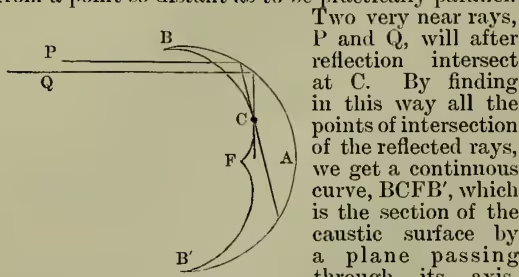
The curve BCFB' varies of course with the form of the reflecting surface. In the case under consideration it is known as an epicycloid.
The reader may see a catacaustic on the surface of tea in a tea-cup half full by holding the circular rim to the sun's light. The space within the caustic curve is all brighter than that without, as it clearly should be, as all the light reflected affects that space, while no point without the curve is affected by more than the light reflected from half of the surface. The rainbow, it may be mentioned, forms one of the most interesting of the whole family of caustics.
When a caustic is produced by refraction, it is sometimes called a Dicaustic. No such simple example can be given of the dicaustic curve as that above given of the catacaustic. It is only in the simplest cases that the curve takes a recognisable form. In the case of refraction at a plane surface, it can be shown that the dicaustic curve is the evolute either of the hyperbola or ellipse, according as the refractive index of the medium is greater or less than unity.