Central Provinces, a chief-commissionership of India, lying between 17° 50' and 24° 27' N. lat., and between 76° and 85° 15' E. long., and embracing 18 British districts and 15 native states. Area, 113,279 sq. m.; pop. (1891) 12,944,798. The surface is very broken, straggling ranges of hills cropping up even in the level portions. In the north extend the Vindhyan and Satpura (2000 feet) tablelands, with the Nerbudda between; south of these stretches the great Nagpur plain, with the Chatisgarh plain to the east, and a wild forest-region beyond, reaching almost to the Godavari. Besides the two mentioned, the chief rivers of the province are the Wardha and Wainganga; all four are rapid streams, with their crystal waters leaping from point to point, and rushing headlong through the narrow mountain-gorges of their upper course. The climate is hot and dry, except during the south-west monsoon, from June to September, when 41 of the mean annual 45 inches of rain fall. Wheat is grown chiefly in the Nerbudda valley, rice in the Nagpur plain; these are the principal crops, but oil-seeds, cotton, and tobacco are also raised. The only manufactures of note are weaving and the smelting and working of iron ores. Iron is abundant, especially in the south, and there are also large coalfields, but the coal is of a very inferior quality. There is considerable trade, but its progress is retarded by the want of means of communication; this drawback, however, is being removed, roads are being made, and the railway system steadily pushed forward. Of the population, three-fourths are Hindus, and one-seventh belong to the so-called aboriginal or non-Aryan tribes, who have found a refuge in the Satpura plateau, and still adhere to their primitive faiths (see GONDS). From these hill-tribes the Hindus throughout the province have contracted beliefs and habits which they have grafted upon the usual worship of their sect; adoration of the dead, worship of the goddess of smallpox, and belief in witchcraft are universal. The population is almost entirely rural, only 6 per cent. residing in the 52 towns of above 5000 inhabitants, of which three—Nagpur, Jubbulpore, and Kampti—have over 50,000 inhabitants. Central India (q.v.) is a term of quite distinct meaning.
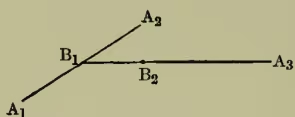
Centre and Central Forces.—CENTRE OF INERTIA (MASS).—If and be the masses of two particles placed at the points and , and if the right line be divided in , so that , the point is called the centre of inertia, or centre of mass, of the two particles. If be a third mass at , and if be divided in , so that
is called the centre of inertia of the three particles. In general, if there be any number of particles, a continuation of the above process will enable us to find their centre of inertia. Every body may be supposed to be made up of a multitude of particles connected by cohesion. From this it is obvious that the centre of inertia is a definite point for every piece of matter.
In general, the determination of the centre of inertia requires the use of the integral calculus. In the case of some bodies, such as those which have a simple geometrical form and are of uniform density, elementary mathematical methods will generally be sufficient. Any straight line or plane that divides a homogeneous body symmetrically must contain its centre of inertia. For the particles of the body may be arranged in pairs of equal mass and at equal distances from the straight line or plane; and, since the centre of inertia of each pair lies in the line or plane, the centre of inertia of the whole must also lie in the same line or plane. For example, the centre of inertia of a uniform thin straight rod is its middle point; that of a uniform thin rod bent in the form of a parallelogram, the point of intersection of its diagonals; that of a lamina, uniform in thickness and density and in form a circle, ellipse, or parallelogram, its centre of figure; that of a uniform spherical shell, its centre; that of a homogeneous sphere, its centre; that of a parallelopiped, the intersection of its diagonals; that of a circular cylinder with parallel ends, the middle point of its axis.
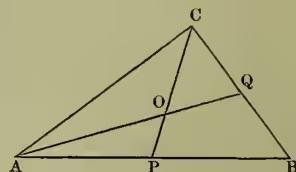
An important case is that of a uniformly thin triangular plate. Let be the plate. Bisect in and join . Let the triangle be divided by right lines parallel to into an indefinitely great number of indefinitely narrow strips. The centre of inertia of each strip is its middle point.
But all the middle points lie on . The centre of inertia of the whole plate must therefore lie on . Again, if be bisected in , and be joined, the centre of inertia of the whole plate must lie in . The centre of inertia must therefore be , the point of intersection of and . It is easily proved by elementary geometry that of . Hence, the centre of inertia of a triangular plate is obtained by joining a vertex to the middle point of the opposite side and taking the point two-thirds of this line measured from the vertex. By a similar method the centre of inertia of other plane figures may be obtained.
CENTRE OF GRAVITY.—If a body be sufficiently small, relatively to the earth, the weights of its particles may be considered as constituting a system of parallel forces acting on the body. Now, the magnitude of the weight of a particle is proportional to its mass. Hence, the line of action of the resultant of the parallel forces will approximately pass through the centre of inertia. For this reason such bodies are said to have a centre of gravity. Strictly speaking, there is no such point of necessity for every body, since the directions of the forces acting on the body are not accurately parallel. Hence, it is only approximately that we can say of a body that it has a centre of gravity. On the other hand, every piece of matter has, as is shown above, a centre of inertia. For all heavy bodies of moderate dimensions it is, however, sufficiently accurate to assume that the centre of inertia and gravity coincide. For example, the centre of gravity of a uniform homogeneous cylinder with parallel ends is the middle point of its axis, that of a uniformly thin circular lamina its centre, and so on.
The centre of gravity of a body of moderate dimensions may be approximately determined by suspending it by a single cord in two different positions, and finding the single point in the body which, in both positions, is intersected by the axis of the cord.
The term centre of gravity is also used in a stricter sense than the one just explained. Thus, if a body attracts and is attracted by all other gravitating matter as if its whole mass were concentrated in one point, it is said to have a true centre of gravity at that point, and the body itself is called a centrobaric body. A spherical shell of uniform gravitating matter attracts an external particle as if its whole mass were condensed at its centre. Such a body has a true centre of gravity. When such a point exists, it necessarily coincides with the centre of inertia.
CENTRE OF OSCILLATION.—A heavy particle suspended from a point by a light inextensible string constitutes what is called a simple or mathematical pendulum. For such a pendulum it is easily proved that the time of an oscillation from side to side of the vertical is proportional to the square root of its length for any small arc of vibration. A simple pendulum is, however, a thing of theory, as in all physical problems we have to deal with a rigid mass, and not a particle, oscillating about a horizontal axis. In a pendulum of this kind the time of oscillation will not vary as the square root of the length of the string, for it is obvious that those particles of the body which are nearest the point of suspension will have a tendency to vibrate more rapidly than those more remote. The former are therefore retarded by the latter, while the latter are accelerated by the former. There is thus one particle which will be accelerated and retarded to an equal amount, and which will therefore move as if it were a simple pendulum unconnected with the rest of the body. The point in the body occupied by this particle is called the centre of oscillation.
As all the particles of the body are rigidly connected, they all vibrate in the same time. Hence it follows that the time of vibration of the rigid body will be the same as that of a simple pendulum, called the equivalent or isochronous simple pendulum, whose length is equal to the distance between the centres of suspension and oscillation.
The determination of the centre of oscillation of a body requires the aid of the calculus. It may be stated, however, that it is always farther from the axis of suspension than the centre of inertia, and is always in the line joining the centres of suspension and oscillation. Let A be the centre of suspension, B the centre of inertia, and C the centre of oscillation, and let AB be equal to , and be the radius of gyration of the body about an axis through B parallel to the fixed axis, then it is easily shown that
Fig. 3. From this there follows the important proposition that the centres of oscillation and suspension are convertible, a proposition which was taken advantage of by Kater for the practical determination of the force of gravity at any station.
CENTRE OF PERCUSSION.—If a body receive a blow which makes it begin to rotate about a fixed axis without causing any pressure on the axis, the point in which the direction of the blow intersects the plane in which the fixed axis and the centre of inertia lie is called the centre of percussion. That such a point must exist is easily shown by suspending a straight rod by a long string attached to one end, and striking it with a hammer in different points. If the rod is struck near the top the foot will move in one direction, and if the blow be applied near the foot the top will move in the opposite direction. It is thus evident that there must be some point which does not move at all at the instant of the blow. If a line through this point be regarded as an axis of rotation, the point at which the body was struck is the centre of percussion, since no pressure is produced on the axis. It is easily proved by means of higher mathematics that the centre of percussion with respect to any axis is the same point as the centre of oscillation.
From what has been said it is obvious that in order that no jar may be felt on the hand a cricket ball must be hit in the centre of percussion of the bat with respect to an axis through the hand.
There are, it may be mentioned, many positions which the axis may have in which there will be no centre of percussion. For example, there is no centre of percussion when the axis is a principal axis through the centre of inertia.
CENTRE OF PRESSURE.—When a plane surface is immersed in a fluid at rest, and held in any position, the pressures at different points of the surface are perpendicular to the surface. These pressures may therefore be looked upon as constituting a system of parallel forces whose resultant is the whole pressure. The point at which this resultant acts is called the centre of pressure, and may be defined as the point at which the direction of the single force which is equivalent to the fluid pressures on the plane surface meets the surface. The resultant action of fluids on a curved surface is not always reducible to a single force. The defini- tion given above is, therefore, limited to plane surfaces. In the case of a heavy fluid it is clear that the centre of pressure of a horizontal area corresponds with the centre of gravity. When, however, the plane is inclined at any angle to the surface of the fluid, the pressure is not the same at all points, being greater as the depth increases; since in the same liquid the pressure varies with the depth. In general, the centre of pressure will be below the centre of gravity. The determination of the centre of pressure requires the use of the integral calculus, but special cases may be treated by ordinary algebra. In the case of a parallelogram, one edge of which is in the surface of the fluid, the centre of pressure is at a distance of one-third up the middle line from the base. In the case of a triangle, having one side in the surface of the fluid, the centre of pressure is at the middle point of the median corresponding to the vertex immersed; while in the case of a triangle, with its apex in the surface, and the base horizontal, the centre of pressure is on the median corresponding to the vertex and at a distance of three-fourths of the median from the vertex.
CENTRE OF BUOYANCY.—The pressures which act on every point of a surface immersed in a fluid can be resolved into horizontal and vertical components. The former balance one another. The resultant pressure must therefore be vertical; and, as the pressure increases with the depth, it is clear that the upward pressures must be greater than the downward. Hence the resultant pressure on an immersed body must be a force acting vertically upwards. Now it is easily shown that the magnitude of this pressure is equal to the weight of the fluid displaced. The point in the displaced fluid at which the resultant vertical pressure may be supposed to act is called the centre of buoyancy, or centre of displacement. Hence, we see that when a body floats in a fluid, it is kept at rest by two forces, the weight of the body acting downwards through its centre of gravity, and the weight of the fluid acting vertically upwards through its centre of gravity, or centre of buoyancy. The relative positions of the centre of gravity and the centre of buoyancy have an important bearing on the safety of ships at sea. If the centre of buoyancy be above the centre of gravity, the equilibrium is stable; in other words, if the ship is displaced, it will tend to return to its original position. If, on the other hand, the centre of buoyancy be below the centre of gravity, the equilibrium will generally be unstable, although a body may float in stable equilibrium even if the centre of buoyancy be below the centre of gravity, as will be explained under the head HYDROSTATICS.
CENTRAL FORCES.—Central forces are forces whose action is to cause a moving body to tend towards a fixed point called the centre of force. By Newton's first law of motion we know that 'every body continues in its state of rest or of uniform motion in a straight line, except in so far as it is compelled by forces to change that state.' From this we learn that, if the speed of a body changes, or if the line of motion be not straight, whether the speed be unaltered or not, some force must be acting. In the latter case the forces acting are called central forces. The doctrine of central forces considers the paths which bodies will describe round centres of force, and the varying velocity with which they will pass along these paths. It investigates the law of the force in order that a given curve may be described, and many other problems which can only be solved by mathematical methods. Gravity affords the simplest illustration of a central force. If a stone be slung from a string, gravity deflects it from the rectilinear path which it would otherwise pursue, and makes it move in a curve called a parabola. Again, the moon is held in her orbit round the earth by the action of gravity, which is constantly preventing her from going off in the line of the tangent to her path at any instant.
In connection with this subject we have to make some remarks on what is called centrifugal force. We have seen that force must always be applied to make a body move in a curved path. Such a force is called a centrifugal force, the old erroneous notion being that bodies have a tendency to fly outwards from the centre about which they are revolving. The use of the term will, however, cause no inconvenience, provided we interpret it merely as indicating that, to keep a body moving in a curve instead of in its natural straight line, a force directed towards the centre of curvature is always required.
Many familiar illustrations of the action of the so-called centrifugal force will occur to the reader. A ball fastened to the end of a string, and whirled round, will, if the motion is sufficiently rapid, at last break the string, and fly off in a tangential path. This is due to the fact that the cohesion of the particles of the string are no longer able to supply the force necessary to keep the ball moving in its circular path. For a similar reason a fly-wheel or a grindstone bursts when it is made to rotate too rapidly. It is found that at a curve on a railway it is the outer of the two rails which is most worn. This is due to the fact that the outer rail has to supply the force necessary to keep the trains moving in curved paths. A glass of water may be whirled so rapidly that, even when the mouth is downwards, the excess of the centrifugal force over the weight of the water is sufficient to prevent the water from falling out. The centrifugal force increases with the velocity. As a matter of fact, it can be shown that when a body moves in a circle of radius , with velocity , its centrifugal force is . By means of this formula it can be proved that about th of its weight is required merely to keep a body on the earth's surface at the equator. By this amount the weight of a body is diminished. Now 289 is equal to . Hence it follows that if the earth were to rotate seventeen times as fast as it does now, the attraction of gravitation would only just be able at the equator to keep bodies from flying off its surface. If the rotating body be plastic, it will swell out in all directions perpendicular to the axis of rotation, and assume the form of an oblate spheroid. For the same reason the earth itself has assumed the form of an oblate spheroid, a result which is seen on a greater scale in the case of Jupiter and Saturn on account of their larger size and more rapid rotation.