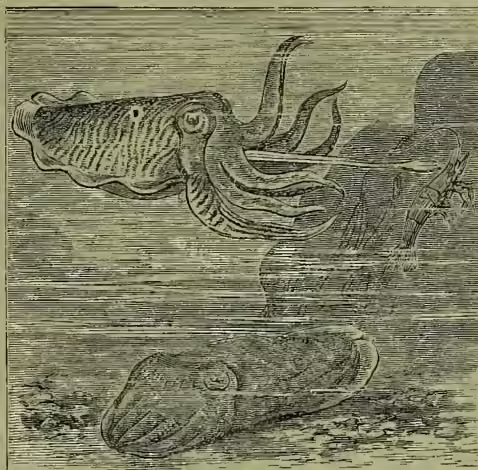
Cephalopoda (Gr., 'head-footed'), the highest class of molluscs, and in some respects the highest invertebrates. They are usually large animals, exclusively marine, with well-developed head-region, but (as the quaint name suggests) with the 'foot' or ventral surface grown round the mouth, and split up into 'arms,' which (with one exception) bear suckers. Another part of the foot is modified to form a funnel through which water is squirted. Two or four gills are present in the usual mantle-cavity. While the ancient forms lived in shells, the Pearly Nautilus alone remains in this state, the shell being in all other cases internal and degenerate. The eyes are peculiarly large, and their ferocious aspect has earned for many common forms the title of 'devil-fish.' The mouth in the midst of the 'arms' is equipped with parrot-like teeth, and with a rasping ribbon on the tongue. The central nervous system, with its closely associated ganglia, is surrounded by a protective cartilaginous sheath, analogous, though in no way homologous, with a vertebrate brain-box. The sexes are separate. The structure and life of these animals will be discussed under the more familiar title CUTTLEFISH; only the general characters, classification, and distribution are here noticed.
Classification.—The Cephalopoda include two distinct orders, one represented by the Pearly Nautilus, the other by all the other living forms, which are again divided into Octopoda and Decapoda, according to the number of the 'arms.'
| DIBRANCHIATA. | TETRABRANCHIATA. |
|---|---|
| Two gills, kidneys, auricles. | Four gills, kidneys, auricles. |
| Eight or ten sucker-bearing arms. | Numerous, without suckers. |
| Shell rudimentary or absent, never external, in one case chambered. | Shell well developed, external, chambered. |
| An ink-bag. | No ink-bag. |
| A completely closed funnel. | A split funnel. |
Distribution.—Most species occur in warm and temperate seas, but those found in the colder waters seem much more prolific. The Tetrabranchiata are the older forms, and begin in the Silurian, whereas the Dibranchiata first appear in Triassic times. The Ammonites (q.v.) are the most familiar representatives of the former, the Belemnites (q.v.) of the latter.
See especially CUTTLEFISH, NAUTILUS, BELEMNITE, AMMONITE; also CALAMARY, OCTOPUS, SEPIA, SQUID; Owen, Memoir of the Pearly Nautilus (1832); Féruillac and D'Orbigny, Histoire naturelle des Céphalopodes (2 vols. Paris, 1835-48); Hoyle, Challenger Report on Cephalopoda.