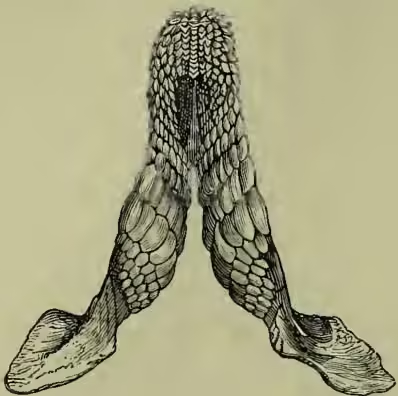
Cestracion, a genus of sharks, regarded as constituting a distinct family, Cestraciontidae, although not more than four species are known as now existing. It is characterised by having two dorsal fins and one anal, the first dorsal situated over the space between the pectorals and ventrals; a spine forming the front of each dorsal; a short wide tail, with its upper lobe strongly notched beneath; the mouth at the fore end of the snout; spiracles distinctly visible, rather behind the eyes; and small gill-openings. The front of the mouth is armed with obtuse angular teeth, whilst the margins and inner surface of the jaws are covered with pavement-like teeth, presenting a general continuity of surface, as in skates, and disposed in rounded oblique scrolls—the former evidently adapted to the seizing of food, the latter to the erushing and bruising of it. They are of obvious use with a diet of hard-shelled crustaceans and molluscs. The front teeth are sharp in the young forms. The egg-case has two curious spiral ridges surrounding it. The Port-Jackson Shark, or 'Nurse' (C. philippi) of the Australian seas, and the Cat Shark of Japan and China (C. zebra), seem to differ chiefly in the patterns of colour. None exceed five feet in length. The Cestracionidae are particularly interesting to geologists, for the oldest fossil sharks belong in great part to this family. 'The remains are found even in the Palæozoic strata; they become more numerous in the Carboniferous series; they are very numerous in the Lias and Chalk formations; but there they cease almost entirely, the strata of the Tertiary series containing scarcely any of them.' In modern times the species are reduced, as we have
Outside view of Egg-case of Cestracion philippi.
seen, to four at most, and other types of shark have become more prevalent. The fossil forms were abundant, also much larger, and the cestracions thus furnish a particularly good illustration of a decadent family.