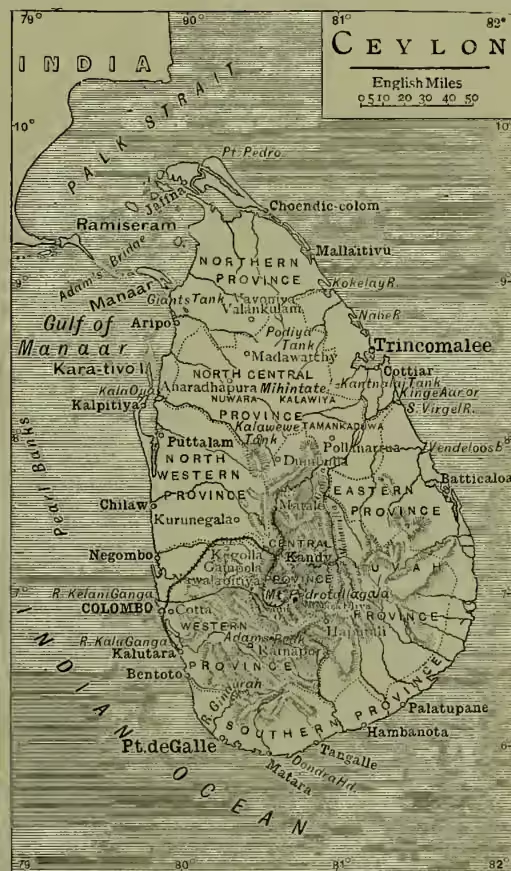
Ceylon (the Taprobane of the Greeks and Romans, and the Serendib of the Arabian Nights), an island and British crown colony in the Indian Ocean, to the south-east of India, from which it is separated by the Gulf of Mannar and Palk Strait, 32 to 120 miles broad. It lies between 5° 55' and 9° 51' N. lat., and 79° 42' and 81° 55' E. long.
Extreme length from north to south, from Point Palmyra to Dondera Head, 266 miles; greatest width, from Colombo to Sangemankande, 140 miles. Area, 24,702 sq. m., of which more than one-fifth is under cultivation.
Physical Features.—In natural scenery Ceylon can vie with any part of the world; and as it rises from the ocean, clothed with the rich luxuriance of a tropical vegetation, it seems to the voyager like some enchanted island of Eastern story. Its hills, 'draped with forests of perennial green,' tower grandly from height to height, till they are lost in clouds and mist. Near at hand, a sea of sapphire blue dashes against the battlemented rocks that occur at isolated points, and the yellow strands are shaded by groves of noble palms. In shape Ceylon resembles a pear, but its inhabitants more poetically compare it to one of their elongated pearls. Undulating plains cover about four parts of the island, and the fifth is occupied by the mountain-zone of the central south, which has an elevation of from 6000 to 8000 feet above the sea-level. Pedrotallagalla, the highest mountain in the range, attains the height of 8260 feet; the celebrated mountain of Adam's Peak, 7420 feet; and the tableland of Nuwara-Eliya, 6210 feet.
Geology.—The mountain-system is mainly composed of metamorphic rocks, chiefly gneiss, frequently broken up by intrusive granite. With the exception of some local beds of dolomitic limestone, the gneiss is everywhere the surface rock, and the soil is composed of its disintegrated materials. The northern part of the island is rising; and the immense masses of corals continually increasing, retain the debris brought from the Indian continent by the currents of the sea, and thus form a flat, ever-increasing madrepore plain.
Metals and Precious Stones.—Iron can be obtained in great quantities, and anthracite and rich veins of plumbago exist on the southern range of hills. Gold has recently been found. The gems of Ceylon have been celebrated from time immemorial. Sapphires, rubies, the oriental topaz, garnets, amethysts, cinnamon stone, and cat's-eye are the principal gems and precious stones of the island. The declared value of the precious stones exported is about £10,000 annually; but as large numbers are purchased by passengers calling at Colombo and by native merchants for sale in Southern India, the actual value is doubtless very far in excess of the sum named. The pearl-fisheries of Ceylon were known at a very remote date in the commercial history of the world. Under the Portuguese and Dutch governments, and now under the British government, the pearl-fisheries form a monopoly, and are under the inspection of an officer, who reports when a sufficient number of pearl-yielding oysters have reached maturity, and when the prospect of a successful fishing is thus probable. The fishings are intermittent and occur at irregular dates. In 1863 the value of pearls obtained was £56,000; in 1874, it was £10,000; in 1877, £19,000; in 1879-80, £29,500; in 1881, £59,800; in 1887, £39,000; and in the intermediate periods practically nothing. In 1890 the value was £17,000, in 1891 about £52,000, but in 1892-99 nothing.
Rivers.—The most important river in Ceylon is the Mahavila-ganga. It has its source in the vicinity of Adam's Peak, and after draining more than 4000 sq. m., it separates into several branches, and enters the ocean near Trincomalee. The south side of the island is watered by ten rivers of considerable size.
Harbours.—Galle, at the southern extremity of Ceylon, and Trincomalee on the eastern coast, are the only natural harbours capable of containing ships of large draught. The construction of a breakwater at Colombo, the capital of the island, which provides safe anchorage for ships of any size in all weather, has concentrated the commerce of the island there, and has also attracted from Galle the mail and passenger steamers from Europe, India, Australia, and China, which used to coal and tranship at Galle. At Trincomalee are the naval stores and dockyard, and the harbour is the finest in eastern waters.
In climate, Ceylon has a great advantage over the mainland of India, and as an island enjoys a more equable temperature. The average for the year in Colombo (q.v.) is 80° in ordinary seasons. April is the hottest month; and in May the south-west monsoon commences amid a deluge of rain, and continues the prevailing wind till October, when the north-east monsoon sets in: 80 inches is the average annual fall of rain, though in an exceptional year 120 inches have been registered. The beautiful tableland of Nuwara-Eliya was first visited by Europeans in 1826, and is now used as a sanatorium. Here the thermometer in the shade never rises above 70°, while the average is 62°; the nights are cool and refreshing. The north of the island, including the peninsula of Jaffna, the plains of Nuwara-Kalawa, and the Wanny, may be reckoned as a third climatic division. Here the annual fall of rain does not exceed 30 inches, and irrigation is largely employed in agriculture.
Flora.—The general botanical features of Ceylon are in many respects similar to those of Southern India. A very large number of the species of plants is, however, peculiar to the island. About 800 species (nearly 30 per cent. of the whole number found in Ceylon) are endemic—that is, found nowhere else in the world. The tree-vegetation of the forests is almost wholly composed of such endemic species, and not a few of endemic genera. The affinities and near alliances of these are with the plants of the Malay Islands and Peninsula. Hence, to speak more correctly, the flora of Ceylon partakes of an Indian as well as a Malayan character, but is identical with neither. As may be expected from the climatic peculiarities of the country the flora is greatly diversified. In the south-west mountainous parts of the island, with the exception of some grassy tracts called patanas and the plantations of tea, coffee, and cinchona, the slopes and summits are forest-clad. The trees are ever-green, with thick coriaceous leaves, growing closely together and forming dark jungles. The undergrowth is largely made up of gregarious plants known as Nilu, species of the genus Strobilanthes, which only flower at regular intervals of five, six, or seven years. Tree-ferns, often 25 feet in height, scarlet-flowering rhododendrons, numerous tufted bamboos, melastomads, and orchids are found in mountain forests. In the low country the vegetation is marked by the prevalence of palms, the cocoa-nut being pre-eminent. The beautiful areca-palm, the feathery jaggery or kitul, and the lordly talipat are the glories of Ceylon lowland vegetation. In the recesses of low-country forests the trees are high and closely packed. Amongst the timber-trees the most valuable are the calamander, satin-wood, and ebony. Two very interesting and peculiarly slender tree-ferns grow in the hot steamy forests of Ceylon, as also the most admired of Ceylon orchids, Dendrobium Macearthii. There has been extensive cutting down of forest in the mountains of Ceylon to establish plantations, and the low-lands have suffered no less severely by the indolent and improvident practice of native cultivation. As a consequence numerous foreign weeds, such as the lantana, white weed, and Spanish needle, have established themselves to the exclusion of native vegetation in the hills; while in the low-lands coarse grasses and worthless scrub have covered the country. The orchids of Ceylon number about 150 species. With the exception of about a dozen Dendrobiums, Erias, and Saccolabiums, and the lovely Wana-rājah, there are few of a striking character. The ferns number about 270 species. Among the latter is an anomalous variety which bears spores on the upper instead of on the under side of the frond. One of the handsomest native trees of Ceylon is the Muruta (Lagerstroemia Flos-regine). To this might be added the Saraca indica, and the lovely Na' (Mesua ferrea), or ironwood. In the forests climbing-plants and epiphytes of prodigious size and striking appearance cover the trees with a mass of parasitical foliage of extraordinary growth. In the north of Ceylon the dry forest-region is remarkable for its valuable timber-trees, such as the Palu, Halmilla or Trincomalee wood, and ebony. The characteristic palm of the north and of the peninsula of Jaffna is the Palmyra (Borassus flabelliformis).
Fauna.—In Ceylon, quadrumanous animals are represented by the Loris gracilis and five species of monkeys. Sixteen species of bats exist in Ceylon, including the flying-fox. Of the larger carnivora, the bear and leopard; and of the smaller, the palm-cat and the glossy genette (the civet of Europeans) may be mentioned. The tiger is not met with in Ceylon. Deer, buffaloes, and the humped ox of India are plentiful; the little musk-deer is less than 2 feet in length. The elephant, which is for the most part tuskless, is emphatically lord of the forests of Ceylon. The wild boar is also found. Whales are captured off the coast. Three hundred and twenty species of birds are found. The song of the robin and long-tailed thrush, and the flute-like voice of the oriole, are heard over the whole mountain-zone and far down into the neighbouring plains. Eagles, the beautiful peregrine falcon, owls, swallows, kingfishers, sun-birds, bulbuls, crows, parroquets, pigeons, pea-fowl, jungle-fowl, and many others of the feathered tribe, might be mentioned did space pennit. Myriads of aquatic birds and waders, amongst which the flamingo is conspicuous, cover the lakes and lagoons. The crocodile is the largest reptile in the island; tortoises and lizards are also found. There are a few species of venomous snakes, and of these the ticpolonga and the cobra da capello are the most deadly.
Inhabitants.—The Sinhalese (Sinhalese, also spelt Cingalese), the most numerous of the natives of Ceylon, are supposed to be the descendants of those colonists from the valley of the Ganges who first settled in the island 543 B.C., and speak an Aryan language closely allied to the Pali (q.v.). The dress of the men, who have delicate features and slender limbs, looks singularly effeminate, and consists of a comboy or waist-cloth, very much resembling a petticoat; their long hair, turned back from the forehead, is confined with combs, and earrings are worn by way of ornament. Polyandry still lingers in the interior of Ceylon; but this and many other customs repugnant to Christianity are disappearing under the influence of education, of which the Sinhalese readily avail themselves. The Kandyans, or Highlanders, are a more sturdy race, and maintained their independence for three centuries after the conquest of the low country by European settlers. The Malabars, or Tamils, have sprung from those early invaders of Ceylon who from time to time swept across from Southern Hindustan, and contended with the Sinhalese kings for the sovereignty of the island. They have formed the chief population of Jaffna for full 2000 years, and constitutionally excel the Sinhalese and Kandyans. The Moormen, who are the most energetic and intelligent of the native communities, are met with in every province as enterprising traders, and are generally believed to be of Arab descent. The 'burghers' of Ceylon are people of European descent, who have become naturalised. Those of Portuguese extraction hold the lowest place, and are mostly tradesmen and artisans; but the Dutch burghers frequently fill responsible posts, and are employed in the government offices. There is besides a remarkable tribe of outcasts—the Veddals—hardly removed from the wild animals of the forest, and believed to be descended from the Yakkhos, the aboriginal inhabitants of the country. They occupy a district in the eastern part of the island, and have there preserved their ancient customs and manner of living unaltered for more than 2000 years.
Religion.—The Sinhalese are devoted to Buddhism (q.v.), which is the prevailing religion of the island. Its sacred books are identical with those of Burma and Siam, and both record the doctrines of Gautama in the Pali language; the deviations are in matters of practice. The Malabar kings adulterated Buddhism to a considerable extent with Brahmanism, introducing the worship of Hindu deities into the Buddhist temples, and this continues more or less to be the case. More than once have the Buddhists of Ceylon sought to restore the purity of their faith—at one time sending deputies to Siam, at another to Burma, with this object in view. The Burman or Amarapura sect have long been the reformers of Sinhalese Buddhism, and maintain no very friendly relations with the party who, supported by the priests of Siam, sanction the worship of Hindu deities and the employment of the priesthood in secular occupations, uphold caste, and restrict the sacred books. Caste was acknowledged by the Sinhalese prior to the introduction of Buddhism, which in principle is opposed to it; but so firmly was it rooted that it still endures, though more as a social than a sacred institution. Gautama Buddha is said to have visited Ceylon three different times to preach his doctrine, and his Sri-pada, or sacred footstep, on the summit of Adam's Peak (q.v.), still commands the homage of the faithful. Buddhism was not, however, permanently introduced into Ceylon till 307 B.C. The influence of the priests gradually increased, and, by the piety of the Sinhalese kings, monasteries were richly endowed, and at the present day no less than one-third of the cultivated land of the island is computed to belong to the priesthood, and is exempt from taxation. The priests of Ceylon are divided into two orders; any member is at liberty to lay aside his ascetic character, and return to a secular life. The most celebrated Buddhistic relic in Ceylon is the Dalada, or sacred tooth of Gautama, at Kandy, which is guarded with jealous care, and preserved in an elegant shrine; but it is well known that the original relic was destroyed by the Portuguese, and the present substitute is a piece of discoloured ivory, bearing no resemblance to a human tooth. Brahmanism or Hinduism (see INDIA) is the faith of the Tamils or Malabars, but the Moormen are Mohammedans. After the expulsion of the Dutch Christians, Protestant missions to the natives of Ceylon were commenced by the Baptists in 1813. The Wesleyan Methodists followed in 1814, the Americans in 1816, the Church of England in 1818, and Christian instruction has made some progress amongst the native populations. Schools, collegiate institutions, and female seminaries, under the direction of the missionaries, are in successful operation; and there is a government system of education.
Ancient Buildings.—In all Buddhist countries the sacred buildings present, with certain modifica- tions, the same general character (see articles BUDDHISM, BURMA, &c.); and in Ceylon we find the three classes represented by the dagoba, or relic-shrine, the temple proper, and the vihara or monastery. The labour bestowed on these edifices in the early ages of the Sinhalese monarchy is truly astonishing. In the north of the island, ruined cities buried for ages in the depths of the forest have been discovered, revealing monuments that in dimensions may almost compare with the pyramids of Egypt. The most remarkable of these vestiges of an early civilisation is Pollanarrua, the ancient capital of Ceylon; and here is the celebrated Gal-wihara, a rock-hewn temple.
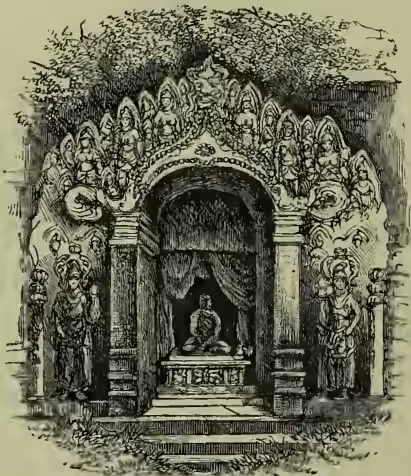
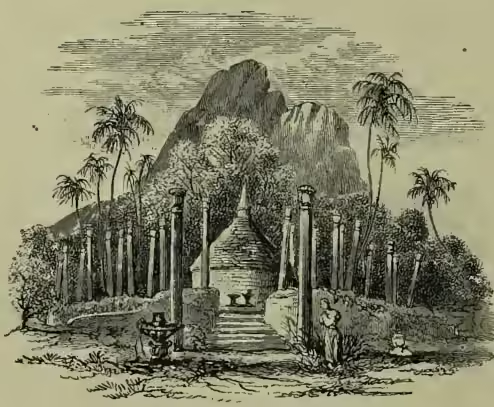
The cave-temple of Dambula was built 100 B.C., and is the most celebrated in the island. The bell-shaped tapering dagobas of Ceylon, as relic-shrines, answer to the pagodas of Burma—which they very much resemble—and the topes of Afghanistan. The ruins of the Jaytawanarama dagoba still reach the height of 249 feet; its diameter is 360 feet; and from base to pinnacle it is covered with trees of the largest size. The Ambustella of Mihintala is another remarkable dagoba. A very famous object in connection with Buddhism in Ceylon is the sacred Bo-tree (q.v.) of Anuradhapura. Amongst the antiquities of Ceylon must be mentioned those wonderful monuments of the former greatness of the Sinhalese people—the ruined tanks, with which scarcely anything of a similar kind, whether ancient or modern, can be compared. Thirty colossal reservoirs, and about 700 smaller tanks, still exist, though for the most part in ruins. The restoration of these magnificent works of irrigation has been for some time carried on by the government. In February 1888 the largest and most important tank in Ceylon, that of Kalawewa, was, after four years of labour, completely restored. It was built 460 A.D. to supply Anuradhapura with water, but has been ruinous for centuries. Now again it contains an area of seven square miles of water 20 feet deep, and supplies smaller tanks more than 50 miles distant.
The history of Ceylon may be conveniently divided into ancient and modern, and the latter into the Portuguese, Dutch, and British periods. The most famous of the Sinhalese books is the Mahāvansa, a metrical chronicle in the Pali language, extending from the earliest period to 432 A.D., and continued to 1756. The story begins with the invasion of Wijayo (543 B.C.), son of a petty Indian sovereign in the country watered by the Ganges. He subdued the Yakkhos, the aboriginal inhabitants; founded a dynasty that held undivided sovereignty in Ceylon for nearly eight centuries; and bestowed on his kingdom his patrimonial name of Sihala (whence Sinhalese, Ceylon). In the reign of King Devenipiatissa (307 B.C.), Buddhism was established as the national religion, and his reign was further remarkable by the planting of the sacred Bo-tree, 288 B.C.; and now commenced the erection of those stupendous buildings already noticed. The next important epoch in Sinhalese history is the usurpation of the Malabars (237 B.C.), foreign mercenaries from the Coromandel coast, to whom the native sovereigns had intrusted the defence of the island. In 1071 A.D. a native dynasty was re-established in the person of Wijayo Bahu, which, for 100 years, delivered the country from the dominion of the Malabars. Prakrama Balu commenced a reign in 1153, the most renowned in the records of Ceylon. He devoted himself to religion and agriculture, and besides many notable religious edifices, he caused no less than 1470 tanks to be constructed, subsequently known as the 'seas of Prakrama.' Thirty years after the death of this monarch, the Malabars landed with a large army, and speedily conquered the whole island. In 1235 a native dynasty recovered a part of the kingdom. During the reign of Dharma Prakrama IX. the Portuguese first visited Ceylon (1505); but it was in 1517 that they first formed a permanent settlement at Colombo for trading purposes. Their encroachments soon met with fierce resistance from the patriotic Kandyan. 'Amity, commerce, and religion,' was the Portuguese motto; but their rule in Ceylon is a sad story of rapacity, bigotry, and cruelty. They were at last driven from the island by the Dutch in 1658, after a contest of twenty years, when the fanatical zeal of Roman Catholic sovereigns for the propagation of the faith was replaced by the earnest toil of the Dutch traders to intrench their trading monopolies. But the purely military tenure of the Dutch was destined to give place to the colonisation of the British. It was during the great European war succeeding the French Revolution that the English gained possession of the island. On the 1st August 1795 an expedition under Colonel James Stuart landed at Trincomalee, which was speedily captured, and finally the garrison of Colombo surrendered on the 16th February 1796. By this capitulation, all the Dutch settlements and strongholds in Ceylon were ceded to the English; though the island was not formally annexed to the British crown till the Peace of Amiens, 27th March 1802. The native sovereigns, however, continued in the possession of their mountain territory; but at length the Kandyan king, Wikrama Raja Singha, after perpetrating the most frightful atrocities on his own people, seized and murdered certain native merchants, British subjects, trading to Kandy. War followed, January 1815; Kandy was taken, and the tyrant sent a captive to the fortress of Vellore. On the 2d March 1815, a treaty was concluded with the native chiefs, by which the king was formally deposed, and his territories annexed to the British crown.
After the settlement of the Kandyan provinces, attention was drawn to the hill country of Ceylon as a probable field for the profitable investment of British capital and energy, and among other agricultural enterprises the cultivation of coffee was entered upon. The condition of soil and climate proved favourable, and the abolition of slavery in the West Indies, and the consequent labour difficulties, caused a rush towards Ceylon, and the area under coffee cultivation rapidly extended. The enterprise, though subject to all the vicissitudes incidental to tropical agriculture, steadily grew, and coffee soon became the staple export from the island; and the revenue directly and indirectly derived from it enabled successive governors to bridge rivers, to make roads and railways, and to restore many of the ancient irrigation works which, in the period antecedent to British rule, had fallen into disrepair. In 1869, however, a fungus (Hemileia vastatrix) attacked the leaves of the coffee-trees, and the energy of the tree which had hitherto produced fruit was now required for the constant reproduction of leaf. Everything which practice or science could suggest was tried to mitigate or overcome the pest, but in spite of all efforts it steadily increased in virulence, and the coffee planters were obliged to turn their attention to other products of the soil.
Cinchona, cacao, cardamoms, and many other products were introduced with varying success, but it soon became plain that Ceylon was capable of becoming a great tea-producing country, and tea has become the chief factor in restoring the financial equilibrium. Cinnamon and cocoa-nut cultivation are chiefly in the hands of natives; tea, cinchona, cacao, and cardamom cultivation in the hands of Europeans; and the export table shows how, through the energy of the planters, new products have to a great extent replaced coffee.
| Coffee in cwt. | Cacao in cwt. | Tea in lb. | |
|---|---|---|---|
| 1873..... | 995,493 | ..... | .... |
| 1878..... | 620,292 | .... | 3,515 |
| 1883..... | 260,053 | 2 | 1,522,832 |
| 1887..... | 180,429 | 17,460 | 12,013,886 |
| 1893..... | 55,423 | 29,776 | 32,269,353 |
In 1898 the export of coffee had decreased to 12,871 cwt., while that of tea had increased to 122,395,517 lb. The other principal exports were cinchona, 977,760 lb., and cinnamon, 4,281,165 lb. In the same year the value of the exports to the United Kingdom was: tea, £3,694,123; plumbago, £198,833; oil, £180,402; nuts for oil, £164,469; cocoa, £138,521; and cinnamon, £62,951. Minor exports are ebony, cardamoms, areca-nuts, and dyes. The principal imports are cotton goods, salt fish, rice, coal and coke, spirits, and wines.
Ceylon is the largest and most important of what are known as the crown colonies of the British Empire. The government is administered by a governor aided by executive and legislative councils (the former consisting of five members, the latter of fifteen, partially elective), and municipal councils. Local boards and village tribunals give a measure of self-government to the people. The population of Ceylon, 2,763,984 at the censuses of 1881, had risen in 1891 to 3,008,239, of whom 2,000,000 were Singhalese, 750,000 Tamil immigrants and settlers, 200,000 Moormen (Mohammedans of Arab descent), 5500 Europeans, 20,000 Eurasian descendants of Portuguese and Dutch, 2500 Veddaids, 22,000 of mixed race.
The revenue in 1889 was 15,299,877 rupees, and exceeded the expenditure by 400,000 rupees; in 1898 the revenue had increased to 25,138,669 rupees, while the expenditure was 22,843,852 rupees, showing a larger surplus. The total imports, including specie, were valued at 97,893,058 rupees, and the total exports, including specie, at 85,372,622 rupees. There are 300 miles of railway. In 1900 many Boer prisoners were interned in the island.
See works on Ceylon by Sir James Emerson Tennent (2 vols. 1859), Captain Suckling (2 vols. 1876), John Ferguson (1887 and 1893), Miss Gordon Cumming (1891), Alan Walters (1892), H. W. Cave (1894 and 1897), and Emil Schmidt (Leip. 1897).