Chætodon, a typical genus of a family of bony fishes, known as Squamipennes. The body is much compressed sideways, and consequently high; the scales are more or less smooth, and cover portions of the dorsal and anal fins in such a fashion that the boundary between fins and body is indistinct.
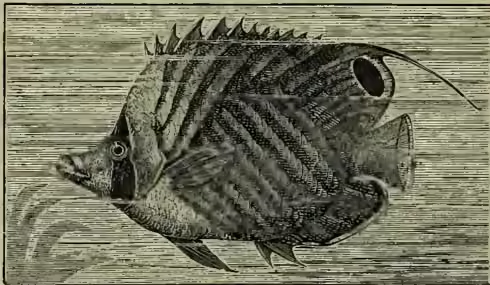
The mouth is generally small in front of the snout, and the slender teeth are arranged in bands. The lower rays of the pectoral fins are branched, and the hind fins are situated far forward on the thorax. The Squamipennes, or as some would call them, the Chætodontidae, are tropical fishes, abounding near coral reefs, and well suited in the beauty of their colouring to such brilliant surroundings. They feed on small animals, are never very large, and but little used for food. Chætodon itself is a large genus, with some 70 beautiful species from the tropical Atlantic and Indo-Pacific. It has one dorsal fin, and a moderately long snout. In Chelmo the snout is longer, and is used to draw animals from their crevices. It often gets false credit for catching insects by spouting water. Heniochus is another pretty genus with horns on its head. Holacanthus, one species of which is called the 'Emperor of Japan' by the Dutch, is yet more brilliantly adorned, and Pomacanthus is peculiarly variable in its colouring. The Atlantic species of Ephippus (E. faber) is peculiar in the pathological-like enlargement of some of the bones at the back of the head. The Archer-fish (q.v.) is an allied genus. See Günther, Study of Fishes (1880).