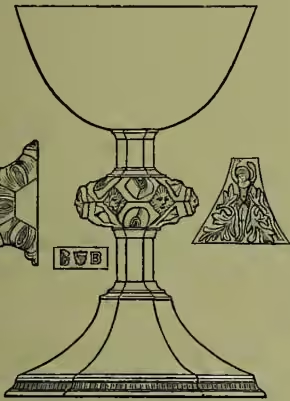
(From Cripps's Old English Plate.)
Chalk, a soft earthy variety of limestone or carbonate of lime, forming great strata, and claiming the attention of the geologist even more than of the mineralogist (see CRETACEOUS SYSTEM). It is generally of a yellowish-white colour, but sometimes snow-white. It is easily broken, and has an earthy fracture, is rough and very meagre to the touch, and adheres slightly to the tongue. It generally contains a little silica, alumina, or magnesia, sometimes all of these. Although often very soft and earthy, it is sometimes so compact that it can be used as a building-stone; and it is used for this purpose either in a rough state, or sawn into blocks of proper shape and size. It is burned into quicklime, and nearly all the houses in London are cemented with mortar so procured. The siliceous particles being separated by pounding and diffusing in water, it becomes whiting, of which the domestic uses are familiar to every one. Carpenters and others use it for making marks, which are easily effaced: the blackboard and piece of chalk are now common equally in the lecture-rooms of universities and in the humblest village-schools. Chalk, per- fectly purified, is mixed with vegetable colouring matters, such as turmeric, litmus, saffron, and sap-green, to form pastel colours or coloured chalks; but vegetable colours which contain an acid are changed by it (see CRAYON). The Vienna white of artists is simply purified chalk. In a perfectly purified state it is administered as a medicine to correct acidity in the stomach. Chalk is also extensively used as a manure. See LIME, MANURE.
BLACK CHALK is a mineral quite different from common chalk, and apparently receives its name from resembling it in meagreness to the touch, in soiling the fingers, and in being used for drawing, writing, &c. It is also called Drawing-slate. It is of a slaty structure, of a bluish or grayish-black colour, easily cut and broken, and makes a perfectly black mark on paper. It is used for drawing and as a black colour in painting. It becomes red by exposure to heat. It is essentially a kind of Clay (q.v.), and derives its colour from carbon, which it contains. It is found associated with schists, &c. in Spain, France, Italy, &c., also in the coal formation in Scotland.—BRIANÇON CHALK and FRENCH CHALK are popular names for Soapstone (q.v.).—RED CHALK is ochry red clay-iron ore, consisting of clay and much peroxide of iron. It is of a brownish-red colour, and a somewhat slaty structure, the cross fracture earthy. The coarser varieties are used chiefly by carpenters for making marks on wood; the finer, by painters. It occurs in thin beds in clay-slate and graywacke-slate in some parts of Germany.