Chamæleon (Gr. chamaileôn, 'ground lion'), a large genus of lizards, forming a very distinct family. Among the most distinctive features may be noted the soft tuberculated skin, with its power of changing colour; the coiled tail, adapted for curling round the branches of trees; the division of the toes of fore and hind feet into two bundles; the absence of an external ear-drum or tympanic membrane; the long worm-like insect-catching tongue, capable of extremely rapid protrusion. Even more remarkably distinctive, however, are certain peculiarities in the skeleton, and especially in the skull, which separate the chamæleons from all other lizards.
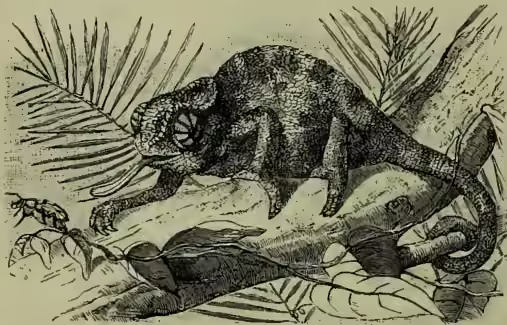
Description.—The body is flattened, and bears a toothed crest of skin along the back. The head is triangular, surmounted by a ridge. The animal stands unusually high upon its legs. The fore-feet are divided into three united internal digits and two external; the reverse (and the digits, corresponding to our great and second toes, form one bundle, and the other three—external—another united group) occurs in the hind-feet. The digits are tipped by long sharp claws. The long compressed tail is curled ventralwards. The mouth-aperture is small, but the tongue extremely long. It is the most active part of the animal, is cup-shaped at the end, covered with a viscid secretion, and very efficient in insect-catching. The large lateral eyes, with circular lids leaving only a small aperture, are very active, and can be rapidly turned in all directions, a possibility which to some extent compensates for the stiffness of the head. The skin is soft, loose, and shagreen-like, the scales being very small. The glandular pores common on the thighs and near the anus of lizards are absent.
Among the internal peculiarities may be noted the largeness of the lungs, which admit of being greatly distended, so as to puff out the body into marked plumpness. They appear to be connected with surrounding air-spaces. The habit the chamæleon has of thus blowing itself out, taken along with its power of fasting, gave origin to the ancient supposition that it fed on air. The skeletal peculiarities are numerous. The chamæleons differ from all lizards except the Amphibœnas (q.v.), in having no 'columella' or epipterygoid skull-bone, and no interorbital septum, and from all other forms in the fact that the pterygoid and quadrate bones are not united. The latter is firmly fused to the skull, and the parietals are also peculiar in their firm attachments. The teeth are confined to a ridge along the summit of the jaws. The vertebrae are hollow in front; the breastbone is small, and only a few anterior ribs reach it; as in the geckos, many of the posterior ribs are united ventrally by hoops across the abdomen; there are no clavicles; the scapula and coracoid of the shoulder-girdle and the ilia of the hip-girdle are peculiarly long and narrow.
Life and Habit.—Except as regards tongue and eyes, the chamæleons are very sluggish. They are strictly arboreal lizards, moving very slowly, in perfect silence, and waiting rather than hunting for their insect prey. At a distance of several inches, about half as long as the body in some cases, they can most unerringly catch the unconscious insect. Probably the most familiar fact about chamæleons is their power of changing colour. Under the thin outer skin there are two layers of pigment-containing cells, the outer bright yellow, the inner brown to black. Under nerve control the disposition and expansion of the pigment-containing cells vary, and this produces change of colour. The change depends much more on internal emotions, expressing themselves in nervous stimulus and inhibition, than on external physical influences. The change appears to be rather emotional than protective. Most chamæleons are oviparous, and lay 30 to 40 thin-shelled eggs, which are deposited in an excavated hollow and covered over with earth and leaves. Moseley has described a South African species which brings forth its young alive.
Species and Distribution.—The genus Chamæleo is a large one, and some naturalists split it up. Chamæleons are especially at home in the Ethiopian region, but may occur beyond its limits. The commonest of the numerous species is C. vulgaris, which is abundant in Africa, and is also found in South Europe (Andalusia). The predominant colour varies in different species. Many males are adorned with horns on the head. One form, distinguished as a distinct genus (Rhampholeon), has a tail too short for clasping purposes, but this loss is made up for by accessory structures on the feet. The chamæleon was well described by Aristotle, but in later days became the subject of numerous ridiculous fables. It was also in repute for supposed medicinal virtues. See LIZARD; Huxley's Anatomy of the Vertebrates; St George Mivart in Nature, vol. xxiv.; Krukenberg's Vergleichend-Physiol. Studien, i. 3 (1880), for colour change.