Chara. The Characeæ or Stoneworts are a small group of common aquatic plants found growing in large tufts, or even covering large expanses on the bottoms of fresh-water ponds and shallow lakes, brackish or even salt-water lagoons, &c., and of which the systematic position has undergone the most extraordinary and instructive vicissitudes. The early botanists, with K. Banhin, had no hesitation in describing them as horsetails (Equisetum). In 1719 Vaillant proposed for them a separate genus (Chara), while Linnæus, although at first disposed to regard them as Algae, as their habitat suggests, decided that the small red male reproductive body must be a stamen, and the larger green female one a pistil, and accordingly placed them as flowering plants among the Monocotyledonæ. His pupils at most ventured to remove these to the Monandria Monogynia, while De Jussieu regarded them as a genus of Naiadaceæ (q.v.), an order of monocotyledonous aquatics with much reduced flowers. In similar opinions he was followed by De Candolle and other eminent systematists: and it was not until 1851 that a careful re-examination of their structure and mode of reproduction by Thuret finally disproved the phanerogamous view, and established their cryptogamic nature. Since that time the group has attracted great attention, and is now on grounds of peculiar instructiveness, both morphological and physiological, one of the classical forms usually presented to the beginner, not only in cryptogamic botany, but general biology.
Commencing with the vegetative system, we find this apparently consisting of a stem with regular whorls of leaves arising at definite points (nodes) of the stem. The internodes, or distances between these, are at first considerable; but as we approach the apex these are shorter and shorter, and at length we lose sight of them in the crowded terminal bud. The resemblance to a young shoot of Equisetum is so far satisfactory, and the mineral incrustation (in some species so abundant as to lead to the substitution of the plant for scouring metal) appears to confirm this. The incrustation, however, is calcareous, not siliceous. Even under microscopic examination we may at first sympathise with the old observers, and seem to see in the stem a multicellular structure, even a cortex; nay, to see under our very eyes the actual circulation of the sap. More careful scrutiny, however, enables us to repeat the work of later and more accurate observers. We see that this movement is not the circulation of the sap in a stem, but a streaming of the protoplasm within what is simply a single enormous cell stretching from one node to the next (see CELL). The apparent cortex is a single layer of cells covering this internodal cell; and the whole vegetative structure is marvelled when we roughly dissect out the terminal bud, harden, stain and imbed this in paraffin, and thus cut a fine longitudinal section (fig. 2).
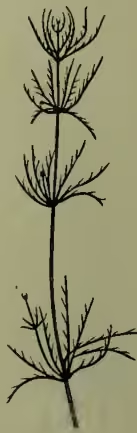
Shoot of Chara.
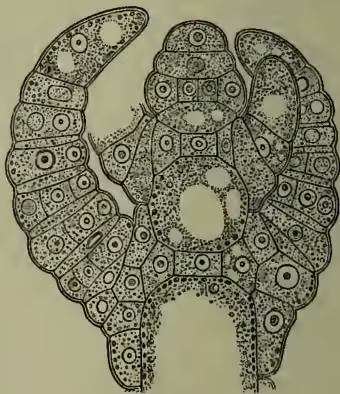
An apical cell is seen which continually segments off a lower one; this divides (still transversely to the axis) into two new ones; and the lower of these henceforth steadily lengthens as the internodal cell, while the upper undergoes repeated division, until a plate of nodal cells is formed. In the simpler family (Nitella) the internode thus consists of a single naked cell: in the higher (Chara), this is inclosed by the so-called cortex, a layer of smaller cells proceeding from those of the upper and lower nodes; and itself showing a minor nodal and internodal arrangement. In all cases, from the nodal cells there divide off, parallel to the outer surface of the stem, a new set of apical cells, which proceed, like the parent one, to form the 'leaves,' reproducing, that is to say, the stem structure, until they lose the power of division, and end in a single enlarged vegetative cell. A branch may arise from a new formed apical cell cut off in the axil of the oldest leaf of any whorl, while the so-called roots, which fix the plant in the mud, are simply unicellular hairs, lengthenings produced from the superficial cells of buried nodes.
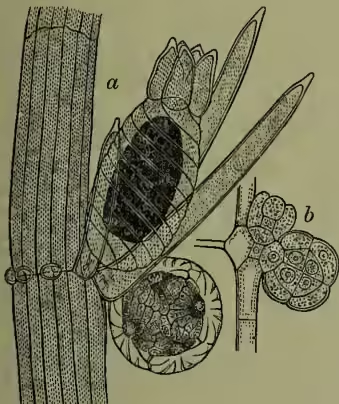
The apparently very complex and characteristic reproductive organs arise also at the nodes of the stem or leaves, in positions and numbers varying with the species. Commencing with the female (fig. 3a), which arises in the position of a branch, we find this to be obviously a shortened and modified one. Its apical cell forms only an internode and node, then ceases division, and becomes enlarged and filled with a store of starch and other reserve material to form an egg-cell; while the cover or archegonium enclosing this is readily seen to be a mere modification of the familiar cortex. In the male apparatus, or anther- idium, the branch structure is further modified: its apical cell similarly remains all but sessile, forming only a short node and internode; but segmentation now begins, thus recalling the behaviour of a nodal cell—with which, in having below it an internodal, and not as in the case of the egg-cell, a nodal cell (fig. 3b), it so far corresponds. Eight quadrant-like cells are formed, but these now segment off new cells in the interior of the spherical mass, and in the growth and development of these the nodal and internodal alternation of ordinary vegetative growth can still be traced. Soon, however, a number of long segmented filaments are developed, and the protoplasm of these undergoes rejuvenescence, and becomes modified into a ciliated spermatozoid. When the reproductive organs are ripe, this archegonium is easily broken, and its filaments spread free in the water; the spermatozoids escape in a myriad, and some reach the egg-cell of the archegonium by means of a small opening, which is left by the all but incomplete upgrowth of the cortical cells which form the wall of the archegonium. After a period of rest, the fertilised ovum germinates, producing, however, not directly a new Chara plant, but a simple filament of cells called a pro-embryo, of which one cell segments into a node, and the oldest cell of this becomes the growing point of the new plant.
The affinities and systematic position of the group thus still afford ground for discussion, although now within narrower limits than formerly; some systematists regarding them as a somewhat aberrant group of Algae, while others insist on their resemblance to the archegoniate cryptogams (see VEGETABLE KINGDOM). The fruits of what seem to have been gigantic Characeae (Spirangium) occur from the Carboniferous to the Wealden, and ordinary Characeae are abundant in the Tertiary strata. See Howes' Biological Atlas, and Sachs' Botany.