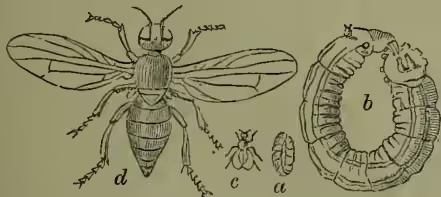
Cheese-hopper, the larva of Piophila casci, a small dipterous (two-winged) fly, of the large family Muscidae, to which the house-fly, blow-fly, &c. belong. The perfect insect is about a line and a half in length, mostly of a shining black colour; antennæ, forehead, and some parts of the legs reddish. It is a pest of dairies and store-closets, laying its eggs in cracks or crevices of cheese, the destined food of its numerous, active, and voracious larvæ. To preserve cheeses from this pest, it is of advantage to brush or rub them frequently, and to remove all cracked or injured cheeses from large stores, besides keeping them dry and in a well-aired place. The same rules are applicable in regard to the other insect larvæ by which cheeses are some- times infested. Of these the most notable are the larvæ of the Bacon Beetle (see DERMESTES), and of another species of dipterous fly, Musca corvina.