Cherry (Cerasus), a sub-genus of Prunus (see PLUM), of which the species and their cultivated varieties yield the familiar stone-fruit of the same name. The most obvious distinction between the cherries and the plums or section Prunus proper is that in the former the leaves are conduplicate, in the latter convolute in bud (see CULTIVATION).
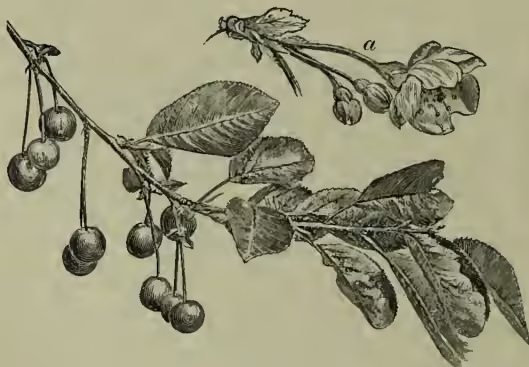
a, blossom.
Two species are chiefly regarded as the parents of the garden cherries usually cultivated, P. Avium and P. Cerasus, the former attaining a height of 40 or 50 feet, and having its leaves and peduncles drooping, with small austere fruit; the latter having erect smooth shining leaves and a more juicy fruit, but being a much smaller tree. Both have white flowers in clusters or nearly sessile umbels, and both are generally regarded as natives of middle and southern Europe, if not also of Britain, where they are both at any rate also naturalised. According to the usual reading of Pliny, P. Cerasus was, however, introduced by
Lucullus from Cerasus in Pontus to grace his triumph after his victory over Mithridates; Belon, however, plausibly identified this as his own cherry-lanrel (see LAUREL). In the wild state, both are often called gean (Fr. guigne); more accurately, however, this is P. Avium. The latter is frequently planted, not only because it is exceedingly ornamental when in flower, but also on account of its value as a timber-tree, being of rapid growth, with firm strong close-grained wood, suitable for the purposes of cabinet-makers, turners, and musical instrument makers. Double varieties of both species are also grown in our shrubberies. The cultivated varieties of the cherry are very numerous, and differ considerably in size, colour, and flavour; opinions hence differ seriously as to their parentage. The fruit is largely eaten fresh, and as an ingredient in preserves, &c.; the woodcutters and charcoal-burners in some parts of France make it a principal ingredient in soups. Besides its use for the dessert and for preserves, the cherry is extensively used for making liqueurs (see KIRSCHWASSER and MARASCHINO). Cherry Brandy is a liqueur made by steeping Morello cherries in brandy; whereas kirschwasser is a spirit distilled from cherries. In some parts of Germany the roads are fringed by avenues of cherry-trees; and the cherry ripens in Norway and East Bothnia as far north as 63° lat. The other species of cherry are numerous. Some species are low or even prostrate shrubs, as P. chamaecerasus, the Ground Cherry of the south of Europe and of Siberia; and P. pumila, the Sand Cherry of North America. The name cherry is also shared by the closely allied Bird-cherry (q.v.) and Choke Cherry (q.v.), including the American Wild Cherry, famous for its medicinal bark; the Mahaleb (P. Mahaleb) of the south of Europe, famous for the fragrance of its flowers, and grown in pots to make symmetrical pipe-stems; the Capollim (C. or P. capollim) of Mexico and Peru, famed for the fragrance of its fruit; and the Laurel-cherry (q.v.). The name cherry is also vaguely and popularly applied in different countries to plants of any kind which happen to recall the true cherry, especially by the size, colour, or taste of their fruit; among these, see BARBADOES CHERRY, WINTER CHERRY, &c. Thus the 'Native Cherry' of Australia is the fleshy fruit-stalk of Exocarpus cupressiformis (Santalaceæ), while the Hottentot Cherry is Ilex (Cassinæ) Macrocentra. The 'Beech Cherry' or 'Brush Cherry' of Australia is Trochocarpa laurina (Epacridaceæ), and so on.