Chess (Fr. échecs; Ital. scacchi; Ger. schach; Dutch schak; Low Lat. ludus scaccorum. Originally from Persian sháh, 'a king,' thus literally 'the game of kings'), a game of skill for two players or parties, played with figures or 'pieces,' which are moved on a chequered board. The game has acquired a great and unique importance throughout the world; mainly, no doubt, in consequence of its extreme difficulty. It is the subject of a most extensive literature, and its study has become rather that of a science than a recreation. The laws governing its play are identical in all countries.
History.—The origin of chess is the subject of an almost hopeless controversy. It has been claimed, by writers and by legends, for China, India, Persia, and recently with some show of reason, by a Spanish archaeologist, for Egypt. As a matter of fact, traces of the game extend beyond history, and are found among races so widely different that any scientific investigation of the matter may now be considered impossible. The game was probably introduced into Western Europe by the Arabs, or about the time of the Arab invasion (8th century); at all events it was known among the cultured classes before the Crusades (1095). As then played, it differed somewhat from modern chess and from the game as played in the East. One of the earliest references to it in literature is in a work, written about 1300, by Jacobus de Cessolis, a preaching friar, and entitled Liber de moribus hominum et officiis nobilium super ludo Scaccorum. This work seems to have found its way into several European countries, MS. copies of it existing in various languages. An English translation from the French was printed by William Caxton in 1474-75 under the title of The Game and Playe of the Chesse, and was the first book printed with metal types in England. Modern chess—i.e. the game as now played, dates from about the middle of the 15th century. A MS. discovered in the university library of Göttingen and dated 1490 is the earliest treatise extant, although frequent mention of chess is made by earlier poets and writers. The game found its first home in Spain, where Vicent (1495) and Lucena (1497) published two volumes, now of little value, of games. They were succeeded in 1510 by Damiano, a Portuguese, whose work, though restricted to a few openings, evinces considerable genius. It was plagiarised most unscrupulously by several later writers. Damiano was followed by Ruy Lopez, a cleric of Safra in Estremadura, who is perhaps the most valuable of the earlier masters. His work, first published at Alcala in 1561, may be said to have laid the foundation of the modern theory of play, and the opening which bears his name is that which modern analysis has shown to be one of the soundest yet invented. Lopez's treatise was republished in Venice in 1584, and from this date the game seems to have left Spain to find a home in Italy. Here should be mentioned Paolo Boi, a native of Syracuse, who, finding no worthy opponent in his own country, made a lengthened tour through the then most civilised part of Europe. He encountered and defeated every master of the game, including the hitherto invincible Ruy Lopez. His genius, added to a prepossessing appearance and a courteous demeanour, gained for him general admiration; he was patronised by Catharine de' Medici and by Sebastian, king of Portugal, both of whom conferred high favours upon him. The early Italian school, which extended from about 1550 to 1620, is identified with the names of Polerio (1590) and his followers, Salvio, Greco, and others. It may claim to be the most versatile and prolific yet founded, some of the most brilliant openings having come down to us from it. At its close, about the time of the Thirty Years' War, the study of chess was somewhat neglected, and there are no writers of note until the middle of the 18th century. At this time, however, two powerful, and to some extent rival, schools sprang up—the later Italian, led by Ercole del Rio and his commentators, Lolli and Ponziani, and the Northern school of Philidor. The former still confined itself to the study of openings and end-games; the latter turned its attention more to the middle game, advocating what is now known as 'play for position.' Both schools, though opposed in theory, were of the greatest practical benefit to students; their work was in a great measure combined by Allgaier, of Eltern, in his well-known treatise published at Vienna in 1795.
Begun in 1745 by Stamma, a Syrian, and led so powerfully by Philidor, the English school had, during this period, been steadily gaining strength and importance. Writers like Sarratt, Cochrane, Lewis, and Walker were doing their best to popularise the game, and they succeeded in giving it a footing in Britain which it has never since lost. Throughout northern Europe its study became general; in France, though there were few analytical writers—Alexandre being the only one of importance—such players as Deschappelles, Boncourt, and De la Bourdonnais earned for the Parisian school a very high reputation; the last-named player was by far the strongest of his day. In Germany, then as now, chief attention was given to theory; there were no very brilliant players, but the analytical work of Bilguer and Von der Lasa still remains the standard. England, however, continued to maintain its supremacy. Some of the greatest European players crossed the Channel and settled in London, and Howard Staunton, who defeated the French champion, St Amant, came to be regarded as the leading player in the world. Up to this time America had produced no player of more than local eminence; but at the congress held at New York in 1858, the first prize in the chief tourney was won by a youth of twenty-one, Paul Morphy (1837-84), of New Orleans. This player, who from the age of ten had shown a remarkable aptitude for the game, is admitted to be the greatest chess genius that has yet appeared. After his victory in New York he came over to Europe, meeting and defeating in turn the strongest players of London and Paris. It must always be a source of regret that the world so soon lost his wonderful power. After his visit to Europe he abandoned the game in order to follow his profession, that of advocate. He only partially recovered from an attack of insanity, and died at the age of forty-seven. From this time the history of chess ceases to be that of a few celebrated players, and must be gathered from the magazines and weekly newspaper columns devoted to it in nearly every civilised country. Public interest in it has of late years increased with great rapidity, keeping pace, it would seem, with the progress of intellectual development. In England, where at one time or other nearly every great modern player has resided, the game has attained a dignity and importance altogether beyond that of a mere pastime, and its recognition by the state as a means of mental training has been seriously demanded. Every town and many villages have at least one club—London having upwards of twenty; and such centres as Dublin, Glasgow, Liverpool, and Manchester, five or six. There are also numerous county and district associations, holding periodical meetings in different towns in their provinces, and offering prizes for competition among their members. The British Chess Association, the most important federation of this kind, may fairly claim to represent national chess. Having its administrative centre in London, it is governed by a committee of the most eminent players throughout the kingdom, and its masters' tournaments attract the strongest players from the Continent and America. In Germany, where almost equal enthusiasm for chess prevails, every town has its club; there are many state and class associations; national tournaments are held at least once every year, and international tournaments in turn with other countries. One significant association is that of the university and college chess clubs, which, supported by many of the professors and more advanced students, are already beginning to compete with the lay clubs in their respective cities. In France there are yet few provincial clubs, though their number is now increasing. Paris is the centre of a very strong circle of players, and in the Café de la Régence possesses the most celebrated chess resort in Europe. The French government has shown its regard for the game by providing prizes in more than one national tournament. Among other European countries where chess is studied, must be mentioned Austria and Italy. Of the former it is sufficient to say that the metropolitan club can produce ten players (the ordinary match team) who could probably defeat the same number from any club in the world. In Italy the game is played in every town, and the Italian Chess Association holds an annual tournament. In the New World, the United States of America is, as may be supposed, in advance of all other countries. Besides numerous city clubs (New York alone having nine), there are six state associations, and a recently organised federation of the university clubs. In Canada the game has gained entrance into the public schools; there are clubs in nearly every town, and a national association. In Australasia there are state associations in Victoria, New South Wales, and New Zealand. A national tournament has been held with great success, and it is probable will now take place annually in one or other of the chief cities.
Description.—THE BOARD.—Chess is played on a square board divided by intersecting lines into 64 squares. To facilitate calculation, every alternate square is black, or of a dark colour. The board should be placed so that each player has a white square at his right-hand corner.
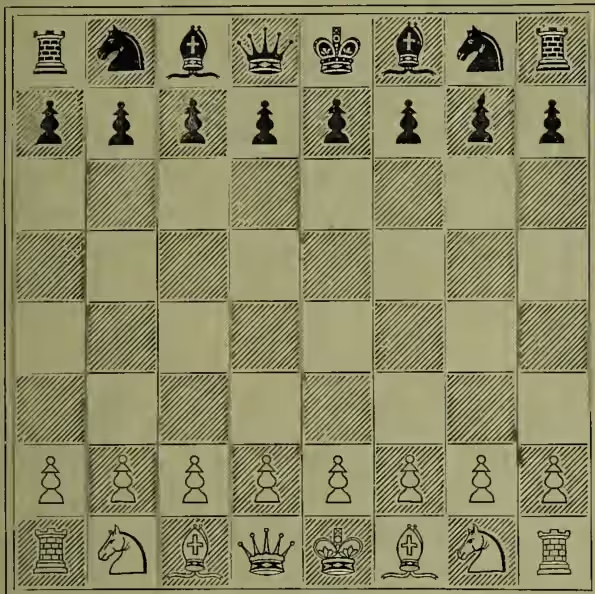
THE MEN.—There are 32 men: 16 white, or of light colour, and 16 black, or of dark colour. Each player has 8 pieces (one king, one queen, two rooks or castles, two bishops, and two knights) and 8 pawns. The following diagram represents the board and men properly arranged for play :
BLACK.
WHITE.
Fig. 1.
(N.B.—The king and queen occupy the two middle squares, the queen being on the square of her own colour.)

The King, = K, moves only one square at a time, but in any direction.

The Queen, = Q, may move any number of squares in any direction in a straight line.

The Rook or Castle, = R, may move any number of squares, but only in a direction parallel to the sides of the board—not diagonally.

The Bishop, = B, may move any number of squares in a straight line diagonally. (It will be seen that each bishop remains throughout the game on squares of one colour.)

The Knight, = Kt (or sometimes in American literature, S, from the German Springer), moves to the next square but one of a different colour from that on which it rests. Its move forms the diagonal of a parallelogram of three squares by two. (The knight is the only piece having power to move over an intervening piece.)

The Pawn, = P, moves one square forward only, but captures diagonally. For its first move, but not afterwards, a pawn may move two squares, but if in doing so it pass an opposing pawn, the latter may take it as if it had moved one square only. A pawn which succeeds in crossing the board must be exchanged for a queen or any other piece of the same colour, except a king.
All pieces, except the knight, can move only across unoccupied squares, and all pieces (not the pawns) capture in the direction of their moves.
The object of the game is to take the opponent's king, and when the king is attacked, warning must be given by the call of 'check.' If the king cannot avoid the 'check'—that is, if he cannot escape capture by his opponent's next move, he is 'check-mate,' and the game is over. The game therefore always stops one move short of the actual capture of the king.
Laws.—Although the main rules governing chess play are identical throughout the world, there are several minor questions awaiting a general settlement. A complete code of laws (which would necessarily be complex), published with approval and authority of the various national associations, has become almost a necessity. Where no published code has been fixed upon, the following may be enforced without injustice:
(N.B.—In cases where no distinction is implied, the word 'piece' is to be understood to include piece and pawn.)
Lots to be drawn for first move, and afterwards throughout a match or sitting each player has the first move alternately, whatever has been the result of the previous game. The player having first move has a right to choice of men. If board or pieces have been wrongly placed at the beginning of a game, the mistake may be rectified before four moves have been made, but not after. A piece touched must be moved, if it can be legally, or unless, before touching it, the player say j'adoue, or words to that effect. (If the piece cannot be legally moved, the king must be moved, but may not castle.) If more than one piece be touched, the adversary may select which is to be moved. An enemy's piece touched must be taken if it can be legally; if not, the king must be moved, but may not castle. Moving the king is a penalty enforceable by the opponent, who must, however, enforce it before he makes his next move. A false or illegal move, and all moves made subsequently, must be revoked, and legal moves made in their stead. No penalty can be enforced if the opponent has made a move or touched a piece in reply. If a player move out of his turn, he must retract the move, but may be called upon by the opponent to play the piece touched on his next move. If a player touch more than one square with a piece, he may not, for that move, play it to any of the squares so touched. If he touch all the squares to which it can be played, he must play it to any one of them his opponent chooses. In castling, the king must be moved first, or both pieces together. A pawn advanced to the eighth square must be exchanged for a piece (not a king) of the same colour, and the move is not complete until a piece is demanded. It is not necessary to call 'check,' but the player neglecting to do so, cannot enforce a penalty if his opponent does not notice the 'check.' A player may at any time call upon his adversary to mate him within fifty moves, and if at the expiration of such fifty moves, no capture has been made, no pawn moved nor mate given, a draw may be claimed. Bystanders may not interfere unless appealed to by a player, unless board or men have been wrongly placed, or unless a false or illegal move has been made. In the last case, however, they have no right to interfere until a move has been made in reply.
Notation.—The necessity for some method of recording moves and games of chess has been recognised from a very early period. It is to be regretted that no universal notation has been adopted; as it is, the systems which are in vogue are all more or less dependent upon the language of the nation using them. The modern systems of notation are separable into two classes, which differ essentially: The first, that adopted by English and Latin speaking countries (France, Italy, &c.), has reference to the pieces. It is somewhat cumbrous, but is more descriptive and intelligible. The second, adopted by Germany and northern Europe, has reference mainly to the board. It is more concise and exact than the first class.
The following diagram will explain the English or Latin system of notation :
| BLACK. | |||||||||||
|---|---|---|---|---|---|---|---|---|---|---|---|
| ·bs | bs | ·bs | ·bs | ·bs | ·bs | ·bs | ·bs | ·bs | ·bs | ·bs | |
| Q R 8 | Q Kt 8 | Q B 8 | Q 8 | K 8 | K B 8 | K Kt 8 | K R 8 | ||||
| z | z | z | z | z | z | z | z | z | z | z | |
| Q R 7 | Q Kt 7 | Q B 7 | Q 7 | K 7 | K B 7 | K Kt 7 | K R 7 | ||||
| z | z | z | z | z | z | z | z | z | z | z | |
| Q R 6 | Q Kt 6 | Q B 6 | Q 6 | K 6 | K B 6 | K Kt 6 | K R 6 | ||||
| z | z | z | z | z | z | z | z | z | z | z | |
| Q R 5 | Q Kt 5 | Q B 5 | Q 5 | K 5 | K B 5 | K Kt 5 | K R 5 | ||||
| z | z | z | z | z | z | z | z | z | z | z | |
| Q R 4 | Q Kt 4 | Q B 4 | Q 4 | K 4 | K B 4 | K Kt 4 | K R 4 | ||||
| z | z | z | z | z | z | z | z | z | z | z | |
| Q R 3 | Q Kt 3 | Q B 3 | Q 3 | K 3 | K B 3 | K Kt 3 | K R 3 | ||||
| z | z | z | z | z | z | z | z | z | z | z | |
| Q R 2 | Q Kt 2 | Q B 2 | Q 2 | K 2 | K B 2 | K Kt 2 | K R 2 | ||||
| z | z | z | z | z | z | z | z | z | z | z | |
| Q R sq. | Q Ktsq. | Q Bsq. | Q sq. | K sq. | K Bsq. | K Ktsq. | K Rsq. | ||||
WHITE.
Fig. 2.
The squares on the first rank are named after the pieces which occupy them at the beginning of the game ; thus (beginning at the left hand) the first square is called the queen's rook's square = Q R sq., since it is occupied by the queen's rook. The second square is called queen's knight's square = Q Kt sq.; the third, queen's bishop's square = Q B sq.; the fourth, queen's square = Q sq., and so on. The squares on the first rank are called home squares. The files are numbered according to their distance from the home square, and take the latter's title. Thus the squares in front of the king's square are called king's second or K 2, king's third = K 3, and so on to K 8. Each player numbers the squares from his own side of the board, so that each square has two names (White K B square is Black K B 8, Black Q R 4 = White Q R 5, &c.). A reference to the diagram will make this clear.
In recording a game, the moves of White and Black pieces are each arranged in column, the name of the piece is then given, and the square is indicated to which it moves—e.g. :
| White. | Black. |
| 1. P to K 4. | 1. P to K 4. |
| 2. Kt to K B 3. | 2. Kt to Q B 3. |
| 3. B to B 4. | 3. B to B 4. |
| 4. B takes P (ch.). | 4. K takes B. |
Here the figures give the number of the move, and 1 P to K 4 signifies that White for his first move plays a pawn to the king's fourth square. It is not necessary to say which pawn, since only one—i.e. the king's pawn—can be moved to the king's fourth square. Black then has to play, and makes a similar move, counting from his side of the board. For his second move, White plays his knight to king's bishop's third square, and again it is not necessary to say which knight, since only the king's knight can move to K B 3. Black's second move is his queen's knight to queen's bishop's third square. White's third move is king's bishop to queen's bishop's fourth square. The student should follow these moves with a board and men, and will see then that White can only move one of his bishops—i.e. the king's bishop—and can only move it to one bishop's fourth square—i.e. queen's bishop's fourth. (The queen's bishop cannot of course move at all, until released by the move of either the queen's pawn or queen's knight's pawn.) Black's third move requires no further explanation. White's fourth move, 4 B takes P (ch.), means that his bishop captures one of the enemy's pawns and gives check. It is not necessary to say which pawn, since only one can be captured—i.e. Black's king's bishop's pawn. For his fourth move, Black has little choice; he must avoid the threat of capture, and he does so by taking the checking piece—i.e. king takes bishop.
The English notation is shortened in some cases as follows, the same moves being recorded in each case :
| (a) White. | Black. |
| 1. P - K 4. | 1. P - K 4. |
| 2. Kt - K B 3. | 2. Kt - Q B 3. |
| 3. B - B 4. | 3. B - B 4. |
| 4. B × P (ch.). | 4. K × B. |
Here the dash - signifies 'to,' and × signifies 'takes.' The numbers of Black's moves are omitted, since they correspond with those of White. (b) In some cases the dash is omitted, and the moves recorded simply P K 4, Kt K B 3, B B 4, &c. (c) The moves are arranged in line, White's move being first, thus : 1 P to K 4, P to K 4, 2 Kt to K B 3, Kt to Q B 3, 3 B to B 4, B to B 4, 4 B takes P (ch.), K takes B. (d) The moves are written in the form of a fraction, White's move being the numerator, and Black's the denominator, and the number of the move is denoted by a figure prefixed—e.g.: 1. ; 2. ; 3. ; 4. .
We give a diagram of the board after the above moves have been played :
Fig. 3.—Position after Black's Fourth Move.
The German notation (known sometimes as Philidor's, from having been used in that master's treatises on chess) consists in denoting the ranks of squares by a figure, and the files by a letter, in accordance with fig. 4 :
Fig. 4.
Thus, referring to the English system, the White king's square is denoted by c 1, the Black queen's square by d 8. In the German system all the squares are counted from White's side only. To denote a move, the first letter of the piece is given, then the square on which it stands, and lastly, the square to which it moves. The moves of pawns are not preceded by any initial letter. A capture is denoted by a colon placed after the move, check is represented by , or a check and capture by . Casting on the king's side is denoted by O - O, and on the queen's side by O - O - O. Taking the same moves as before, the game would be recorded therefore as follows :
White.
- 1. e 2 - e 4.
- 2. Kt g 1 - f 3.
- 3. B f 1 - c 4.
- 4. B c 4 - f 7 \ddagger.
Black.
- 1. c 7 - c 5.
- 2. Kt b 8 - c 6.
- 3. B f 8 - c 5.
- 4. K c 8 - f 7 :
This system may be and is in some cases still further abbreviated by the omission (a) of the initial letters of the pieces, or (b) of the square from which the piece moves ; and the moves may also be written in line or fractionally as in the Latin system.
TECHNICAL TERMS.—The following list is not exhaustive, only the terms in general use being given :
Blindfold Chess, or Chess sans voir, the game played mentally, without sight of board or men. This almost inexplicable feat is not altogether one of memory, as is generally supposed ; it is rather the result of a special faculty not necessarily corresponding with that for ordinary chess. Some great masters, notably Mr J. H. Blackburne, of London, can conduct as many as twelve games blindfold simultaneously ; and most players of first and second rate strength can play at least one in this way.
Casting, a double move allowed once on the part of each player in a game. The rook is moved to the square next the king, and the king is then moved to the other side. Figs. 5 and 6 show the operation of casting :
The conditions under which casting is allowed are : (a) That neither king nor rook have been moved ; (b) that no piece intervenes ; (c) that the king is not in check ; (d) that the king does not cross a square commanded by an opposing piece or pawn.
Check, the warning which must be given when the opponent's king is attacked.
Checkmate, a position in which the king cannot avoid capture on his opponent's next move. Checkmate is from the Persian shāh māt, 'the king is dead.'
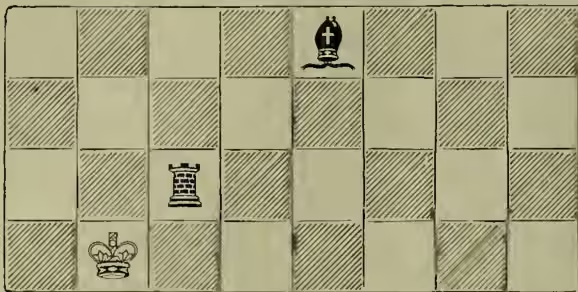
Discovered check, an attack which is opened on the king by the removal of an intervening piece or pawn.
In the diagram (fig. 7) the king is not in check ; but if the rook be moved, the diagonal with the bishop is opened, and the rook is said to 'discover check.'
En passant.—A pawn which, having moved two squares for its first move, and thus passed an opposing pawn, may be taken, on the next move only, by the latter, en passant.
En prise.—A piece is said to be en prise when it is in a position to be captured by an opposing piece or pawn, and is not properly defended.
Exchange, the capture of a piece in return for the loss of one of equal value. To 'win the exchange'
Fig. 5.—Casting with King's Rook.
a, before casting.
b, after casting.
Fig. 6.—Casting with Queen's Rook.
a, before casting.
b, after casting.
is to capture a rook in return for the loss of a bishop or knight. To 'lose the exchange' is to capture a bishop or knight in return for the loss of a rook.
Gambit, a game in which one player, at the beginning, voluntarily sacrifices part of his force (often a pawn) for the sake of an ultimate advantage.
J'adoube, an expression necessary before a piece or pawn may be touched for the purpose of adjustment, &c. The rule otherwise is that a piece or pawn touched must be moved.
Opening.—The various methods of beginning the game have been the subjects of much study, and are so complex as to elude anything like exhaustive analysis. Openings are classed as: (a) Gambits (see above), (b) Games, in which the line of play does not involve any sacrifice, and (c) Defences, which have reference to the line of play adopted by the second player. Openings in which both players move the king's pawn to king's fourth square for their first moves are arbitrarily classed as 'Regular,' all others as 'Irregular.' All openings of repute have distinctive titles, often being named after their inventors or from some country where they are popular. Steinitz Gambit, Scotch Game, French Defence, are examples. The study of openings is most difficult and practically endless, and should not be begun until the student has some practical acquaintance with the game.
Problem, an imaginary position in which the winning line of play is artfully concealed, and has to be discovered in accordance with given conditions.
BLACK (4 pieces).
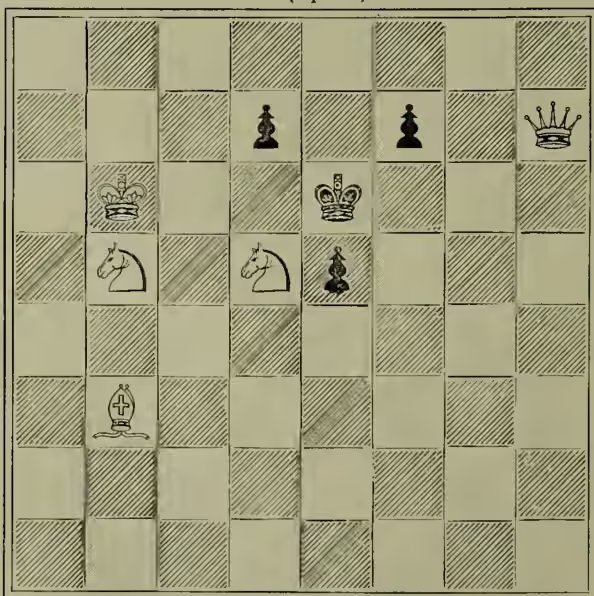
Fig. 8.—Problem by W. Skinkman (Kcy move, B to R4).
Queening a pawn, the promotion of a pawn which has crossed the board, to the power of another piece. (Of course a queen is selected in most cases, as the most valuable piece.)
Stalemate, a position in which the king, though not attacked, cannot move without being subject to capture, and in which no other move by any other piece or pawn is possible. The game in this case is drawn.
Time Limit, a condition of modern play under which each player is compelled to make a certain number of moves (generally twenty) in each hour. The time is recorded by an ingenious arrangement of clocks, one being set going when the other is stopped.
See The History of Chess, by Forbes (1860); Geschichte des Schachspiels, by Van der Linde (Berlin, 1880); Falkener, Games, Ancient and Oriental (1892); The Chess Player's Handbook, by H. Staunton (1847-49); Chess Openings (1889) and Chess Endings (1892) by Freeborough and
Ranken; works by Gossip (1894), Green, Mortimer, &c.; Handbuch des Schachspiels, by Bilguer and Von der Lasa (Leip. 1843; 6th ed. 1880); Führer durch die Schachtheorie, by O. Cordel (Berlin, 1888); Cook's Synopsis; Book of the London Tournament, 1883; The Chess Problem, by Planck and others. See also the Chess magazines.