Chester, an ancient episcopal city, municipal and parliamentary borough, and river-port, the capital of Cheshire, on the right bank of the Dee, 22 miles from the mouth of its estuary, 16 miles SE. of Liverpool, and 179 miles NNW. of London. Chester is one of the most picturesque towns in England. It stands on a rocky sandstone height, and is still surrounded by the entire circuit of its ancient walls, nearly 2 miles round, 7 or 8 feet thick, and forming a promenade with parapets, where two persons can walk abreast. The ancient gateways have been all rebuilt. The castle, with the exception of 'Cæsar's Tower,' has been removed, its site being occupied by barracks and county buildings. The Dee is crossed by two bridges, the old picturesque bridge of seven arches, and the new or Grosvenor Bridge, with a noble single arch of stone 200 feet in length (see BRIDGE, Vol. II. p. 437). The two main streets cross each other at right angles, and were cut out of the rock by the Romans 4 to 10 feet below the level of the houses. These streets exhibit the curious arrangement called the 'rows:' the front parts of their second stories, as far back as 16 feet, form a continuous paved promenade or covered gallery, open in front, where there are pillars and steps up from the street below, with private houses above, inferior shops and warehouses below, and the chief shops of the town within. There are a considerable number of the picturesque old timber houses of the 16th century, and many of the more modern buildings are in the same style of architecture.
Chester Cathedral is an irregular massive structure of crumbling sandstone, 375 by 200 feet, with a massive tower of 127 feet. It was formerly the church of the abbey of St Werburgh, which for 650 years was one of the richest in England. It became a cathedral church after the dissolution of the monasteries. It is of various dates from Norman to Late Perpendicular, its most striking feature being the fine Perpendicular window of the west front. The building has undergone extensive restoration under the direction of the late Sir Gilbert Scott. A part of St John's Church, a ruined Norman edifice, has lately been restored. It was a cathedral church for some years during the 11th century, when the See of Lichfield was temporarily transferred to Chester. The present bishopric of Chester dates from the reign of Henry VIII. Other public buildings are the town-hall, the Grosvenor Hotel, the general post-office, the free library, and the music-hall. Suburbs of villas have recently arisen outside the walls ; and a public park was opened in 1867. On the common called the Roodee there is a racecourse. The huge railway station, with a frontage of 1010 feet, is the centre of several important railways. Chester has manufactures of lead, oil, and chemicals, iron-foundries, and an iron-shipbuilding yard. The making of boots and shoes is an important industry. The navigation of the Dee has lately been greatly improved. The chief exports are cheese, copper, cast-iron, and coal. Pop. (1851) 27,756; (1871) 35,257; (1881) 36,794; (1891) 37,105. The city was in 1888 made a county borough. It has returned members to parliament since the reign of Henry VIII., but by the Distribution of Seats Act, 1885, it lost one of its two members.
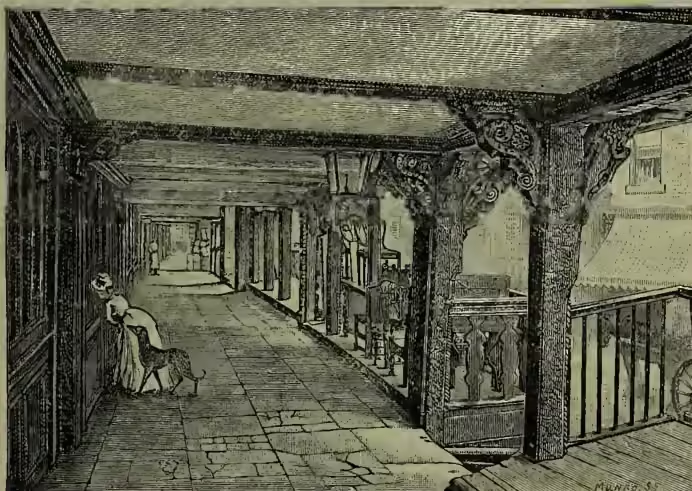
Chester was Deva or Devana Castra, an important Roman station, and has yielded many Roman remains—as masonry, coins, inscriptions, fibulae, altars, a hypocaust, and a statue of Pallas. The British name was Cuerleon: Chester, alone or in composition, represents the Anglo-Saxon Cæster, from the Roman Castra. After the departure of the Romans it was held by Britons, Saxons, and Danes; and in 605 was laid utterly waste by Æthelfrith of Northumbria. It remained an inclosure of waste walls—occupied at times, as in 894, by a body of marauding Danes, till in 908 it was rebuilt by Ætheired of Mercia; and prosperity came after 942. Chester was the last place in England that held out against William the Conqueror; not till its capture (1070) was the duke really king of England. Henry Lupus, nephew of the Conqueror, was created Earl of Chester, and until the time of Henry III. the Earls of Chester had their own courts and parliaments at Chester, with eight subfeudatories and the superiors of the great religious houses, Cheshire being then a county palatine. On the death of John, Earl of Chester, Henry III. made his eldest son Earl of Chester, and since that time the title has usually been held along with that of Prince of Wales by the eldest sons of English sovereigns. Llewelyn ravaged Chester in 1255. The twenty-five famous Chester mysteries or religious plays by Randle, a monk (1250-60), were acted in the church. After a long and memorable siege (1643-46), the inhabitants, who held out bravely for the king, were starved into surrender. A projected Fenian attack on the castle in 1867 proved abortive. Among the bishops of Chester have been Pearson, Porteus, and Stubbs. Trinity Church contains the graves of Matthew Henry, the commentator, and the poet Parnell.
See CHESHIRE; and books by Rupert Morris (1895) and G. L. Fenwick (1897).