Chestnut, or CHESNUT (Castanea), which must be clearly distinguished from the Horse Chestnut described below, a genus of Cupuliferae, closely allied to the Beech (Fagus), and distinguished from it by long male catkins, longitudinally set with groups of flowers, a 5-8-celled ovary, and compressed rounded nuts. The name is derived from the town of Castanum, in Thessaly. The Common,
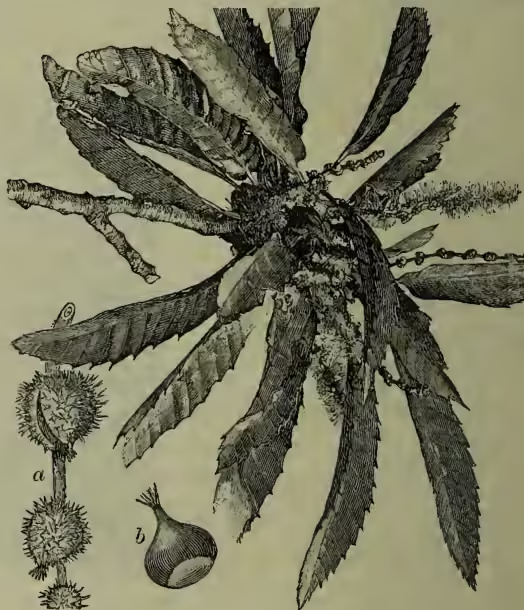
a, fruit, b, seed.
Spanish, or Sweet Chestnut (C. vulgaris), is said to have been first brought from Asia Minor, but has long extended over the south of Europe, where it has become completely naturalised, and forms extensive woods. It is an ornamental and stately, or, in exposed situations, a very spreading tree, of great size and longevity: the famous chestnut-tree of Totworth in England was known as a boundary-mark in the reign of King John; while a yet more celebrated tree on Mount Etna is said to have measured 204 feet in circumference. The timber is durable and hard, and is used in house-building, for making furniture, and for many other purposes. The timber described as chestnut in ancient buildings is usually, however, really oak. The bark is used for tanning, but is worth only about half the price of oak-bark. Young chestnut-trees are much esteemed for hop and espalier poles. The chestnut is therefore frequently grown in England as coppice-wood; but it succeeds well as a timber-tree even in Scotland, although it does not generally ripen its fruit. In Devonshire, however, and in some other parts of England, it is planted as a fruit-tree. It succeeds throughout all the middle latitudes of Germany, but dislikes a damp foggy atmosphere. It prefers a dry light soil, and succeeds only where there is a dry subsoil. The nuts are generally three in each husk. They form an important part of the food of the poor in the south of Europe, being used either roasted or boiled, and are ground into flour, and made into a kind of bread. They contain 15 per cent. of sugar, and by pressure yield a fermentable sugary juice. When cultivated as a fruit-tree it is generally grafted, by which means the better varieties are secured. A variety with golden-edged foliage, and another with thin thread-like divided leaves, are sometimes cultivated for their foliage. Other species also bear eatable fruits: those of the American Chestnut (C. americana), a tree much resembling the common chestnut, and of the Dwarf Chestnut, or Chinquapin (C. pumila), a low tree, or more generally a shrub of 7-8 feet high, are used in America.—A number of species are natives of the East. The inhabitants of the mountains of Java eat the fruit of the Silvery Chestnut (C. argentea), and the Tungurrut (C. Tungurrut), boiled or roasted, like the common chestnut. Both of these are large trees, the Tungurrut reaching a height of 150 feet. Closely akin to the true chestnuts is the Californian Chinquapin (Castanopsis Chrysophylla).
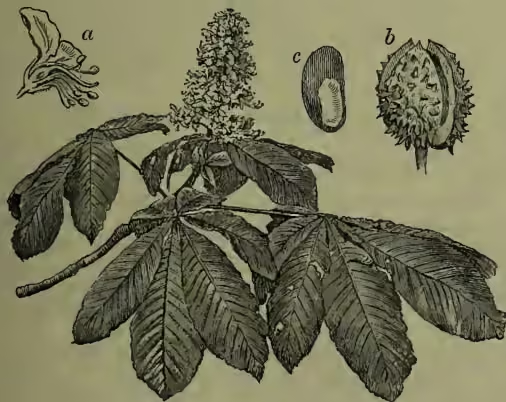
(Esculus Hippocastanum): a, vertical section of single flower; b, fruit; c, a single seed, its coat partly removed.
The HORSE-CHESTNUT (Esculus Hippocastanum) is a wholly distinct Sapindaceous tree, supposed to have been introduced from Asia about the middle or latter half of the 16th century; and of which the exceptionally magnificent foliage and blossom, rapid growth, stately size, and general effect have made it a favourite among arboriculturists, though the timber is soft and of little value. It forms singularly effective avenues: those of Bushy Park at Hampton Court Palace near London are well known and largely visited, particularly when in flower. The palmate leaves and terminal racemes or panicles need no description, while the characteristic 3-lobed, thick, prickly capsule, with its one or two (rarely three fully developed) beautifully marked and coloured seeds, is among the most familiar recollections of childish treasure-trove in early autumn. Other species and varieties have also been introduced, of which E. indica is probably the handsomest. E. rubicunda, the so-called scarlet-flowered horse-chestnut, although sometimes described as a native of North America, is perhaps only a variety of the preceding. The American species of Esculus and its practically indistinguishable ally, a sub-genus Pavia, are popularly termed Buck-eye. None is so beautiful, or at least possesses such a combination of beauties, as the common horse-chestnut; but P. californica, although only reaching a height of 12 to 15 feet, has a singular wealth of fragrant blossom. P. rubra, with its many varieties, is the Red Buck-eye.
In Queensland the seeds of Castano-spermum, a leguminous tree, are sometimes eaten like chestnuts, and so called; similarly is it at the Cape with the seeds of Brabejum stellatum, a Proteaceous plant. The so-called water-chestnut of Europe is the curious horned nut of Trapa natans (order Haloragiaceæ), and is an article of food in southern Europe, China, and Cashmere. See TRAPA.