Chicago (pronounced Shekahgo) is situated in the north-east corner of the state of Illinois, about the fork and mouth of the Chicago River, on the west shore and near the head of Lake Michigan, in 41° 52' N. lat., and 87° 35' W. long. The city covers an area of nearly 37 sq. m., or 23,680 acres, and is divided by the river and its branches into north, south, and west 'sides,' which are connected with each other by thirty-three bridges, and two tunnels for vehicles and passengers. The river frontage, counting both sides, extends 41 miles.
Joliet and Marquette visited the place in 1673, and a rude church was erected by the latter in the following year. At a subsequent date the French, in extending their possessions to New Orleans, built a fort here, which was afterwards abandoned. In 1795 the Indians, who had been very troublesome, agreed to a treaty whereby they, among other things, ceded to the government 'one piece of land, six miles square, at the mouth of the Chekajo River, emptying into the south-west end of Lake Michigan, where a fort formerly stood;' and near the mouth of the river 'Fort Dearborn' was built in 1804. The history of Chicago as a city dates from 1837, when it was incorporated, with a population within its limits of 4170. In 1840 the first census was taken, the inhabitants numbering 4479. In 1845, however, these figures were nearly trebled, the statistics showing 12,088. Since that time the city has made prodigious strides in extent and in the acquisition of wealth. From a small trading village it has expanded into a great metropolis, ranking, in the United States, second only to New York. It is the largest grain market in the world; and more hogs are killed, and more pork, bacon, and lard shipped, than in and from any other two cities on the continent. Its rapid growth has continued, and the population was in 1890 returned at 1,099,350.
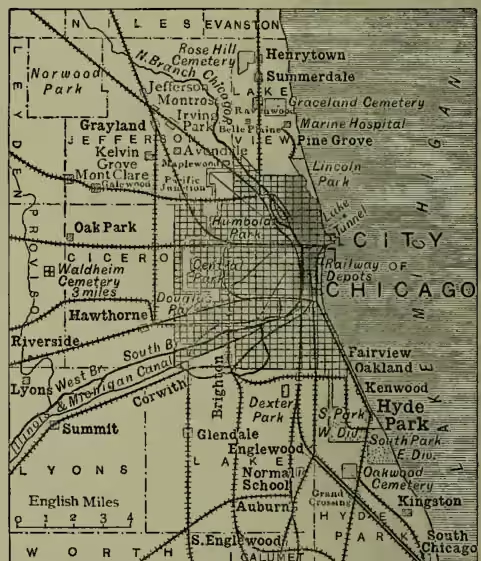
The site on which to rear such a city was anything but enticing, the land in places being barely on a level with the lake; but thoroughfares were gradually raised from 8 to 12 feet, and the surrounding lots progressively filled in. Now Chicago has some of the finest streets (laid out with mathematical regularity; cf. map) in all America, notably Michigan Avenue and Drexel Boulevard, and its thoroughfares measure altogether 640 miles. There are four city railway companies, with 113 miles of track; considerable portions of the north and south side roads being worked by the cable-car system.
Among the public buildings of Chicago, many of them noted for their architectural beauty, are the new Board of Trade building, of granite, with a tower, rising 304 feet from the street level; the county court-house and city-hall, a structure of Silurian limestone and Maine granite, erected at a cost of nearly $6,000,000; the criminal court and county gaol; the United States custom-house and post-office; the Art Institute building; the Dearborn Observatory; the Exposition Building, an immense structure on the lake front, frequently used for concerts and exhibitions; the Auditorium, a public hall, with a seating capacity of 7500; 20 theatres, and several music-halls; 34 hotels, some palatial in size and appointments; the Cook County Hospital, with accommodation for 800 patients; 6 other hospitals, and 25 orphan asylums and other benevolent institutions.
Chicago is also a city of church buildings, yet it contains fewer church-going people in proportion to its population than any other American city. All the places of amusement—theatres, concert halls, dime museums, summer gardens, &c.—are crowded with the working-classes on Sunday; and in the summer season the pleasure-steamers are loaded with excursionists. All Sunday laws have been repealed, and the day is one of general festivity. Of churches there are about 300 of all denominations, many of them fine specimens of ecclesiastical architecture. Many of the office buildings are enormously tall, accessible in the upper stories by elevators; these 'sky-scraper' are built on the steel-frame system, the brick walls not actually serving as a support. Dwelling-houses are also built of iron or steel filled in with brick. Many of the poorer suburbs consist almost wholly of mean wooden houses. Besides several high schools, there are over a hundred public schools. The Chicago University, founded in 1892, and housed in a grand range of granite buildings, has an endowment of 7,000,000 (of which 3,000,000 were given by Mr Rockefeller), and 150 teachers and 1000 students. The telescope of its observatory, costing 750,000, has an aperture of 42 inches (as compared with the 36 inches of that in the Lick Observatory). There are also medical and commercial colleges, a large (Methodist) university at Evanston, 12 miles to the north, and several religious seminaries in the city and its suburbs. The public library, with 120,000 volumes, is one of the largest in the United States; and the Newberry Free Library, founded in 1888 by a legacy of 2,000,000, has some 100,000 volumes. The Chicago Historical Society has a library of 20,000 volumes.
The park system is without a parallel in America; it embraces Lincoln Park, on the lake shore to the north, and five others, and is divided into three sections, all connected or nearly so by magnificent boulevards, which, with the park drives, measure 58 miles. Among other open spaces are 20 large cemeteries, beautifully laid out, besides numerous smaller parks and squares, and three driving parks close to the city. The water-supply system is considered to be the finest of any in the country, with its 640 miles of pipe; a new tunnel, capable of furnishing 100,000,000 gallons a day, and running 4 miles out into Lake Michigan, was constructed in 1888. The sewerage of the city is emptied, by a canal connecting the Chicago and Illinois rivers, into the Mississippi, and thence to the Gulf of Mexico; and the garbage is disposed of by fire, in a furnace specially constructed for the purpose, capable of consuming 150 tons a day.
The great secret of Chicago's phenomenal growth, disturbed of late years by a railway strike and labour war, and by a period of depression after the closing of the World's Fair, is its transportation facilities by rail and water. Fully one-third of the railroad system of the United States centres there. But the great waterway by Lake Michigan and its connections is unquestionably of most importance for the prosperity of the city. Most of the lake-vessels, though they are often large and handsome craft, differ considerably in build and rig from sea-going vessels. Some 10,000 ships of near 6,000,000 tons annually enter this harbour; the tonnage of those clearing is a little less. In 1888 a steamer from London direct landed her cargo at this city. This was the first event of the kind, although sailing-vessels had previously cleared thence for European ports.
South-west of the city, and just beyond its limits, are the Union Stock-yards, established in 1866, the largest live-stock market in the world, occupying 345 acres of land, and costing upwards of 3,000,000. The yard and pens cover 146 acres, with accommodation for 25,000 head of cattle, 150,000 head of hogs, 20,000 sheep, and stabling for 1000 horses. About 40 miles of railroad track are owned by the company, and these connect with every road centering in the city. The combined capacity of the packing-houses located at the yards is about 60,000 hogs per day. Another remarkable feature of the Chicago cattle trade is the 'dressed beef' business; and large orders for canned meats are also filled here for the different European governments. Chicago is also the leading grain market of the world, and has unequalled facilities for handling, storing, and marketing this produce. Across the lake lie the immense 'pineries' of the states of Michigan and Wisconsin, from whence the Chicago market is mainly supplied with lumber, the transactions in which exceed those of any other city. The manufactures of the city include nearly every conceivable variety of production, from a child's toy to the largest steam-engine. Its 30 or more elevators, with their enormous carrying capacity, dealt with a combined total of 204,506,701 bushels of grain (wheat, oats, rye, barley, maize) in 1890, inspected on arrival, and in 1891 of 205,836,347 bushels. Some 2,000,000 hogs meet their fate here annually, besides a million cattle and half a million sheep. The total trade was estimated at 930,000,000 in 1880, at 1,422,500,000 in 1890, and at 1,504,225,000 in 1891—including produce, wholesale and manufacturing trades, calculated on the first selling value.
Chicago is a highly cosmopolitan city. At the census of 1890, while 292,463 of the population of Chicago were native-born Americans, no fewer than 384,958 were Germans, 215,534 Irish, 54,209 Bohemians, 52,756 Poles, 45,867 Swedes, 44,615 Norwegians, 33,785 English and Scotch, 12,963 French, and 6989 Canadians. Whereas the area in 1887 was 36.7 square miles, it had in the census year increased to 180.2. The city now extends lengthwise for 21½ miles, and from east to west at the broadest part 10½ miles. The system of boulevards and parks by which the city is almost entirely surrounded stretch for about 35 miles.
In Jackson Park, to the south-east of the city, was the site chosen for the great World's Columbian Exposition or World's Fair, held 1st May to 30th October 1893, in celebration of the fourth centenary of the discovery of America by Columbus. The buildings were dedicated with elaborate ceremonies on 21st October 1892. The area occupied for the purpose, 633 acres, had a frontage of a mile and a half on Lake Michigan; the enormous building for manufactures itself covered 30½ acres of ground, and had 13½ acres of gallery space. Engines of 24,000 horse-power provided motive power, besides 17,000 horse-power derived from electricity. The number of visitors between 1st May and 30th October 1893 was 23,529,400.
In 1892 a scheme for the improvement of the drainage discharge was adopted, and arrangements made for commencing work. A canal is to be made from the Chicago river, at present the main outlet, to another stream that runs into the Mississippi; and the scheme comprises not merely a sewage system, but a system of navigation between Lake Michigan and the Mississippi—practically between the North Atlantic and the Gulf of Mexico.
What is known as the great fire, which broke out on Sunday, October 7, 1871, devastated a total area, including streets, of nearly 3½ sq. m.; about 17,450 buildings were burned, 98,500 persons rendered homeless, and some 200 lives sacrificed, the total money loss being estimated at 190,000,000. As a result of this disaster, when this central portion was rebuilt, brick, iron, and stone structures were erected, and stone pavements also were substituted for wood. Another conflagration, on July 14, 1874, destroyed about 4,000,000 worth of property, including over 600 houses, mostly frame shanties. On the evening of May 4, 1886, occurred the 'Haymarket Massacre,' in which eight policemen were killed and sixty maimed by a dynamite bomb thrown by an anarchist from among a crowd of labour agitators. For this crime four men were hanged, November 11, 1887, and three others received various terms of imprisonment. Another anarchist plot was detected in July 1888. See Andreas' History of Chicago (Chicago, 1885).