Chimæra, a genus of cartilaginous fishes, and type of a distinct order, Holocephali, which is often ranked along with the sharks and rays, or Elasmobranchs. The chief distinctions are the presence of a fold of skin covering the (4) gill-clefts, the nakedness of the skin, the fusion of the upper jaw to the skull, the separation of anal, urinary, and genital apertures. There are no 'spiracles,' nor 'spiral-valve.' Except in the above particulars, and a few others of a more technical nature, the members of this small order agree with the ordinary Cartilaginous Fishes (q.v.). There are only two living genera—Chimæra and Callorhynchus. The best-known species of chimæra (C. monstrosa) is often called the King of the Herrings, and is occasionally taken in herring-nets in British seas.
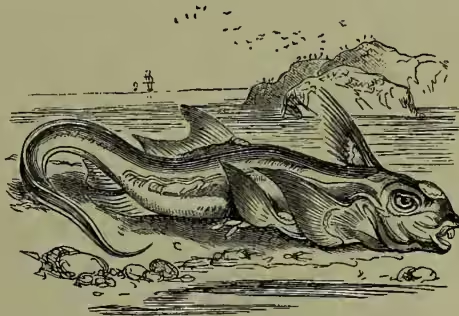
It is found on the coasts of Europe and Japan, in North Atlantic, and at the Cape of Good Hope. In the United States it is called Sea Cat. It is an ugly fish, seldom over 3 feet in length, of a whitish colour, spotted with brown above. The males have clasping organs; the large eggs are inclosed in a leathery case. The C. Collieri is found on the west coast of North America; and the C. Affinis on the coast of Portugal. In the other genus, Callorhynchus, in the South Pacific, the snout bears an appendage, and the tail is not symmetrical as in the above, but slightly shark-like.