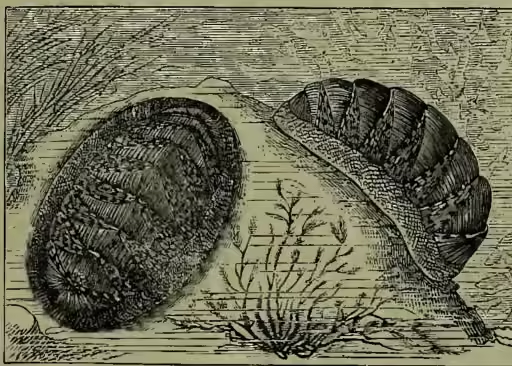
Chiton, a genus of marine molluscs, type of an important sub-class which may be regarded as introductory to gasteropods. Unlike the lop-sided snails, the chitons are bilaterally symmetrical. The head is at the anterior end, the anus posterior; the 'foot' occupies the whole of the ventral surface; the heart, the gills, the excretory tubes, the genital ducts, all exhibit the same symmetry. This marked contrast to the gasteropods proper is further supported by the disposition of the two important nerve cords (pedal and visceral) which run parallel to one another along the body. In some forms there are numerous eyes, which occur, however, not on the head, but on the body. Another striking feature is the presence of a series of eight shell-plates along the back. On these and other grounds the chitons are separated from gasteropods proper, and established as a separate order, on which the name Polyplacophora, alluding to the multiple shell-plates, has been bestowed. Nor is the order a small one. Of the genus Chiton alone over 400 species have been recorded, and other smaller genera are also distinguished. The British species are small; those from warmer climates sometimes measure 3 to 4 inches in length. They are undoubtedly representatives of a primitive type, and include numerous fossil forms from the Silurian onwards. They are not, however, the simplest gasteropods, for a few other forms, known it is true with less fullness, exhibit the same essential features in even simpler expression. These are (a) the Neomeniæ, including the genera Neomenia and Proneomenia, and (b) the single genus Chaetoderma. The systematic import of these last forms has been emphasised by Professor Hubrecht (Quart. Jour. Micr. Sci. 1882). Along with the chitons they are usually gathered together into a special subclass or class styled Isopleura or Amphineura, names referring to the equal-sided symmetry and to the double parallel nerve-cords. See GASTEROPODS; Haddon, Challenger Report, xv. (1886).