Chlamydo'phorus, a rare and peculiar mammal of the sloth and ant-eater order (Edentata); in its general features resembling the Armadillos, but unique in the character of its skin armour.
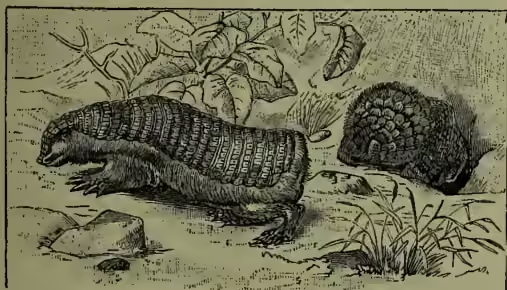
The head and trunk are covered by about twenty movable cross bands of quadrangular horny (slightly bony) plates. These form an overhanging dorsal shield, attached to the body only along the middle line of the back. The hind parts are protected by the abrupt occurrence of a strong upright bony shield attached to the hip-girdle. The short tail, which is broadened out into a trowel shape, and tucked in between the legs, is protected by horny plates, as are also the dorsal portions of the short, clawed limbs. The rest of the body is covered with long silky hair. There are 8 teeth on each side above, and 8-9 below. The eyes and ears are inconspicuous. C. truncatus (the Pichiciago) is a burrowing animal, living 'in the sandy plains of the western part of the Argentine Republic.' During the day it keeps to its burrow, and is little known. It is 5 or 6 inches in length, with white hair and pinkish scales. C. retusa, from Bolivia, is larger, and the dorsal shield has a wider attachment to the body. See ANT-EATER, ARMADILLO, EDENTATA, SLOTH.