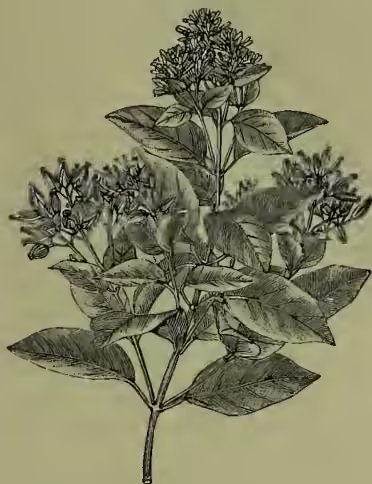
Cincho'na (properly CHINCHONA), a most important genus of trees of the order Rubiaceæ (sub-order Cinchonaceæ), yielding the bark so much valued in medicine, which has been variously known as Peruvian Bark, Jesuits' Bark, China Bark, Quina, Quinquina, Cinchona Bark, &c., and from which the important alkaloids quinine and its congeners are obtained. The species of this genus are sometimes trees of great magnitude; but an aftergrowth springing from their roots when they have been felled, they often appear only as large shrubs; and some of them in the highest mountain-regions in which they are found are low trees with stems only 8 or 10 feet in height. They are natives of South America between 20° S. lat. and 10° N. lat., and chiefly on the eastern slope of the Cordilleras. The best cinchona formerly came from the province of Loxa in Ecuador. The range of altitude of course diminishes as we recede from the equator, but may be averaged at from 8000 to 5000 feet for the best varieties. The climate of these regions is extremely variable, and this seems to have more effect upon the trees and their product than differences in soil. All the cinchonas are evergreen trees, with laurel-like, entire, opposite leaves; stipules which soon fall off; and panicles of flowers, which, in general appearance, are not unlike those of lilac or privet. The flowers are white, rose-coloured, or purplish, and very fragrant.
Such difficulty has been found in determining the species of cinchona and the different varieties of bark known in commerce that a voluminous special literature of 'quiology' has been called into existence. This difficulty is due partly to the large number and great variability of the species, and even of individual specimens of bark, as also to the difficulty of obtaining specimens of flowers and leaves along with particular kinds of bark. The most important species are C. officinalis of Ecuador and Peru, C. Calisaya of Bolivia and south-east Peru, and C. succirubra of the western slope of Chimborazo; but others (Carthagenia Bark, Colombian Bark, &c.) are also of importance, while the varieties are too numerous to mention. The barks of allied species which, although more or less bitter and even febrifugal, contain no quinine are apt to be used as substitutes or adulterations.
The cutting and peeling of cinchona-trees is a laborious and difficult operation carried on by Indians during the dry season. They build a hut, which serves both for their abode and for drying the bark. The trees are felled as near the root as possible, that none of the bark may be lost; and the bark being stripped off, is carefully dried and packed; the quilled form of the thinner bark is acquired in drying.
This wasteful and costly mode of collection from almost impassable forests, in which, moreover, the tree was becoming exterminated, and this in face of an increasing demand, gradually roused the attention of European botanists to the desirability of inaugurating a regular culture in similar regions and climates of the Old World; but the successful introduction of cinchona-seeds into Europe was only effected by Weddell in 1848, and his seedlings were sent from the Jardin des Plantes to Algiers in 1850, and to Java in 1852. The Dutch government also imported a few living plants from Peru in 1854. The credit of really solving the difficult problem of acclimatisation is, however, due to Mr Clements R. Markham. Himself going to Peru and Bolivia for C. Calisaya, he secured the services of Spruce, a well-known collector then resident in Ecuador (who was similarly successful in obtaining C. succirubra), as well as those of three other effective coadjutors. The expedition was attended by much difficulty and danger, and its narrative has a prominent place in the history of botanical travel. Plantations were formed in the Neigherry Hills, and thence spread to Sikkim at the foot of the Himalayas, to British Burma, Ceylon, &c. Cinchona is also being grown in the West Indies, and its acclimatisation in all suitable localities continues to make progress and to become an important industry.
The Indians of Peru call the cinchona-trees Kina, from whence are derived the names Quina, China, &c. But there is no evidence that they knew the use of the bark before the arrival of the Spaniards, nor will they even yet employ it in their native medicine. It was first imported into Europe in 1639, by the Countess of Chinchon, the wife of the viceroy of Peru, who had been cured of an obstinate intermittent fever by means of it, and who thereafter habitually distributed it to those suffering from fever. Upon this account it was named C. Bark and Countess's Powder (Pulvis comitissæ). The Jesuit missionaries afterwards carried it to Rome, and distributed it through their several stations, and thus it acquired the name of Jesuits' Bark and Pulvis patrum. Cardinal Juan de Lugo having been particularly active in recommending and distributing it, it was also known as Cardinal de Lugo's Powder. It attained great celebrity in Spain and Italy, being at first distributed to the poor, but later sold at high prices by the Jesuits, by whom it was lauded as an infallible remedy, while by most of the orthodox physicians it was coldly received, and by the Protestants altogether repudiated. Falling thus into practical disuse in Europe, it was again brought into notice by Robert Talbot or Talbot, an English apothecary, who acquired great celebrity through the cure of intermittents by its use. In 1678 he was appointed physician in ordinary and knighted by Charles II., whom he next year cured of a tertian fever. In 1679 he similarly cured the Dauphin and other eminent personages on the Continent, and thus induced Louis XIV. to purchase his secret. The adoption of the drug was henceforth assured, despite the exceeding jealousy of the profession in England and France of both the success and fortune of the irregular practitioner, who did not, however, live much longer to enjoy his reward. The Parisian faculty of medicine held out bravely, a corroboration, if any were needed, of Molière's account of them, but the example and authority of Morton and Sydenham at length gained respectability to the side of science. As it came into general use, it became a most important article of export from Peru; and in order to the maintenance of a commercial monopoly, although no attention was ever paid to its culture, extraordinary methods were employed to prevent it from becoming known at a comparatively recent period of Spanish rule in America. The discovery of the alkaloids on which its properties chiefly depend constitutes a new era in the history of this medicine, and did not take place till the beginning of the present century.
The account of these alkaloids and their physiological and therapeutic action will be found under Quinine (q.v.). An excellent outline of the whole subject, with introduction to the literature of quinolgy, is to be found in Flückiger and Hanbury's well-known Pharmacographia, and in most manuals of pharmacology. In Markham's Peruvian Bark (1880) will be found almost all matters of general interest; and there is a Handbook of Cinchona Culture, by Van Gorkhom (trans. by Jackson, 1882).