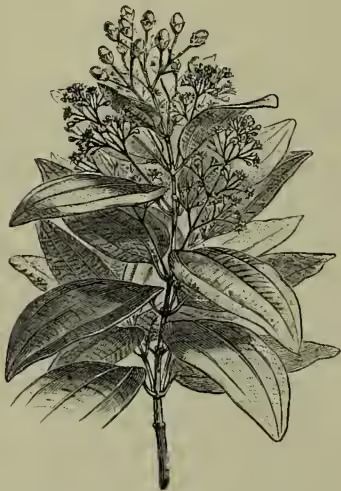
Cinnamon is the aromatic bark of certain species of the genus Cinnamomum. This genus belongs to the natural order Lauraceæ, which includes a considerable number of species, natives of tropical and of subtropical parts of the East. Cinnamon has been in use from the remotest antiquity. It is mentioned in the Old Testament, and by a name almost the same as that which it still bears in most languages. The finest kind is produced by Cinnamomum Zeylanicum, or the Ceylon cinnamon-tree. It is still mainly derived from its native island, but was introduced into the West Indies in 1782, along with various other plants of the East, and is now cultivated there to some extent. The tree naturally attains the height of 20-30 feet, and is sometimes foot in thickness, but the cultivated trees are not allowed to grow higher than 10 feet. Its bark is of a grayish-brown colour, internally of a yellowish red. The leaves are oval, 4-6 inches long, with a blunt point, and marked with three principal nerves. They have the taste of cloves. The flowers are of a silky gray on the outside, and a pale-yellow colour internally. The fruit is somewhat like an acorn in shape; it is a small drupe, brown when ripe. There are two seasons of cinnamon-harvest in Ceylon, the first commencing in April, and the last in November—the former being that in which the chief crop is obtained. The branches of 3-5 years' growth being cut down, the epidermis is scraped away; the bark is then ripped up longitudinally with a knife, and gradually loosened, till it can be taken off. The slices are then exposed to the sun, when, as it dries, it curls up into quills, the smaller of which are inserted into the larger, and the whole tied up in bundles of about 88 lb. each. The wood when deprived of its bark has no aroma, and is used as fuel. When the bark is first taken off it is said to consist of an outer portion, which tastes like common bark, and an inner and highly aromatic portion. In the course of drying, the oil upon which the aroma and flavour depends, is diffused throughout, and the quality of the whole is supposed to depend upon the relative quantities of these portions. Cinnamon is examined and arranged according to its quality by persons who are obliged for this purpose to taste and chew it, although in a short time it produces painful effects on their mouths and tongues. The finest cinnamon is yielded by the young branches of the tree, especially by the numerous shoots which spring up from the stump after a tree has been cut down, and which are cut when about 10 feet long, and of the thickness of an ordinary walking-stick. The smell, particularly of the thinnest pieces, is delightfully fragrant, and the taste pungent and aromatic, with a mixture of sweetness and astringency. It is used like other spices by cooks and confectioners, and also in medicine as a tonic, stomachic, and carminative. The average quantity annually imported into London is about 500,000 lb. Its virtues depend chiefly upon the essential oil which it contains (oil of cinnamon). Oil of cassia is very often substituted for this oil, as cassia is for cinnamon. The root of the cinnamon-tree contains camphor. The fruit yields a concrete oil, called cinnamon suet, which is highly fragrant, and in Ceylon was formerly made into candles for the exclusive use of the king. Cassia (q.v.) is the produce of another species of Cinnamomum.—C. Loureirii, a native of Cochin-China and Japan, yields a bark which is preferred by the Chinese to that of C. Zeylanicum. A species of cinnamon is found at the elevation of 8500 feet in the Sikkim Himalaya.
The constituents of cinnamon are a volatile oil (oil of cinnamon), tannin, starch, mucilage, woody-fibre, resin, colouring matter, and an acid. The oil of cinnamon is generally prepared in Ceylon by grinding the waste pieces of cinnamon broken off in packing, soaking them in sea-water for two or three days, and then distilling. Two oils pass over, one lighter, the other heavier than water. Oil of cinnamon varies in colour from yellow to cherry-red, the yellow variety being considered the best, and is most highly esteemed. Oil of cinnamon leaf is prepared from the leaves in Ceylon by a similar process, and is met with in commerce under the name of clove oil, which it much resembles in odour. Cinnamon water is obtained by adding water to cinnamon, and distilling a large quantity, or by diffusing the oil of cinnamon through water by the aid of sugar or carbonate of magnesia. Spirit of cinnamon is procured by acting upon cinnamon with spirit of wine and water, and distilling; and tincture of cinnamon, by soaking cinnamon in spirit of wine, and straining. The medicinal properties of cinnamon, and its preparation, are aromatic and carminative, and it is serviceable in cases of nausea and vomiting, and in cases of flatulence and spasmodic states of the stomach and alimentary canal.
The genuine Ceylon species of cinnamon is now cultivated in Guiana, St Vincent, the Cape Verd Islands, Brazil, Mauritius, Pondicherry, Guadeloupe, and Java. It yields the best bark when grown on a sandy soil. The name cinnamon is from the Hebrew qinnamón, akin to qánéh, 'a reed or cane.'