Circle, a plane figure bounded by a curved line called its circumference, which is everywhere equally distant from a point within it called the centre. The circumference is sometimes itself called the circle, but in geometry that term is properly applied only to the surface or area bounded by the curve. Any line drawn through the centre, and terminated by the circumference is a diameter, which is therefore bisected in the centre (see ARC, CHORD). In Co-ordinate Geometry, the circle ranks as a curve of the second order, and belongs to the class of the conic sections. It is got from the right cone by cutting the cone by a plane perpendicular to its axis. The circle may be described mechanically with a pair of compasses, fixing one foot in the centre, and tracing out the curve with the other held at a fixed distance. The following are some of its leading properties:
- 1. Of all plane figures having the same perimeter, the circle contains the greatest area.
- 2. Of all plane curves, the circle alone has the same curvature at every point.
- 3. The circumference of a circle bears a certain constant ratio to its diameter. This constant ratio, which mathematicians usually denote by the Greek letter (perimeter), has been determined to be 3.14159, nearly, so that, if the diameter of a circle is 1 foot, its circumference is 3.14159 feet; if the diameter is 5 feet, the circumference is ; and, in general, if the diameter is expressed by (twice the radius),
then (circumference) . Archimedes, in his book De Dimensione Circuli, showed that the ratio is nearly that of 7 to 22. Various closer approximations in large numbers were afterwards made, as, for instance, the ratio of 1815 to 5702, 1010 to 3173; or the excellent one of Adrian Metius—viz. 113 to 355. Vieta in 1579 showed that if the diameter of a circle be 1000, then the circumference will be greater than 3141.5926535, and less than 3141.5926537. This approximation he made by ascertaining the perimeters of the inscribed and circumscribed polygons of 393,216 sides. By increasing the number of the sides of the polygons, their perimeters are brought more and more nearly into coincidence with the circumference of the circle; but this oprose method was long ago superseded by easier modes derived from the higher mathematics. Suffice it to say that various series were formed expressing its value; by taking more and more of the terms of which into account, a closer and closer approach to the value can be obtained by ordinary arithmetic. We subjoin some examples:
where and .
Series (3), or one of its modifications, is the most expeditious mode yet known of extending the approximation to the ratio . It has now been calculated to 707 places of decimals, and verified to over 600. The number , though fixed in value, cannot be exactly expressed in figures, being Incommensurable (q.v.). Finally, the multiplier gives a close approximation, useful to the practical arithmetician.
4. The area of a circle is equal to multiplied by the square of the radius (); or to the square of the diameter multiplied by ; i.e. by .7854. Archimedes proved this by showing that the area is equal to that of a triangle whose base is the circumference, and perpendicular height the radius of the circle.
5. It follows that different circles are to one another as the squares of their radii or diameters, and that their circumferences are as the radii or diameters.
The circle is almost always employed in measuring or comparing angles, from the fact demonstrated in Euclid (Book vi. Prop. 33), that angles at the centre of a circle are proportional to the arcs on which they stand. It follows from this, that if circles of the same radii be described from the vertices of angles as centres, the arcs intercepted between the sides of the angles are always proportional to the angles. The easiest subdivision of a circumference is into six equal parts, because then the chord of the arcs is equal to the radius. Divide one of these arcs into sixty equal parts, and we thus obtain the unit of the sexagesimal scale, called a degree. Each degree is divided into 60 seconds, and each second into 60 thirds, and so on. According to this scale, 90° represents a right angle; 180°, two right angles, or a semicircle; and 360°, four right angles, or the whole circumference—the unit in the scale being the th of a right angle. As the divisions of the angles at the centre, effected by drawing lines from the centre to the different points of graduation of the circumference, are obviously independent of the magnitude of the radius, and therefore of the circumference, these divisions of the circumference of the circle may be spoken of as being actually divisions of angles. By laying a graduated circle over an angle, and noticing the number of degrees, &c. lying on the circumference between the lines including the angle, we at once know the magnitude of the angle. Suppose the lines to include between them 3 degrees, 45 minutes, 17 seconds, the angle in this scale would be written 3° 45' 17".
The sexagesimal measurement of circumferences and angles is the most ancient, and still recommends itself universally to practical mathematicians. A second mode was proposed at the French Revolution, but though adopted by Laplace in the Mécanique Céleste, has long been abandoned even in France. By this scale, called the centesimal, the right angle is divided into 100 degrees, while each degree is divided into one hundred parts, and so on. Such a quantity as 3° 45' 17" is expressed in this notation by 3.4517, the only mark required being the decimal point to separate the degrees from the parts. Of course, in this illustration, 3° means 3 centesimal divisions of the right angle, and 45' means 45 centesimal minutes, and so on. If we want to translate ordinary degrees into the centesimal notation, we must multiply by 100, and divide by 90. To translate minutes in the same way, multiply by 100, and divide by 54; and for seconds, multiply by 250, and divide by 81.
There is also a theoretical method of measuring angles, which, though indispensable in advanced trigonometry and other branches of analysis, is scarcely required in elementary mathematics. For the circular measure, as it is called, the unit angle is thus found: Let POA be an angle at the centre O of a circle, the radius of which is ; APB a semicircle whose arc accordingly ; and let the length of the arc AP . Then, by Euclid,
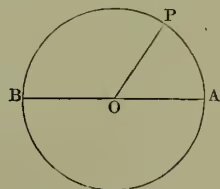
Now, supposing and to be given, although the angle POA will be determined, yet its numerical value will not be settled unless we make some convention as to what angle we shall call unity. We therefore choose such a one as will render the preceding equation the most simple. It is made most simple if we take . We shall then have (denoting the numerical value of the angle POA by ) . The result of our convention is, that the numerical value of two right angles is , instead of 180°, as in the method of angular measurement first alluded to; and the unit of angle, instead of being the ninetieth part of a right angle, is , or 57° 17' 44" 48" nearly. Making in the equation , we have (or AP) (or AO), which shows that in the circular measure the unit of angle is that angle which is subtended by an arc of length equal to radius. Thus the circular measure of is , or 3.14159, &c., , , , and so on; and since is a fixed number, any angle is thus represented absolutely, and not as a part or multiple of another angle—i.e. an abstract number will as exactly denote an angle as it does the length of a line. If we say , then in degrees ; if , then sexagesimally. For the squaring or quadrature of the circle, see QUADRATURE; for the circles of the sphere, see ARMILLARY SPHERE; see also MURAL CIRCLE.