Classification and Forms of Interest.—The order of Centipedes is one of the three or four divisions of Myriapods (q.v.), and, like the class, generally represents a somewhat low grade of development among animals breathing by air-tubes. The most evolved centipede is a very uniform and old-fashioned animal when compared with any normal insect or spider. In the order itself we distinguish four families—(1) Scutigeridæ, (2) Lithobiidæ, (3) Scolopendridæ, (4) Geophilidæ. The first of these includes curious forms with compound eyes, very long feelers, eight shields along the back, and fifteen pairs of very long legs. The feelers and the last pair of legs are longer than the body; there are external generative appendages. In Scutigera, and apparently in some other centipedes, there are peculiar 'lung-like' dorsal aggregations of air-tubes opening on the back, and perhaps the beginning of the 'pulmonary chambers' of some arachnids. Scutigera is represented by about a score of species, widely distributed in warm countries, and common in houses. In Lithobiidæ, as in the two other families, simple eyes alone are present; there are fifteen pairs of legs, antennæ measuring a third or more of the body length, and fifteen dorsal shields. The genus Lithobius includes over one hundred species—L. forficatus (of a reddish-brown colour, and about an inch long) is very common throughout Europe and America; our most familiar British species, L. mutabilis, also very common, has the habit of feigning death. The bite occasions considerable irritation, like that due to nettle-stings.
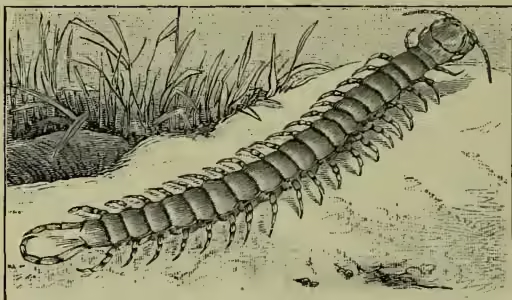
The Scolopendridæ have over a score of legs, short many-jointed antennæ, not more than one-fifth of the total length of the body; and simple eyes, not over four pairs in number, or altogether absent. About one hundred species are known, distributed over sixteen genera. They are especially at home in warm countries, where they often attain large size, the Scolopendra gigas, for instance, being sometimes a foot long. The poisonous bite of some of the larger forms is really dangerous to man. Scolopendra is the most important genus. Lastly, the Geophilidæ are very long, worm-like centipedes, of somewhat sluggish habit, with 31 to 173 pairs of legs, short feelers, and no eyes. Some 22 species and 9 genera have been recorded, especially abundant in warm climates. Geophilus electricus and another species, G. longicornis, both found in Britain, shine in the dark. This is probably due to a viscid fluid excreted all over the ventral surface. Hymantarium, found round the Mediterranean, is the largest form of Geophilidæ. Well-developed spinning glands are seen in this family, and their secretion cements together ova and spermatozoa.
Distribution.—The centipedes are world-wide, but abound especially in warm regions. Some-what unsatisfactory fossil remains have been obtained from the American Carboniferous strata; better preserved possible centipedes have been got from the Solenhofen strata, but it cannot yet be said with certainty that centipedes are known before Tertiary times.
Practical Import.—The centipedes have some direct practical importance as voracious devourers of injurious insects, larvæ, snails, and the like, while some of the large tropical forms are known in a somewhat different connection as animals able to give a painful and poisonous bite. In his Personal Narrative, Humboldt says he saw Indian children draw large centipedes out of the ground and eat them.
Literature.—Newport, Monograph of the class Myriapoda, order Chilopoda (Trans. Linnæan Society, vol. xix. 1845); Haase, Schlesiens Chilopoden (1880–81); Latzel, Die Myriapoden Oesterreichs (1880–84).