Clef

Chambers's Encyclopaedia, Volume 3: Catarrh to Dion, p. 286

Clef, a musical character placed on the staff, by which the absolute pitch of the notes is fixed. There are three clefs—viz. the G, the C, and the F clef. The G clef is placed on the second line, and the stave with this clef is known as the treble stave; the C clef on the third line as the alto stave; and the F clef on the fourth line as the bass stave. The C clef is a fifth below the G clef, and a fifth above the F clef, thus :
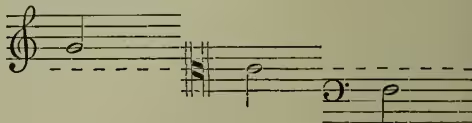
A musical staff diagram illustrating the positions of the G, C, and F clefs. The G clef is shown on the second line from the bottom. The C clef is shown on the third line from the bottom. The F clef is shown on the fourth line from the bottom. The diagram shows the staff lines and the clef symbols to indicate their relative positions.

The C clef is also placed on the fourth line for some instruments, and for the tenor part in vocal music, thus : A musical staff diagram showing the C clef on the fourth line from the bottom, with a note on the fifth line above it. ; and in old vocal music, and also in full scores, the C clef placed on the first line is used for the soprano.

Source scan(s): p. 0297