Clem'atis (Gr. clēma, 'the shoot of a vine'), a genus of plants of the natural order Ranunculaceæ, having four coloured sepals, no corolla, and for fruit numerous one-seeded achænia with long—generally feathery—awns. The species are pretty numerous, herbs or shrubs, generally with climbing stems, natives of very different climates, and much scattered over the world. They possess more or less active caustic properties. The long awns give the plants a beautiful appearance even in winter. The flowers of many species are also beautiful. C. vitalba, the common Traveller's Joy (fancifully so named because of its ornamental appearance by the wayside), is the only native of Britain.
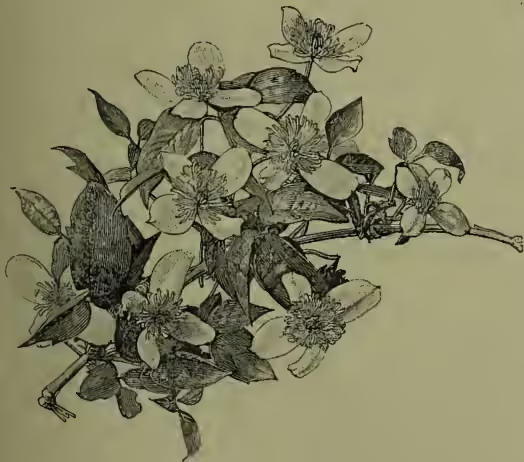
It is common in the south, but becomes rarer towards the north, and is scarcely found in Scotland. The twigs are capable of being made into baskets. It rapidly covers walls or unsightly objects. The fruit and leaves are acrid and vesicant, the leaves are used as a rubefacient in rheumatism; and those of other species are also employed in the same way. In ornamental gardening the genus is a most important one. A number of species and many garden varieties are of the greatest beauty, and most profuse in flowering. The flowers of some in different varieties attain the diameter of from 4 to 8 inches, and range in colour from pure white to pale azure, deep purple, and claret or ruby. In the United States there are many native species. A beautiful evergreen species from New Zealand, C. indivisa, with pure white flowers, is one of the handsomest of greenhouse climbers; and C. flammula, a native of southern Europe and northern Africa, with white flowers, which have a very strong honey-like smell, is the species known as Sweet Virgin's Bower. The garden varieties are propagated by grafting the young shoots in spring on the roots of such common species as C. vitalba and C. flammula. Many are propagated by cuttings, and all may be increased by seeds, but the garden varieties cannot be depended upon to come true by that means.