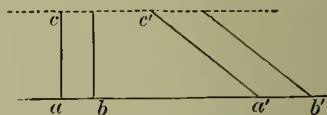
Climate (from the Greek klima, 'a slope or inclination,' afterwards applied to a tract of country, with reference to its supposed inclination to the pole, and the effect of the obliquity of the sun's rays upon the temperature), a term now employed as including not merely the conditions of a place or country with regard to temperature, but also its meteorological conditions generally, in so far as these exercise an influence on the animal and vegetable kingdoms. The effect of the sun's rays is greatest where they fall perpendicularly on the surface of the earth, and diminishes as their obliquity increases; the surface which receives any given amount of the sun's rays increasing with their increased obliquity, as is greater than in the annexed figure; whilst at the same time the oblique rays being subjected to the influence of a greater number of particles of the atmosphere, as is longer than , a greater amount of their heat is absorbed before they reach the surface of the earth at all. The greater or smaller extent of surface receiving a certain amount of heat, also makes important differences to arise from exposure by slope towards the equator or towards the nearest pole. Elevation is a most important cause of differences of climate. As we ascend from the level of the sea to the greatest mountain altitudes, the temperature gradually diminishes, and we ultimately reach a region of perpetual snow, as in approaching the poles. The progressive diminution of the temperature is, however, affected by many causes, so that the line of perpetual snow is far from being at the same elevation in all places of the same latitude. Thus the snow-line on the southern side of the Himalayas is depressed by the heavy rainfall brought by the winds from the Indian Ocean; and that on the northern side is elevated by the extreme drought and summer heat in the vast tablelands of Central Asia, thus causing active evaporation from the snow-fields; so that the difference between the two is not less than 4000 feet in favour of the northern side of the mountain-ranges; and Humboldt says, 'millions of men of Tibetan origin occupy populous towns in a country where fields and towns would, during the whole year, have been buried in snow, if these tablelands had been less continuous and less extensive.'
As the actual temperature of the atmosphere depends not so much upon the direct rays of the sun as upon the radiation from the heated surface of the earth, the diversities in the character of that surface are productive of great effects in modifying climate. A sandy desert, a tract of country clothed with luxuriant vegetation, and an expanse of water, absorb and radiate heat in very different degrees. A newly ploughed field both absorbs and radiates heat much more rapidly than a field covered with grass. A sandy desert heats the atmosphere above it much more than either a fertile tract or a watery expanse, whilst a watery expanse only slightly raises the temperature; but, on the other hand, the desert cools sooner by terrestrial radiation; whilst the heat absorbed by the water being diffused through a larger mass, owing to the depth to which solar radiation penetrates and to vertical as well as horizontal currents generated by the winds to great depths, the influence of the ocean, of seas, and of great lakes, is very powerful in maintaining a greater equableness in the temperature of the air. Thus maritime places, and particularly islands and peninsulas, have a more equal temperature, with less diversity of the extremes of summer and winter, than more inland or continental places otherwise similarly situated. The effect of the sea is modified by many circumstances, and particularly by currents, of which the Gulf Stream (q.v.) affords a notable instance, the heated water conveyed by it and by the general surface-flow north-eastwards of the waters of the Atlantic, from the equatorial to the polar regions, having a great influence on the climate, particularly of the north-west of Europe. Over the world generally, atmospheric currents or prevailing winds must be regarded as exercising even a greater influence on climate than oceanic currents. The quantity of rain or snow that falls in the course of a year, and the times and manner of its falling, are circumstances which have the greatest possible effect on climate; these being in their turn much influenced by the distribution of land and water, and by the character and elevation of the surface of the land, according as the mountain-ranges lie across or in the line of the rain-bringing wind.
The relations of climate to vegetation are generally determined less by the mean annual temperature than by the relative duration of summer and of winter. Thus maize, which may be mentioned as an important example, succeeds well in climates of which the winter-cold is severe, the summer season alone being sufficient for its whole life; whilst, on the other hand, such plants as fuchsias, some kinds of laurel, and even the common hawthorn, which succeed well enough where maize would scarcely put forth an ear, would perish from the colder winters of countries where it is profitably cultivated. The polar limit of particular species of animals, except those which hibernate, is generally determined by the degree of winter-cold which they can bear without injury.
Bogs and marshes exercise an unfavourable influence on climate, cooling the air and generating fogs, as do clay-soils also to some extent, through their retentiveness of moisture; whilst marshes of some kinds, and in some situations, abound in malarious and other exhalations very unfavourable to health. Similar remarks apply to large tracts of forest.
The clearing, drainage, and cultivation of land have generally favourable effects on climate; although plantations are often beneficial for shelter, and a too complete removal of natural forests may prevent the deposition of moisture from the atmosphere to such a degree as to cause droughts, a result stated to be exemplified in some of the smaller West India Islands, and the tendency to which is said to be manifested on a great scale in some sections of the continent of North America.
The important and difficult subject of climate will be found further elucidated in some of the principal geographical articles (ASIA, &c.), and in the articles ATMOSPHERE, GEOGRAPHICAL DISTRIBUTION, GLACIAL PERIOD, HEALTH RESORTS, HYGROMETRY, METEOROLOGY, MONSOONS, PLEISTOCENE, RAIN, SEASONS, SNOW-LINE, STORMS, TEMPERATURE, TRADE-WINDS, WEATHER, WIND. See also Ramsay, Bibliography and Index of Climate (1888), and the works named under CROLL.