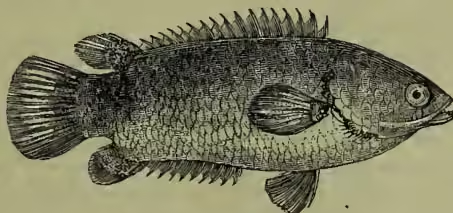
Climbing Perch (Anabas scandens), a bony fish in the Acanthopteri division, famous for its peculiar climbing habits. It is a native of rivers and ponds in most parts of the East Indies. It is about six inches long, and in general form somewhat resembles a perch. That this fish climbs trees, has been asserted by observers whose veracity and accuracy cannot easily be questioned; yet others, who have enjoyed ample opportunity of observation, express great doubt concerning this habit. According to circumstantial accounts, the fish suspends itself by its spiny gill-covers, and by fixing its anal fin in cavities of the bark, urges its way upwards by distending and contracting its body. There is no doubt that it often leaves pools when they are in danger of being dried up, and travels in search of water. Though these fish are sometimes compelled in their distress to travel by day, and have been met in the glare of noon toiling along a dusty road, their migrations are generally performed at night or in early morning, whilst the grass is still wet with dew. This restless fish is aided in its peregrinations out of water by an accessory labyrinthine respiratory cavity, in which water may be retained for a considerable time. Climbing perches are plentiful in the Ganges, and the boatmen have been known to keep them for five or six days in an earthen pot without water, using daily what they wanted, and finding them as lively as when just caught. Some related forms, such as the walking fish (Ophiocephalus), exhibit to a less marked degree the same power of living out of water. Closely related also is the Chinese Macropod, not unfrequently kept for its beauty in aquaria. Many of the genera make nests for the eggs, over which the males frequently keep guard.