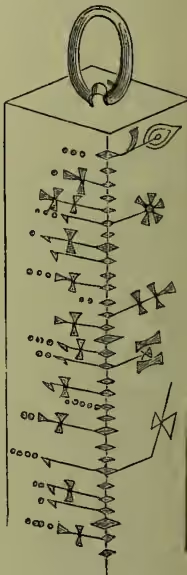
Clog Almanac, the name given in England to a primitive kind of calendar or almanac, called also a 'rim stock' and 'prime staff.' In Scandinavia it was called a 'Runic staff,' from the Runic characters used in its numerical notation. It was generally of wood (whence its name of 'clog'—i.e. log or block), of about 8 inches in length, but was sometimes of brass, of bone, or of horn. When of wood it was most commonly of box; but elm, fir, and oak were also employed. 'This almanac,' says Dr Plot, in his Natural History of Staffordshire, written in 1686, when it was still in use among the common people of that county, 'is usually a square piece of wood, containing three months on each of the four edges. The number of days in them are expressed by notches: the first day by a notch with a patulous stroke turned up from it, and every seventh by a large-sized notch. Some are perfect, containing the dominical letters as well as the prime and marks for the feasts, engraven upon them, and such are our prime staves in the Museum at Oxford: others imperfect, having only the prime and immovable feasts on them, and such are all those I met with in Staffordshire.' The marks on the left side, in the figure, indicate the golden numbers of a cycle showing the new moons throughout the year. On the right side against the 6th January is a star, the symbol of Epiphany; against the 13th St Hilary is shown by the bishop's double cross; 25th, conversion of St Paul, by an axe. The mark against the first notch (or New-year's Day) symbolises the Circumcision of our Lord. Christmas was marked by a horn, the sign of health-drinking—notans cornua exhaucricenda, as Dr Plot quotes. Examples of the clog almanac may be seen in the British Museum (one cut apparently towards the end of the 17th century); in the Ashmolean Museum and the Bodleian Library at Oxford; in St John's College, Cambridge; and in the Cheetham Library, at Manchester. It is described by the Swedish historian, Olaus Magnus, in the 16th century; and by the Danish antiquary, Olaus Wormius, in the 17th century. Some of the clog almanacs show a peculiar numerical notation. The first four digits are marked by dots; the fifth, by a sign like the Roman numeral V; the next four, by this sign and additional dots; and the tenth, by the sign +. See Chambers's Book of Days.