Clover, or TREFOIL (Trifolium), a genus of Leguminosæ, sub-order Papilionaceæ, containing a great number of species, natives chiefly of temperate climates, abounding most of all in Europe, and some of them very important in agriculture as affording pasturage and fodder for cattle. The name clover is indeed popularly extended to many plants not included in this genus, but belonging to the same natural order, and agreeing with it in having the leaves formed of three leaflets, particularly to those of them which are cultivated for the same purposes, and sometimes collectively receive from farmers the very incorrect designation of artificial grasses, in contradistinction to natural grasses—i.e. true grasses. See MEDICK and MELILOT. The true clovers (Trifolium) have herbaceous, not twining stems; roundish heads or oblong spikes of small flowers; the corolla remaining in a withered state till the ripening of the seed; the pod inclosed in the calyx; and containing one or two, rarely three or four seeds. About 20 species belong to the flora of Britain, and many are North American.—The most important of all to the farmer is the Common Red Clover (T. pratense), a native of Britain and of most parts of Europe, naturalised in America, and growing in meadows and pastures. It is a perennial, but is generally treated as if it were a biennial. This plant was formerly reputed very noisome to witches; knights and peasants wore the leaf as a potent charm against their arts. The Zigzag Clover (T. medium), also called Meadow Clover, Marlgrass, and Cow-grass, much resembles the Common Red Clover, but is easily distinguished by the stems being remarkably zigzag, and more rigid than in T. pratense; the heads of flowers are larger, more lax, more nearly globose, and of a deeper purple colour; and the leaflets have no white spot. It is a common plant in Britain and most parts of Europe, and grows sparingly in the
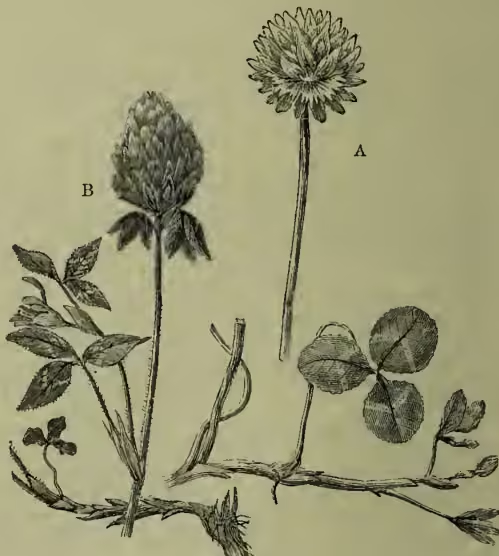
B, Red Clover (Trifolium pratense).
United States.—White or Dutch Clover (T. repens) is also a common native of Britain and of most parts of Europe, and grows everywhere in North America. When a barren heath is turned up with the spade or plough, White Clover almost always appears. This is sometimes but erroneously called the Shamrock (q.v.). The flowers of all kinds of clover are the delight of bees, but those of this species perhaps particularly so.—Alsike Clover (T. hybridum), a perennial species introduced from the south of Sweden about 1850, has proved a most valuable forage plant.—Crimson Clover, or Italian Clover (T. incarnatum), an annual, native of the south of Europe, with oblong or cylindrical spikes of rich crimson flowers, is much cultivated in France and Italy, and has of late been pretty extensively grown in some parts of England, producing a heavy crop. The Crimson Clover is also sometimes employed as a decorative annual in the flower-garden.—Moliner's Clover (T. Molineri) very much resembles Crimson Clover, but is biennial, and has pale flowers. It is cultivated in France and Switzerland.—Alexandrian Clover, or Egyptian Clover (T. Alexandrinum), an annual species, a native of Egypt, universally cultivated in its native country, where it is the principal fodder for cattle, has been tried in Britain, but the colder climate has been found to render it less luxuriant and productive. It is supposed to be one of the best kinds of clover for many of the British colonies. It has oval heads of pale-yellow or whitish flowers.—Yellow Clover, or Hop Trefoil (T. agrarium), is very common in dry gravelly soils in Britain, and in parts of the United States, but is not much esteemed. It has smaller leaves and heads of flowers than any of the cultivated species. Its flowers are yellow.—The Showy Clover (T. speciosum) is the only plant made into hay in the island of Zante, and has therefore been recommended on trial as a fodder plant in the south of England and the warmer colonies. None of the strictly native North American species have been much utilised as forage plants.
It is little more than a century and a half since clovers were introduced into field-culture in Britain. They are now universally cultivated on large farms in alternation with grain-crops. The kinds most generally sown are the Common Red, Cow-grass, Dutch White, Yellow, and Alsike. The Common Red is the finest and most valuable, but it is difficult to grow unless on naturally rich soils. Land must be thoroughly cleaned of perennial weeds before it is sown with clover, as the land cannot be subjected to cultivation while it is under this plant; clover, therefore, is always sown in the end of the rotation, or as near the fallow or turnip crop as possible. A well-manured soil greatly assists in keeping the plants from dying out in spring. Clovers, like grasses, play a most important part in restoring fertility to land which has been exhausted by grain-crops. Their leaves gather food—carbonic acid and ammonia—from the atmosphere, which they store up in their roots and stems; and these, on decomposing, afford food for cereals or other crops which are more dependent on a supply within the soil.
The caterpillars of a number of species of moth feed on the leaves of different kinds of clover; but the insects most injurious to clover crops are weevils of the genera Apion and Sitona. See CLOVER-WEEVIL, and WEEVIL.