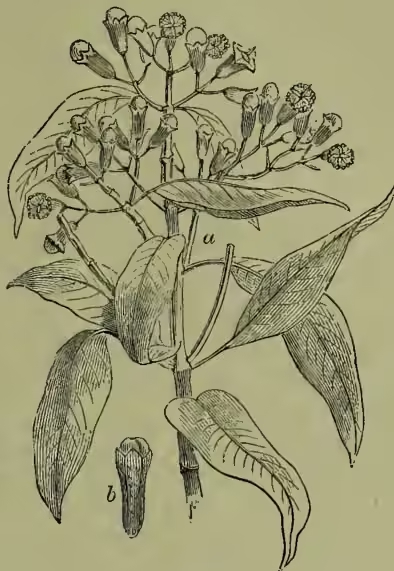
Cloves (Span. clavo, 'a nail') are the flower-buds of the Clove-tree (Caryophyllus aromaticus). The genus to which this tree belongs is of the natural order Myrtaceæ; the tree is from 15 to 40 feet high, with a beautiful pyramidal head. The leaves are large, ovate-oblong, acuminate at each end, evergreen; the flowers are small, but produced in great profusion in cymes. Leaves, flowers, and bark have an aromatic odour. The ripe fruit resembles an olive in shape, but is not quite so large; it is of a dark-red colour; it sometimes appears in commerce in a dried state, under the curious name of Mother Cloves; it has an odour and flavour similar to cloves, but much weaker; the broken fruit-stalks are sometimes also used for the same purposes as cloves; but the flower-buds themselves are the principal product of the tree. They are gathered, and are dried by exposure to the smoke of wood fires, and afterwards to the rays of the sun, or by the latter alone. When first gathered they are reddish, but become of a deep-brown colour. The unexpanded corolla forms a little round head at the end of the calyx tube, which is about half an inch long, and thus the appearance is not unlike that of a little nail, whence the name. The clove-tree is a native of the Moluccas, and the Amboyna cloves are still esteemed the best; but the tree is now cultivated in Java, Sumatra, Réunion, Mauritius, Zanzibar, Guiana, and some parts of the West Indies. The Dutch, in order to secure a monopoly and keep up the price, destroyed the trees in the other Molucca Islands in the 17th century, and confined the cultivation of them to Amboyna. In 1770 the French succeeded in introducing the plant into the Isle de Bourbon (Réunion). It is not deemed quite certain that cloves are the karyophyllon of the ancient Greeks; but before the discovery of the Spice Islands eastern merchants brought them from Arabia, Persia, and Egypt, to the harbours of the Mediterranean, from which the Venetians and Genoese diffused them over Europe.
The Wild Clove-tree of the West Indies is Myrcia acris. See MYRCIA.
The properties of cloves depend chiefly on an essential oil, Oil of Cloves, which forms one-fifth or one-sixth of their whole weight. They are used for flavouring dessert dishes and articles of confectionery, also for driving moths from clothing, furs, &c., by placing them in the boxes or drawers with the clothing. They are also reputed to possess febrifuge properties. They have a hot taste and a characteristic odour. The oil of cloves is obtained by repeatedly distilling cloves with water, when two oils pass over, one of which is lighter and the other is heavier than water. The oil has a hot acrid taste, is of a light yellow when pure, and brown red when not so carefully prepared. It has a well-known odour, and is soluble in ether, alcohol, and the fixed oils. It is useful in medicine to check nausea and griping, caused by the administration of purgatives, and has consider- able reputation as a cure for toothache. It is also employed in the scenting of soap, and by the distiller. Tincture of Cloves is obtained by treating cloves with alcohol for several days, and then straining, or by a solution of the oil of cloves in spirits of wine. It is added, in medicine, to stomachic, tonic, and purgative mixtures. Cloves are adulterated by adding to the fresh spice more or less of the buds from which the oil has been distilled, and which are thereby rendered practically worthless. The exhausted buds are made to appear fresh by rubbing them between the hands moistened with sweet oil, or otherwise varnishing them with a thin coating of oil.