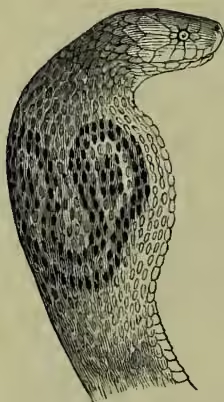
Cobra da Capello ('hooded snake'), the Portuguese name for one of the most deadly of the poisonous Indian snakes, technically known as Naja tripudians. It belongs to the sub-order of venomous Colubrine snakes (Proteroglyphia), in which the fangs borne on the upper jaw are not perforated by a complete canal, but possess simply an anterior groove down which the poison trickles. The cobra is a large snake, 5 feet or more in length; the colour varies considerably from pale yellow to dark olive; one variety has spectacle-like black markings on its neck. By the dilatation of the anterior ribs during excitement the neck can be distended so as to produce a hood-like appearance. It is by preference nocturnal, and feeds on amphibians, reptiles, birds, eggs, small mammals, &c. It does not appear to be naturally aggressive, but instinctively assumes a threatening attitude when disturbed. It then dilates its neck, hisses loudly, and prepares to strike by raising its fangs in the usual snake fashion. The habits vary greatly in different situations. It may haunt human dwellings for the sake of poultry and other food, and is said to occur 8000 feet up the Himalayas. Though essentially land animals and fond of concealing themselves among old masonry, stone heaps and the like, the cobras can swim and climb with ease. In gracefulness of movement they excel. The head and neck are often raised above the level of the rest of the body, which remains horizontal. In spite of pictures to the contrary, they can only raise the front part of the body to a very limited extent.
The bite of the cobra is as usual accompanied by the compression of one of the salivary glands modified as a poison bag. The secretion trickles down the grooves of the fangs, and entering the wound produces rapid nervous paralysis, from which recovery is, to say the least, extremely rare. Great numbers of deaths occur annually in India from cobra bites, but as the assailant often escapes, identification is frequently a matter of conjecture. No certain remedy is known, but excision, cauterising, ligaturing, doses of ammonia, drugging with rum, &c. are often resorted to. The victims are usually natives, who, going about after dark, not unfrequently trample upon the cobra and other snakes. The rattles which they use to warn off the reptiles do not appear to have much more effect than the spells to which they trust. The cobra has become the centre of numerous native superstitions, the object of animal-worship, and a favourite subject with the adroit snake-charmers.
Naja tripudians is found in India, Java, and South China; N. haje, an allied species, is common in Egypt and parts of Africa. The coral snake (Elaps), the rock-snake (Bungarus), the venomous water-snake (Hydrophis), are genera within the same sub-order.
See SNAKES, and works there quoted; also Professor G. Günther's Reptiles of British India (Ray Society, 1861), and Sir Joseph Fayrer's Thanatophidia of India (1874).