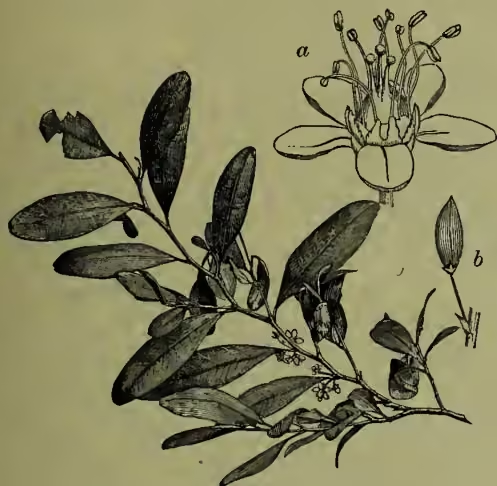
a, a flower; b, fruit.
Co'ca (Erythroxylon Coca—which has of course no connection with Cocoa or with Cocoa-nuts), a shrub of the order Erythroxylaceæ, of which the leaves furnish an important narcotic and stimulant. The shrub is 6 or 8 feet high, and somewhat resembles a blackthorn bush; the leaves are ovate-lanceolate, simple, with entire and slightly wavy margins, and strongly marked veins, of which two on each side of the midrib run parallel to the margin. It has been in use from a very remote period among the Indians of South America, and was extensively cultivated before the Spanish conquest. Many of the Indians of the Peruvian Andes are to this day excessively addicted to it, and its use is quite general among them, besides extending to men of European race. The dried leaves are chewed with a little finely powdered unslaked lime, or with the alkaline ashes of the Quinoa (q.v.), or certain other plants. An infusion is also occasionally used. An habitual coca-chewer takes a dose about four times daily. In soothing effect it recalls tobacco, but its influence is a much more remarkable one. It greatly lessens the desire for ordinary food, and at the same time permits of much more sustained exer- tion, even without sleep; it affects the nervous mechanism of respiration, so that the difficulty of breathing, so common in the ascent of long and steep slopes at high elevations, is little felt. These properties readily explain its high esteem among the Indians, to whom long and difficult journeys, heavy burdens, and constant privation have always been familiar.
COCAINE.—In Europe, little importance was attached to coca until the veteran pharmacologist Christison awakened interest by personally verifying in old age its sustaining powers. Investigations followed, and the alkaloid cocaine, upon which the active properties mainly depend, has now come into regular use as a local anaesthetic, by help of which not merely some of the operations of dentistry, but much more serious surgical operations, can be performed without chloroform. To oculists it is of special value, at once dilating the pupil and removing all sensibility. Cases of intoxication and abuse are not infrequent with the leaves, and have been already recorded in connection with the more powerful extract.