Cockroach (Blatta or Periplaneta), a large genus of insects, type of a family (Blattidæ) within the important order Orthoptera, which likewise includes locusts, grasshoppers, crickets, leaf-insects, earwigs, &c. Though often spoken of as beetles, cockroaches have in no sense direct connection with that order. Familiar enough as pests, cockroaches require no minute description. The antennæ longer than the body—i.e. over an inch, the bent down head (half-hidden by the large first thoracic plate), the long spiny legs compressed terminally, the flat broad segmented abdomen, the cigar-shaped anal appendages (which are supposed by some to represent a pair of rudimentary abdominal legs), are among the more striking external features. The two adult sexes in the common cockroach are readily distinguished, since the female has a somewhat broader abdomen, and only slight traces of wings. In the male, the anterior wings form stiff opaque wing-covers (tegmina), while the posterior pair are membranous, really wing-like, and folded longitudinally; in the female, the tegmina are very small, and the posterior wings only suggested by marks. Certain cockroaches, however, are wingless in both sexes. There are complex copulatory and egg-laying structures in the respective sexes.
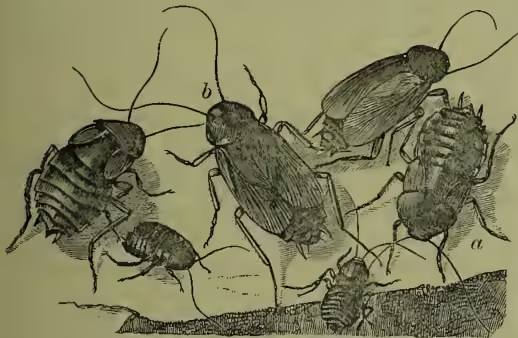
a, female; b, male.
The essential male organs atrophy in the adult males. The eggs are surrounded by a peculiar hard capsule, which the female carries about for a long time, but eventually attaches by a glutinous secretion to some suitable sheltering object. This cocoon, in the common species, usually contains sixteen eggs, one from each of the ovarian tubes. Like other true Orthoptera, the cockroaches have no marked metamorphosis in their life-history. The larvæ, when developed, appear to soften the edges of a side slit in the inclosing capsule, and emerge through this into active life. They pass through no fasting quiescent state, and when hatched, differ from the adults only in minor quantitative details. They are said to moult seven times before becoming quite adult in the fifth year of their life.
Cockroaches are voracious insects, devouring both animal and vegetable substances, which they seek out by aid of their almost certainly olfactory antennæ. Their mouth organs (three pairs of jaws) are very typical, and well adapted for biting. The juices of the mouth leave a disgusting smell on the objects over which the insects pass. They are nocturnal in habit, most abundant in warm countries, fond of sheltering in houses, and notoriously a pest to bakers and millers. To get rid of them a tame hedgehog is often employed, or they may be caught in large numbers in a slippery milk basin, baited with treacle, and led up to by a piece of wood which cannot be regained from the bottom. The commonest species in Britain (Periplaneta orientalis) is said to have been brought to Europe from Asia within the last two hundred years; P. americana has found its way hither in bales, &c. from America. The German cockroach (Blatta or Phylodromia germanica) is a troublesome, widely distributed form, which appears, however, to go to the wall before our common pest. Another form (Blatta or Ectobia lapponica) of smaller size, which occurs commonly in the woods of north and central Europe, is specially important in Lapland, where it sometimes does great injury by devouring the winter stores of salted fish. The largest form known is a native of South America and the West Indies, which measures about 3 inches in length, and makes a loud drumming noise. The cockroach is an ancient insect, having been actually found in Silurian strata. As a tolerably evolved, and yet not too highly specialised type, the cockroach forms a very convenient type for the anatomical study of insects. See Miall and Denny, The Cockroach: an Introduction to Entomology (1886).