Coffee (Turkish qahveh, from Arabic qahveh, originally meaning 'wine'). This well-known beverage is an infusion of the roasted seeds of the coffee-tree (Coffea Arabica), a native of Abyssinia, Arabia, and many parts of Africa, and naturalised in many of the tropical countries colonised by Europeans. There are some twenty species of Coffea, but few of them seem to possess valuable properties; the seeds of C. Mauritiana, prepared in the same way, are bitter and slightly emetic. The genus belongs to the natural order Cinchonaceæ. It has a tubular 4-5-cleft corolla, and a succulent fruit containing two cells lined with a cartilaginous membrane, and each containing one seed.
In a wild state, it is a slender tree of 15-25 feet high, with few branches; in cultivation, it is seldom allowed to become more than 6-10 feet high, and is made to assume a sort of pyramidal form, with horizontal branches almost from the ground. The leaves are evergreen, opposite, very shining, oblong, and leathery; the flowers are small, clustered in the axils of the leaves, and snow-white; the whole appearance of the tree is very pleasing; and the smell of the flowers is delicious. The fruit, when ripe, is of a dark-scarlet colour, and the seeds are semi-elliptic and of a horny hardness. The seeds are commonly but incorrectly termed coffee beans, or, still more incorrectly, coffee berries.
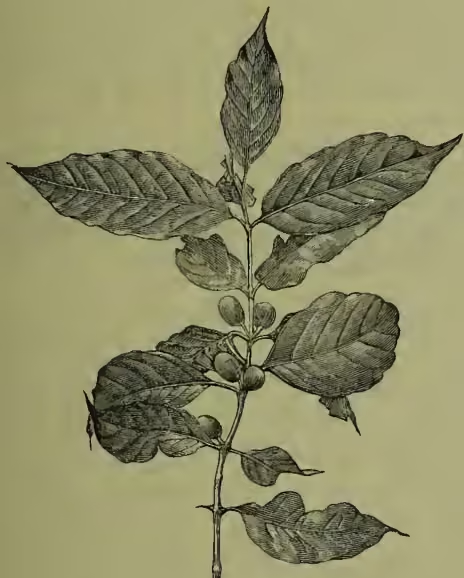
The coffee-tree succeeds only in countries where the average temperature of the year is about 64-70° F. In Pern and Quito it is acclimatised at an elevation of 6000 feet, where, however, frost never occurs; but as it delights in a moist atmosphere, it nowhere thrives better than in tropical islands. In the lothouses of Britain the coffee-tree frequently flowers and the fruit ripens. Coffee plantations are laid out pretty much in the same way everywhere. In quadrangles, bordered by fruit-trees, the coffee-trees stand in rows; they are pruned to the same height, and the ground between them is carefully kept clear of weeds. Where the climate is dry, abundant irrigation is necessary, but the supply of water is cut off as the fruit begins to ripen, in order to improve the aroma of the seeds. The tree yields its first crop in the third year; from a full-grown tree it may amount to a pound of coffee beans. As the coffee-tree continues flowering for eight months, its fruits are at any given time of very unequal ripeness; in the West Indies and Brazil, three gatherings are therefore made annually. The beans are placed on mats or large floors specially adapted for the purpose, where they are dried by the sun's rays, being meanwhile frequently turned. They are passed between rollers to remove the dried pulp of the bean, and the membrane which incloses the seeds themselves. The coffee is afterwards freed from impurities by winnowing, and conveyed in bags to the seaports. As equal care is not, however, bestowed upon the preparation of it in all places where it is cultivated, there are great differences in quality and price.
The earlier history of the coffee-tree is not very clear. Coffee was not known to the Greeks or Romans; but in Abyssinia and Ethiopia it has been used from time immemorial. In Arabia it was certainly in use in the 15th century, and over the rest of the East in the 16th century. Towards the end of the 17th century, the coffee-tree was carried from Mocha to Batavia by Wieser, a burgomaster of Amsterdam, where it was soon extensively planted, and at last young plants were sent to the botanical garden at Amsterdam, from which the Paris garden obtained a tree. A layer of this was carried out to Martinique in 1720, where it succeeded so well, that in a few years all the West Indies could be supplied with young trees.
The following sorts are particularly distinguished from each other in commerce. Mocha Coffee, which comes from Arabia, and is known by its small gray beans inclining to greenish; Java or East Indian Coffee, which has large yellow beans; Jamaica Coffee, with beans somewhat smaller and greenish; Surinam Coffee, which has the largest beans; Bourbon Coffee, with beans pale yellow and almost whitish. The devastation of the Ceylon plantations by the leaf disease (see CEYLON) has led to the introduction of a hitherto neglected variety, the Coffea Liberica, or Liberian Coffee, a native of the west coast of Africa. It appears to resist the ravages of the disease which has been so fatal to the Arabian variety in Ceylon; but being of coarser character, it is grown only to a very small extent.
The great demand for coffee has led to the employment of a number of cheaper substitutes, of which Chicory (q.v.) root is the best known. Of others, dandelion root, carrot, and the seeds of the common yellow iris may be mentioned. They are prepared by roasting like coffee. The seeds of Astragalus Beticus, are known on the continent of Europe as Swedish Coffee, and are said to be the best substitute for coffee yet discovered. But all these substitutes want the most important constituent of true coffee, caffeine; and are therefore very different from it in their qualities. Ground coffee is subject to great adulteration, as will be seen from the article ADULTERATION.
In France and other continental countries, ground coffee is largely mixed with caramel or burnt sugar. This is for the most part prepared by skilfully roasting the 'feet' or dregs obtained in the refining of sugar. In moderate quantities it imparts a flavour considered by many to improve the infusion. The so-called 'French coffee' now so largely sold in England contains more or less of caramel—commonly much more than is desirable, its commercial value being very small. A rough test or indication of this is easily obtainable by dipping a bright silver or plated spoon into the infusion. The caramel infusion adheres to the spoon much more decidedly than the pure coffee infusion, and leaves a darker stain. Infusion of chicory behaves similarly to that of caramel.
The leaves of the coffee-tree are used in the western part of Sumatra instead of the seeds. They are prepared by quick drying in a manner similar to that in which tea-leaves are prepared; and in this state contain even a larger proportion of caffeine than the coffee beans of our shops.
Coffee owes its exhilarating and refreshing properties to the presence of three substances: (1) Caffeine (q.v.), which occurs in the roasted bean to the extent of to 1 per cent.; (2) a volatile oil, which is not present in the raw bean, but is developed during the process of roasting to the extent of only one part in about 50,000 of the roasted coffee; and (3) astringent acids, resembling tannic acid, but called caffec tannic and caffic acids. The average composition of unroasted coffee is as follows:
| Caffeine ..... | 0.8 |
| Legumin (vegetable Caseine) (q.v.)..... | 13.0 |
| Gum and sugar ..... | 15.5 |
| Caffec-tannic and Caffic acids..... | 5.0 |
| Fat and volatile oil..... | 13.0 |
| Woody fibre ..... | 34.0 |
| Ash..... | 6.7 |
| Water..... | 12.0 |
| 100.0 |
When the beans are roasted till they assume a reddish-brown colour, they lose 15 per cent. by weight, and gain 30 per cent. in bulk; when further roasted till they become chestnut brown, they have lost 20 per cent. by weight, and increased 50 per cent. in bulk; whilst if the roasting is continued till the beans become dark brown, they lose 25 per cent. in weight, and acquire 50 per cent. in bulk. When the roasting is carried too far, more or less charring is the result, and a disagreeable burnt smell is produced, which tends to overcome the natural pleasant aroma.
In Britain coffee is usually under-roasted, probably in order to escape the loss of weight, as the roaster is also the retailer. But in France, in Norway, in Germany, and other countries where it is roasted at home by the consumer, the roasting is carried to the dark-brown stage. The writer, who has watched the domestic roasting of coffee in many countries, attributes the superiority of the pure infusion made in these countries mainly to this and the use of the freshly roasted and ground coffee. The Norwegian peasant usually adds a very small quantity of butter to the beans while roasting in the simple apparatus, like a covered shovel or frying-pan, she uses; always shaking it while over the fire. Every tourist praises the result.
The important offices which coffee fulfils are, to allay the sensation of hunger; to produce an exhilarating and refreshing effect; and, according to some authorities, to diminish the amount of wear and tear, or waste of the animal frame, which proceeds more or less at every moment. See DIET, DIGESTION, FOOD.
An endless variety of apparatus have been contrived—some of them of great complexity—for preparing coffee for the table. The chief object aimed at is to obtain the liquor free from all sediment. The simplest and cheapest device is that of placing a bag or metal strainer—by means of a suitable rim—in the upper part of the coffee-pot, placing the ground coffee in this, and pouring boiling water through it. Or the ground coffee may be simply placed in a saucepan or coffee-pot, hot water poured upon it, and boiled for a few minutes. After this the grounds will settle down, and the coffee may be poured off fairly clear.
Many forms of coffee-pot have been devised in which atmospheric pressure is applied for forcing the hot water through the ground coffee resting upon a metal strainer, doing this in such a manner that the water shall all pass through while just at the boiling heat, and then shall leave it.
The question whether coffee should be boiled at all, or simply infused like tea by pouring boiling water on it, has been much discussed. The writer has observed that in countries where pure coffee is used, boiling is practically in favour. This suggested some experiments which have shown that pure coffee is improved by two or three minutes' boiling, while chicory is rendered bitter and unpalatable by such treatment. We therefore recommend that where a sufficient quantity of mixed coffee is prepared to render it worth while to take the trouble, the chicory should be separately infused like tea, the coffee boiled, and the two then mixed. Soyer recommends that, before the boiling water is poured in, the saucepan should be set dry on the fire, and the powder stirred till it is quite hot, but not in the least burned. In France, an equal measure of boiling milk is added to a very strong infusion in making café au lait. The chief effect of adding chicory to coffee is to deepen the colour. When milk is added to coffee it should be boiled; cream may be used without boiling. The Turks drink it thick with sediment; some Arabs make a tea-like beverage from the dried pulp; the Somali boil the berries in oil, and soak maize in the mixture. Raw coffee beans are improved by age. Essence of coffee is a highly concentrated infusion, mixed to the consistence of treacle with extract of chicory and burnt sugar, which must be kept in well-corked bottles; mixed with boiling water, it makes a tolerable beverage. Of a total world's production of 12,000,000 bags in 1894-95 (each of 132 lb.), Brazil produced 7,500,000 bags, Java and the Dutch Indies 1,000,000. The destructive coffee-bug is a Coccus (q.v.), specifically Coccus or Lecanium adonidum.
See Lester Arnold, Coffee: its Cultivation and Profit (1886); Lock, Coffee: its Culture and Commerce in all Countries (1888); works by Hull (1877), Nietner (1880), Thurber (1881), and A. Brown (1884). Also E. F. Robinson's Early History of Coffee-houses (1893).