Coffin (Lat. cophinus, Gr. kophinos, in both languages signifying a basket, coffer, or chest, but never a coffin). Coffins for the bodies of the dead constructed of wood are known to have been used in prehistoric times in Europe. The earliest form of the wooden coffin is simply a suitable length of an oak-tree trunk split, and hollowed out for the reception of the body. Two such coffins containing the skeletons of a man and a woman of the bronze age, with their clothing undecayed, and their weapons, are preserved in the museum at Copenhagen. The wooden coffins of the iron age were sometimes of tree trunks, and at other times of hewn planks fastened with clinker nails. From Bede we learn that the Saxons occasionally employed wood; but the common people, both then and in the subsequent Norman and English eras, were simply wrapped in cloth, and so put into the ground. The same custom seems to have been followed with monks down to a comparatively recent period, and is still in use among the poorer classes in the East. See EMBALMING.
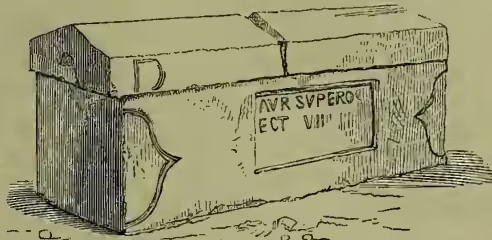
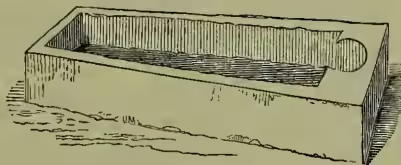
It has been keenly disputed amongst scholars, whether it was more usual with the Greeks to bury their dead or to burn them (see BURIAL); but both customs unquestionably prevailed. Greek coffins were called by various names (soroi, pucloi, &c.), and composed of various materials, the most common being baked clay, or earthenware. Their forms also varied. In Rome the ancient practice was to bury the dead, not to burn them; though under the Empire, and previous to the recognition of Christianity, the latter custom became almost universal. The coffin in Rome was called arca or loculus, and was frequently made of stone, sometimes of a peculiar kind of stone brought from Assos, in Troas, which was said to consume all the body except the teeth in forty days, and which, from this circumstance, was called sarcophagus—an eater of flesh (see SARCOPHAGUS). Roman stone coffins, both of the heathen and early Christian time, have been found in Britain. Cremation was repugnant to the feelings of the primitive Christians, who buried their dead in receptacles of stone. These were either hewn out of the rock as in the catacombs, or were sarcophagi elaborately sculptured with scenes from Scripture history and emblems of the faith. The simplest form of stone coffin was that used in prehistoric times throughout Europe, consisting of unhewn stones set on their edges, so as to cover the sides and ends of the grave, one or more flat stones being then laid over the body to form a lid. This form of rude stone cist or coffin was continued long after the introduction of Christianity in most European countries, and many ancient cemeteries, formerly regarded as pagan and prehistoric, are now recognised as Christian by the orientation of their stone-lined graves. To these succeeded stone coffins, which were commonly used for persons of the higher classes throughout the middle ages; and so late as 1686 the antiquary Dugdale was buried in a stone coffin. These stone coffins were generally of a single block, commonly tapering from the upper end. In the hollow for the reception of the body, there was from the 12th century a part peculiarly fitted for the head, and a hole in the bottom to allow of the escape of moisture. Such coffins, for the most part, were not buried deeply in the earth, and were frequently placed so near the surface that the lids were visible, which, within a church, often formed part of the pavement, and were covered with elaborate sculpture representing crosses and other ornaments. Sometimes they were even above the ground altogether, and thus became the originals of the table-tombs and altar-tombs of the middle ages. Leaden coffins were also occasionally used in the middle ages, as those in the Temple Church in London testify, but the slight wooden cases now in common use appear to be of comparatively recent origin. The practice of surrounding the wooden shell with a coffin of lead, and inclosing both in an oak casket, is, for sanitary reasons, to be discouraged. Even a wooden coffin, if well made, greatly retards decomposition, and keeps the process long incomplete; and to remedy this the use of wicker coffins, of white or stained osiers, has been suggested. In America, however, zinc or copper lining and lids of heavy French glass are employed by undertakers to render their work as far as may be airtight and indestructible; and of late years caskets of zinc or copper, and even of iron or rolled steel, have come into use. The modern hexagonal form of coffin is peculiar to Great Britain. The sides of the American casket are parallel, the ends either rounded or broken into three panels; the exterior is sometimes ornamented with carved work, but is more commonly covered and draped with broadcloth, velvet, or satin, fringed and tasseled. Expensive woods and silvered handles and nails are frequently employed; and the lid may have a removable face glass. French and German coffins are of a similar shape, but plainer. The colour in Germany is usually brown. At Leipzig formerly coffins were always painted green, as a symbol of hope.