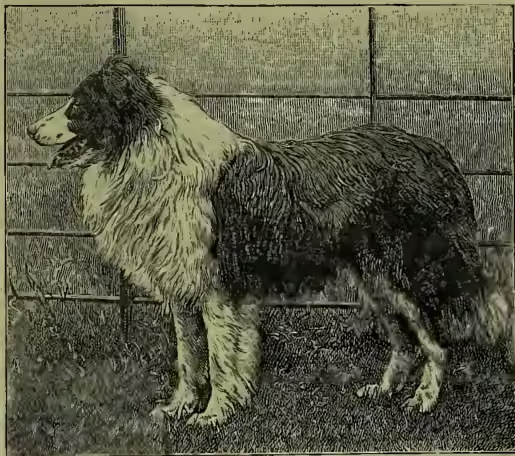
Collie. The origin of the collie is somewhat obscure, but great antiquity is claimed for it. Buffon has gone so far as to call it the oldest known breed of dogs, an opinion not now generally entertained; though it is only reasonable to suppose that the ancients, after providing a dog for the chase, next turned their attention to obtaining a guardian for their flocks. For many years collies were confined to Scotland and the northern counties of England, until their good points as a graceful and intelligent companion attracting more attention, they were taken south in large numbers, and became the most popular breed of the day. Thanks to judicious breeding and a large expenditure of money, the best show collies are now all found in England. Tempted by the demand for black-and-tan dogs, a cross with the Gordon setter was resorted to, producing many collies with the flat ears and open coat of the setter, a cross to be avoided at all costs. In judging the collie the fact should never be forgotten that it is meant to do work in all weather, requiring the best of legs and feet, a close coat, and a strong active body capable of great speed; and that a long and beautiful coat, if unaccompanied by a thick under-coat, is a hindrance, not a protection. The chief points of the collie are—head long and sharp, with bright, keen eyes, set rather close together, and a small ear drooping slightly at the tips; back strong and muscular; legs with plenty of bone and not too much feather, bare below the hocks; feet round and cat-like. The collie should have a short dense under-coat fitted to withstand the severest wet or cold, with a long and beautiful outer-coat springing from it; round the neck this coat develops into a 'ruff' or 'frill' which sticks out in front and on each side to a great length, adding largely to the dog's beauty. Many anecdotes are told of the collie, who from his intimate association with man has acquired almost human intelligence, a good dog being able to separate the sheep under his care from those of other flocks. The collie often deteriorates in intelligence when kept merely as a companion; he is apt to get cross-tempered, a fact which the shepherd does not consider a fault, as it prevents strangers interfering with the sheep. But when not spoilt no dog makes such an agreeable companion as the collie, as his instinct is to attach himself to one person to whom he becomes devoted.