Cologne (Ger. Köln), a city and free port on the left bank of the Rhine, 362 miles by rail WSW. of Berlin, 175 SE. of Rotterdam, 149 E. of Brussels, and 302 NE. of Paris. Formerly an independent city of the German empire, it is now the capital of Rhenish Prussia. Cologne is a fortress of the first rank, forming a semi-circle, with the Rhine as its chord, and the town of Deutz on the opposite bank as a tête-du-pont. It is connected with this suburb by a bridge of boats, and an iron bridge 1362 feet in length, for railway and carriage traffic. Pop. (1871) 129,233; (1891) 282,537; (1895) 321,964—one-sixth being Protestants. The old streets are narrow and crooked; but the area freed by the removal of the ancient fortifications, which dated originally from the 13th century, is laid out on a more spacious plan. This area, which doubles that occupied by the old town, was purchased in 1882 by the corporation for about £600,000; its most prominent feature is the handsome 'Ringstrasse' or boulevard, nowhere less than 60 feet wide, which encircles the entire old town. The new fortifications include a number of detached forts, planted round Cologne and Deutz, within a radius of about 4 miles from the cathedral. The ancient buildings in Cologne, both secular and ecclesiastical, are of great architectural interest; the Romanesque and Transition styles are specially well represented in the numerous churches of the 11th, 12th, and 13th centuries. The church of St Maria im Capitol, consecrated in 1049, is the earliest example in Cologne of a church with a trefoil-shaped ground-plan for transepts and choir. In the church of St Ursula are preserved the bones of the 11,000 virgins, companions of St Ursula (q.v.). The church of St Gereon boasts of the possession of the bones of St Gereon, and of the 308 martyrs of the Theban legion, slain during Diocletian's persecution. The church of St Peter contains the altar-piece of the crucifixion of St Peter by Rubens, and that of the Minorites the tomb of the famous scholastic, Dnn Scotus.
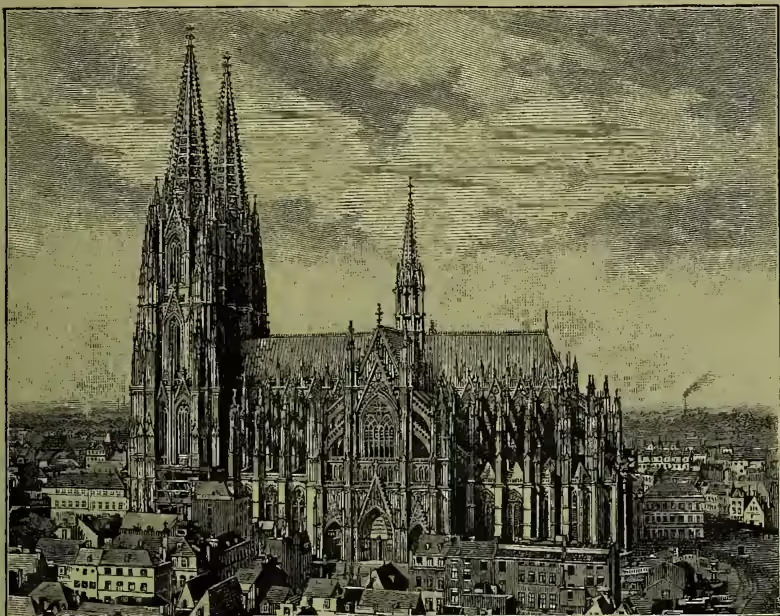
The chief object of interest in the city, however, as well as its greatest ornament, is the cathedral, one of the noblest specimens of Gothic architecture in Europe. This cathedral is said to have had its origin in an erection by Archbishop Hildebold, during the reign of Charlemagne in 814. Frederic Barbarossa bestowed upon it, in 1162, the bones of the three Magi (q.v.), which he took from Milan, and this gift greatly increased its importance. The bones are retained as precious relics to this day; but the old structure was burned in 1248. According to some accounts, the present cathedral was begun in the same year, but others fix the date of its commencement in 1270-75. To whom the design of this noble building is to be ascribed is uncertain. The choir, the first part completed, was consecrated in 1322. The work was carried on, sometimes more actively, sometimes more slowly, till 1509, when it was suspended; and during the subsequent centuries what had been already executed was not properly kept in repair. Since the beginning of the 19th century, however, the necessary funds to repair and complete it according to the original design, have been supplied by subscriptions from all parts of Germany. The work of renovation began in 1823, and in 1842 the foundation-stone of the new part was laid. The naves, aisles, and transepts were opened in 1848; the magnificent south portal was completed in 1859; in 1860 the iron central fleche was added; and with the exception of the western spires, the church was completed in 1863. The spires, the crown of the edifice, were finished in 1880, and on October 15 the completion of the work was celebrated before the Emperor William I. The body of the church measures 440 feet in length, and 240 feet in breadth; the spires rise 515 feet above the pavement of the nave. Since 1823, upwards of £1,000,000 has been expended on the building; the total cost of the whole is estimated at £2,000,000. For the 'Kaiserglocke,' see BELL. Among the chief secular buildings of Cologne are the town-house, begun in the 14th century upon Roman foundations; the Gürzenich (1441-52), the finest secular Gothic erection in Cologne, a public banqueting-hall, now containing the exchange; the modern law-courts; and the Wallraf-Richartz Museum, containing a good collection of paintings.
The educational and benevolent institutions of Cologne are numerous and well equipped. The town has recently acquired a high reputation for music. The situation of Cologne is extremely favourable for commerce. Various branches of manufacture are carried on, of which the chief are the making of beet-sugar, tobacco, glue, carpets, soap, leather, furniture, pianos, chemicals, and spirits of wine, besides the characteristic manufacture of Eau-de-Cologne (q.v.). Annually 5500 craft enter and 4500 clear the port of Cologne. Cologne has extensive and important railway connections.—The city was founded by the Ubii, about 37 B.C., and was at first called Ubiorum oppidum; but a colony being planted here in 50 A.D. by Agrippina, the wife of the Emperor Claudius, it received the name of Colonia Agrippina. At the partition of the Frank monarchy in 511, it was included in Austria; and by a treaty in 870, it was united to the German empire. It entered the league of the Hanse towns in 1201, and contended with Lübeck for the first rank. The merchants of Cologne carried on commerce far and wide, and had warehouses in London, near the Guildhall. Cologne was at a very early period the seat of a bishopric, which was elevated, at the end of the 8th century, into an archbishopric.—The archbishops acquired considerable territories, some of them distinguishing themselves as politicians and warriors. They took their place amongst the princes and electors of the empire, but were involved in a protracted contest with the citizens of Cologne, who asserted against them the independence of the city; and the archiepiscopal resi- dence was therefore removed to Bonn. The archbishopric was secularised in 1801, when the city also lost its independence, and the congress of Vienna did not attempt to restore to it its former character, but assigned the whole territories to Prussia. The archbishop, therefore, has not now the political rights and power that belonged to his predecessors.