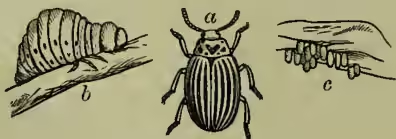
Colorado Beetle (Chrysomela or Doryphora decemlineata), a North American beetle which commits fearful ravages among potatoes. First discovered near the upper Missouri in 1824 by Thomas Say, it belongs to the sub-order of Coleoptera known as Tetramera or Cryptopentamera, and is a good type of the family Chrysomelidae. It is an oval insect, from 9 to 11 millimetres in length, of an orange colour, with black spots and lines as seen in the figure. The antennæ are club-shaped. The larvæ and adults live on the potato-plant, and have sometimes (as in 1859) quite destroyed the crop in certain parts of America. They pass the winter underground, and emerge from their hiding-places in the beginning of May. The female lays many hundreds of eggs in groups of twelve to twenty on the under side of potato leaves. The larvæ, which emerge in about a week, are reddish and afterwards orange. They grow up quickly and produce a second generation, which may again produce a third in the same summer. Their rate of multiplication is therefore very rapid.
The home of the Colorado beetle is in the western states; 'from Nebraska and Iowa it travelled eastward, until, in 1873-76, it reached the eastern shores of America. In 1877 it was found at Liverpool in a cattle-boat from Texas.' Owing in great measure to the stringent regulations of an order in council, which provides that 'it shall not be lawful for any person to sell, keep, or distribute living specimens of the Colorado beetle in any stage,' this pest has fortunately not succeeded in establishing itself in Britain. The surest remedy in case of attack is said to be a preparation of arsenic known as 'Paris Green' or 'Scheele's Green.'
The genus Chrysomela ('golden beetle') to which the Colorado beetle belongs, is represented by many hundred often beautifully metallic species in temperate and tropical countries. C. cerealis, sometimes injurious to grasses and cereals, C. staphylea, C. or Lina populi, found on poplars, are common species.