Colorado (Span. for 'red' or 'reddish'), a remarkable river of North America, formed in 39° 17' N. lat., 109° 50' W. long., by the union of the Grand and Green rivers. The Green River rises in Wyoming, U.S., and drains the south-west portion of that territory; it also receives affluents from Utah and the north-west angle of the state of Colorado. The Grand River rises in Colorado, where its more common name is the Gunnison. Its main tributaries in that state are the Bunkara, or Blue, and the Dolores. Below the junction of the
Green and Grand rivers the main affluent in Utah is the San Juan, which drains an interesting region in the south-west of Colorado and the north-west of New Mexico. In Arizona the main affluents are the Colorado Chiquito or Flax River, the Bill Williams, and the Rio Gila, all from the left. The only important affluent the Colorado receives from the right is the Rio Virgen. From the junction of the Grand and Green, the general course of the stream is to the south-west, through the southern part of Utah and the north-west of Arizona; and it afterwards separates Arizona from Nevada and California. The lower part of its course is in Mexican territory, where it flows into the north extremity of the Gulf of California. The most striking features of the Colorado basin are its dryness, and the deeply channelled surface of the greater part of the country. Almost every stream and water-course, and most of all the Colorado itself, has cut its way through stratum after stratum of rock, until now it flows, in a great part of its course, at the bottom of a deep trench or cañon.
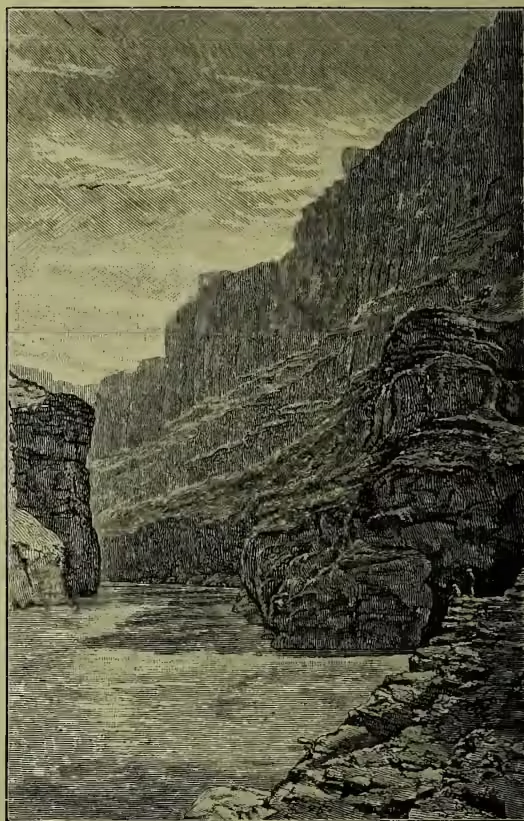
(From a Photograph by E. Baer, of Prescott, Arizona.)
The main stream for nearly 400 miles below the mouth of the Colorado Chiquito, thus makes its way through a great plateau, forming what is called the Grand Cañon of the Colorado, the most extensive and marvellous example of the kind anywhere known. The cañon-walls throughout the upper part of the great cañon are from 4000 to 7000 feet in height, and are often nearly perpendicular. At some points the walls on either side rise sheer from the water; at others there is a talus of fallen rock, or occasionally a strip of fertile soil, on one or both banks. This over-drained river basin has an area of 240,000 sq. m. Its former adaptedness to the support of human life on a considerably greater scale than at present, seems to be evidenced by the presence of great numbers of abandoned and prehistoric dwellings, sometimes perched upon cliffs within some cañon, or on a high ridge or mesa, as if for protection from hostile attack. The Moqui towns in Arizona are still inhabited by interesting tribes of semi-civilised aborigines, no doubt relics of a race once very much more widely spread. The whole course of the river below the junction is about 900 miles; to its remotest sources it is 2000 miles. Navigation is possible for light-draught steamers for over 600 miles. At extreme high water, steamboats sometimes go up to the mouth of the Rio Virgen to load rock-salt. The lower portion of the river is visited at certain seasons by bores, or high tidal waves, a phenomenon to be seen in only a very few North American rivers. The non-tidal portion of the river is subject to vast and frequent changes of volume, and except where confined by cañon-walls, the river channel shifts to and fro in its sandy alluvial bed to a very remarkable degree. Navigation is much impeded by rocks and sand-bars.
COLORADO RIVER OF TEXAS rises by many head-streams in the south part of the Llaño Estacado, of North-west Texas. Its two main head-streams are the Concho or Salt Fork, and the Red or North Fork. The river takes a devious south-eastward course of 900 miles, and discharges its waters by two main outlets into Matagorda Bay. It is about 900 miles long, and its drainage area is put at 24,700 sq. m. Sand-bars at its mouth impede navigation. Steamboats have ascended the river as far as Austin, the capital of the state; but the stream is not much navigated. The basin of the river is in part very level, but in some parts of the course the banks are bold and bluffy. The valley of the Colorado is fairly supplied with timber, and the soil is generally fertile; but the rains are much less abundant than in the river basins lying farther to the eastward. It is stated that this river was named Brazos by the Spanish colonists, and that the Colorado of the same settlers was what is now called the Brazos; the names having been misapplied or transposed in later times by mistake. The Colorado is the largest river wholly within the state of Texas, except only the Brazos.