Comb (Saxon camb). This well-known toothed implement has been used in every age and by all peoples for dressing and keeping clean the hair. Combs are also used for fastening the hair when dressed, and as head ornaments. In early times the bodkin (acus), equivalent to the modern hair-pin, was employed for the latter purpose, but in medieval times elaborately ornamented combs, sometimes of precious metal, were used for ornamental hair fastening. An allusion to this practice we have in the ancient Scottish ballad of Sir Patrick Spens:
O lang, lang may their ladyes sit,
Wi' their gowd kames in their hair.
Fig. 1 represents an ancient Irish long rack comb in the museum of the Royal Irish Academy.

Fig. 2 is an example of an ancient Scottish double-edged comb of bone from the Broch of
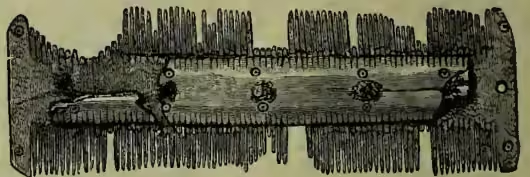
Burrian, Orkney, drawn to half the size of the original.
Combs of ivory or of boxwood have been frequently found in early Christian tombs, it being a common practice of antiquity to inclose in the sepulchre objects, especially those of the toilet, that had been used by the deceased. For a late instance, see the article on ST CUTHBERT. Combs also figure commonly in inventories of articles belonging to the medieval churches, and, being made use of by the priests prior to service, that they might approach the altar with the more decency, these instruments became in some sort sanctified by their employment.
Combs are made of horn, tortoiseshell, ivory, wood, bone, metal, india-rubber, and of a com- position called xylonite (see CELLULOID). In dealing with horn, which is the principal comb-making material, the horns are cut into rectangular pieces in a manner which involves the least possible loss. These segments are damped and heated till they become soft, when they are opened out and pressed quite flat. The plates are next squared, smoothed, and trimmed preparatory to the tooth-cutting, which formerly was done with a stadda, or double saw, having two blades of steel set parallel to each other, with a space between them equal to the thickness of the intended tooth. Tooth-cutting is now done by small circular saws to which the plates are automatically applied, the horn moving the space of a tooth after each cut. In this way 70 or 80 teeth may be cut in an inch of ivory for fine-toothed combs. The teeth are then thinned, smoothed, and finished by means of thin wedge-shaped files. Saw-cutting is the only process available for bone, ivory, and wooden combs, and it is used for the finer kinds of horn combs also.
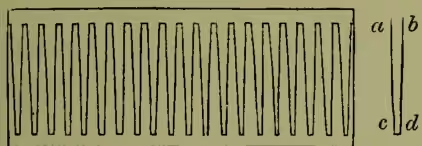
A great economy of material and time, however, is effected by making horn and tortoiseshell combs by the method of 'twinning' or parting. By saw-cutting, the material corresponding to the spaces between the teeth is of course wasted; by the process of parting, this is made available to form the teeth of a second comb. The annexed figure will show how this may be effected. The prepared horny plate is cut through by means of a stamping-cutter, consisting of two thin chisels inclined to each other, as ac and bd, which represent their edges; between these, and connecting the ends, c, d, is a small cross-chisel. When this compound cutter descends with sufficient force upon the plate, it will cut one of the teeth shown in the figure. By simple machinery, the table carrying the plate is made to advance a distance equal to the thickness of one tooth while the cutter is rising, and thus the successive cuts are made as represented. A slight pull is now sufficient to part the plate into two combs, the teeth of which only require filing and finishing.
India-rubber combs, now so extensively used, are manufactured by pressing the caoutchouc to the required form in moulds, and 'vulcanising' or combining it with sulphur afterwards. Xylonite combs are similarly made by moulding; but comb teeth of these materials are not so strong and elastic as those of horn and ivory.